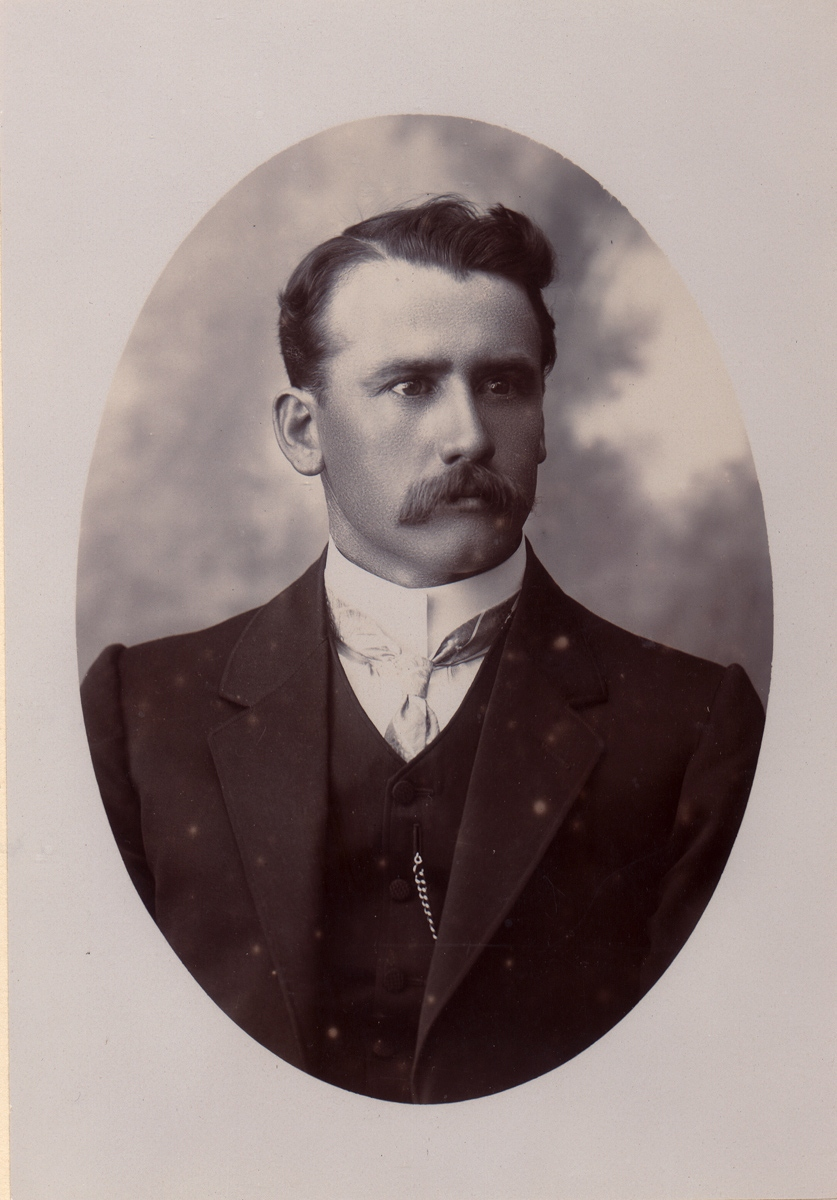
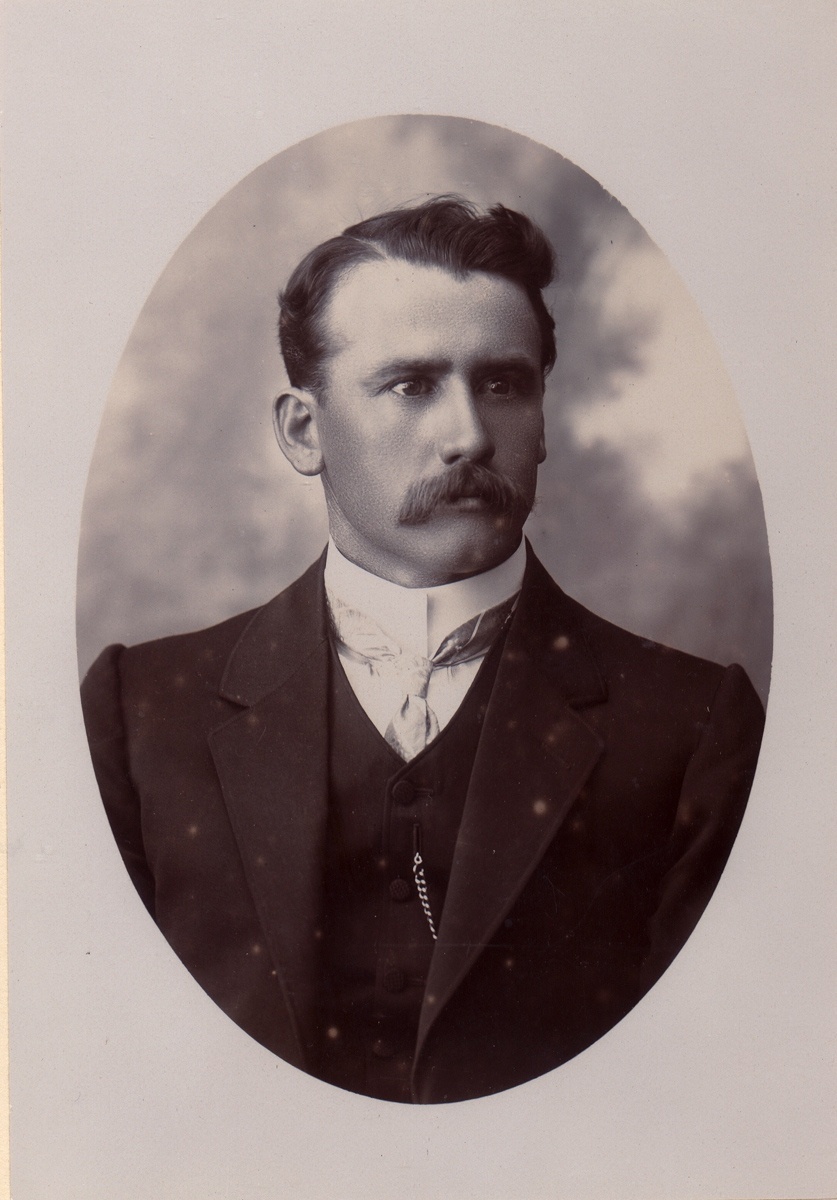
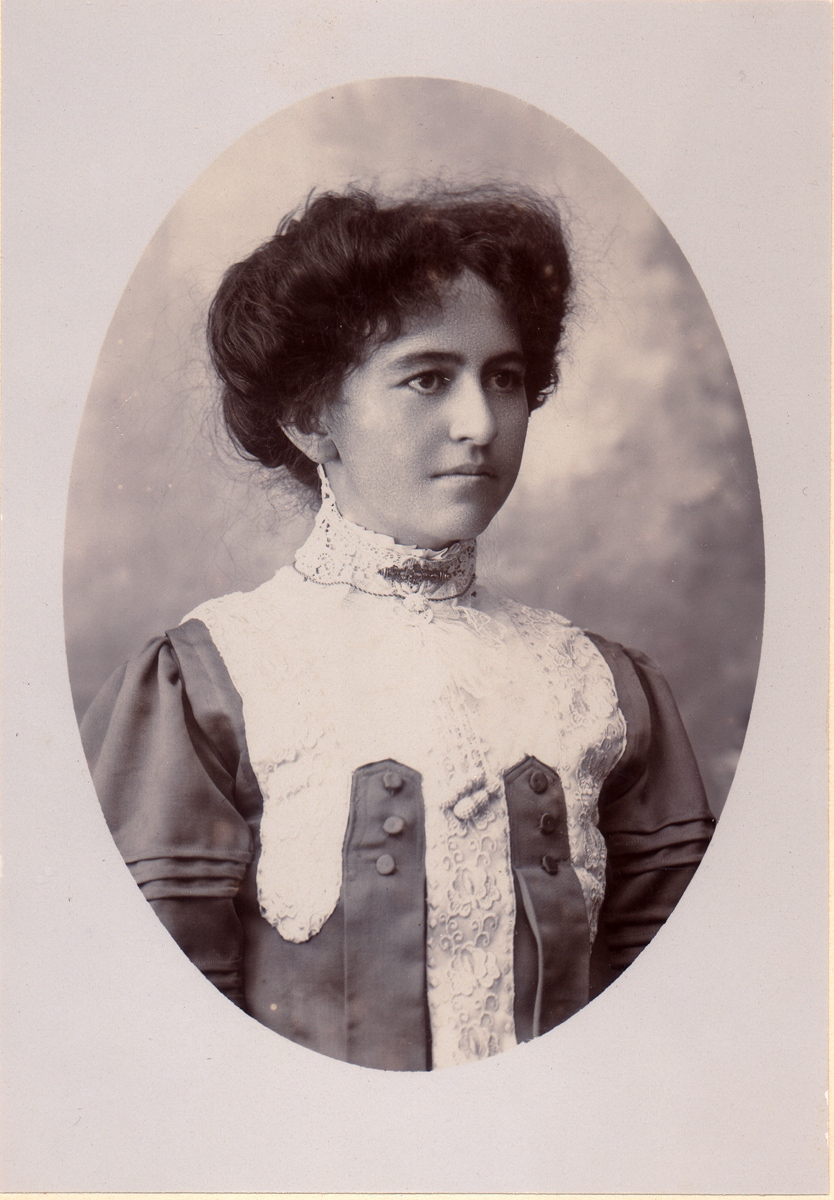
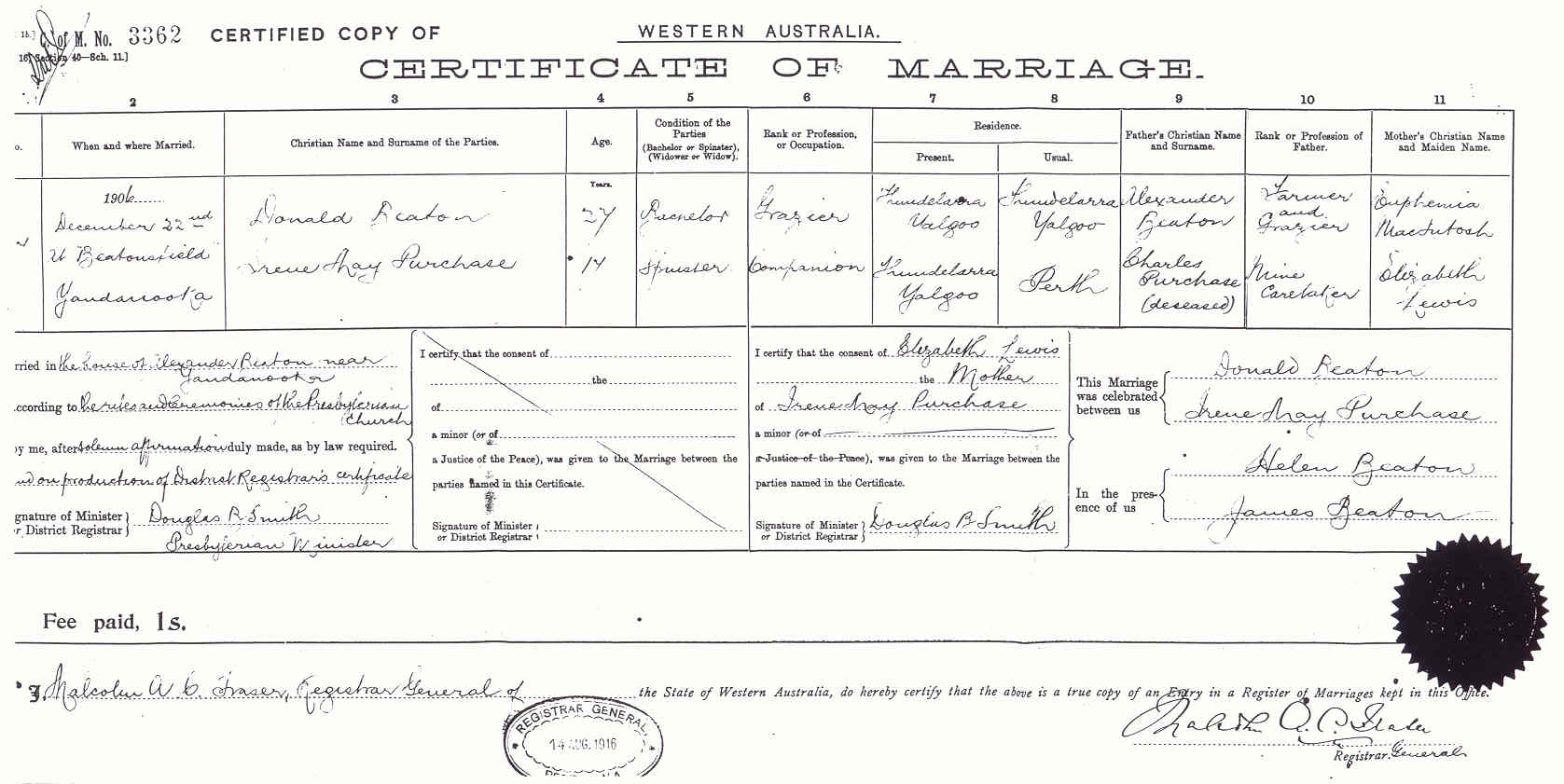
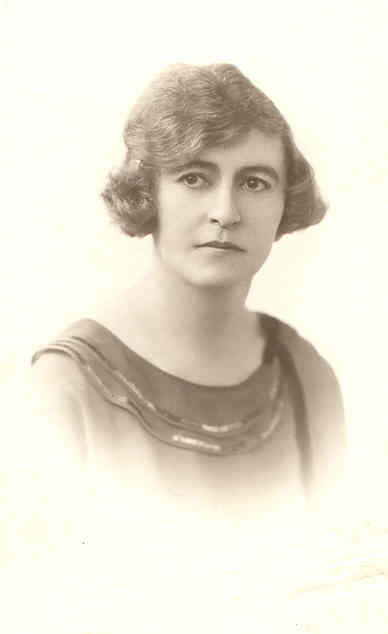
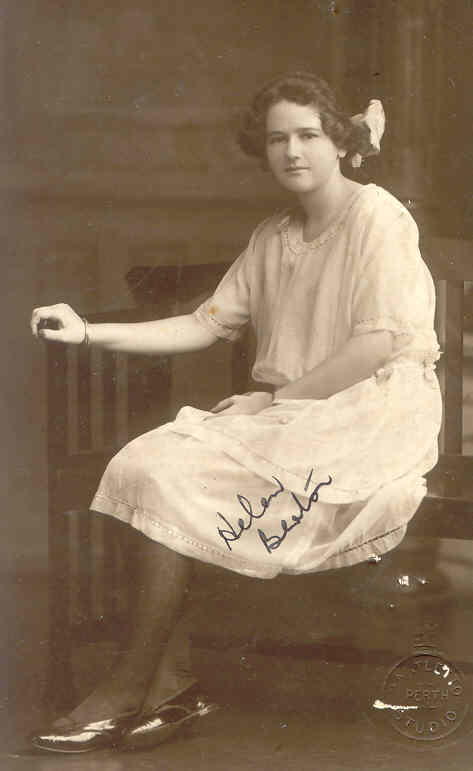
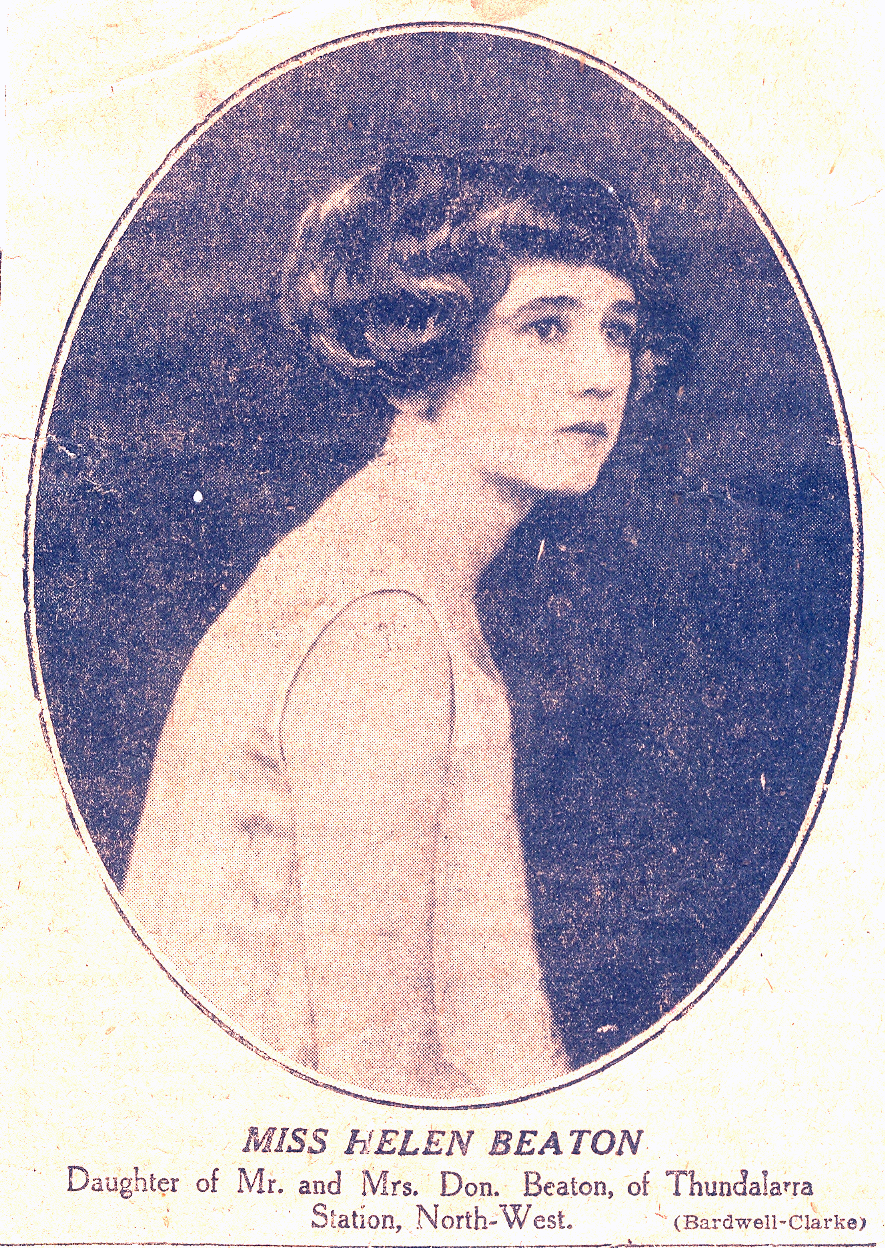
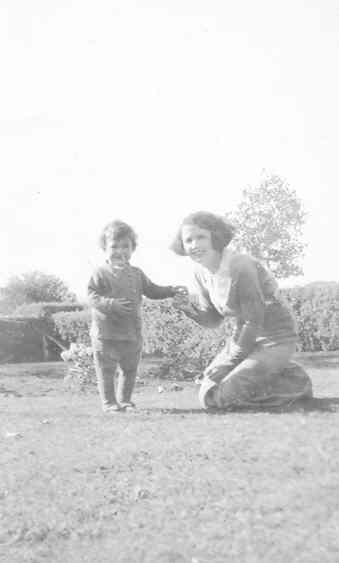
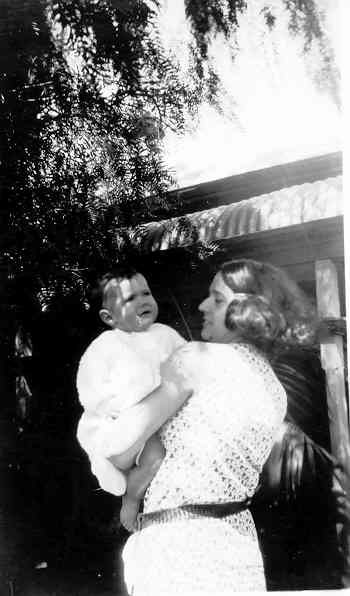
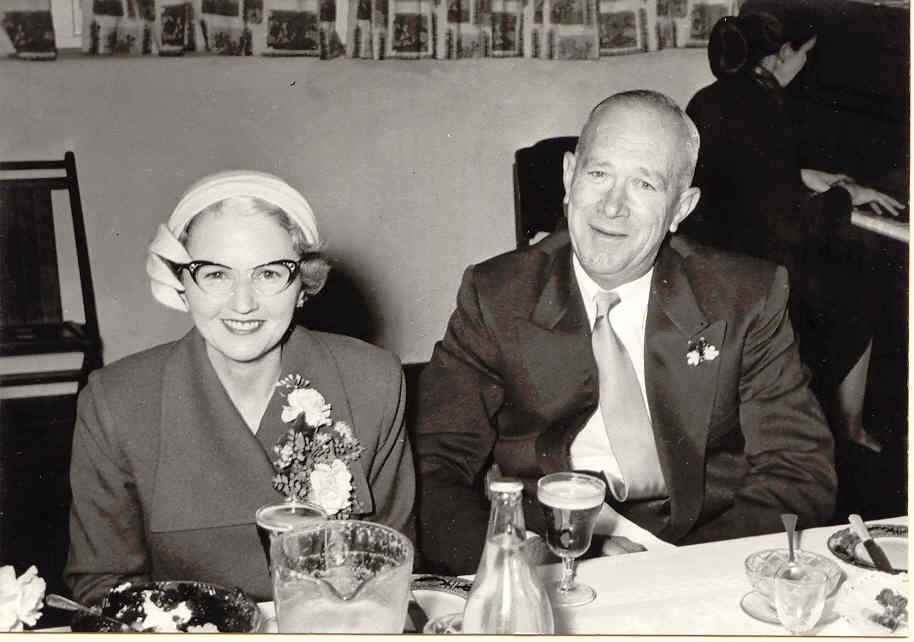
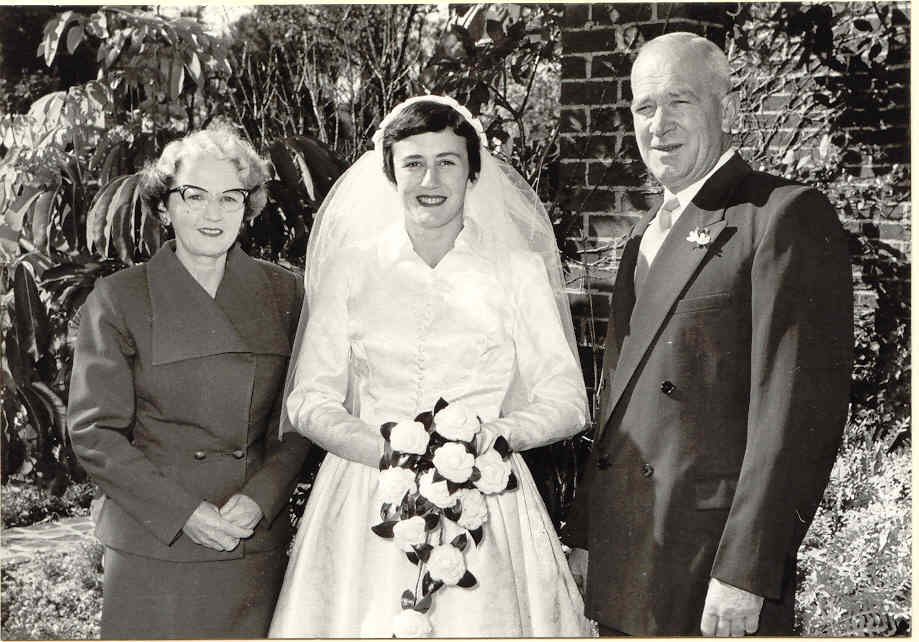
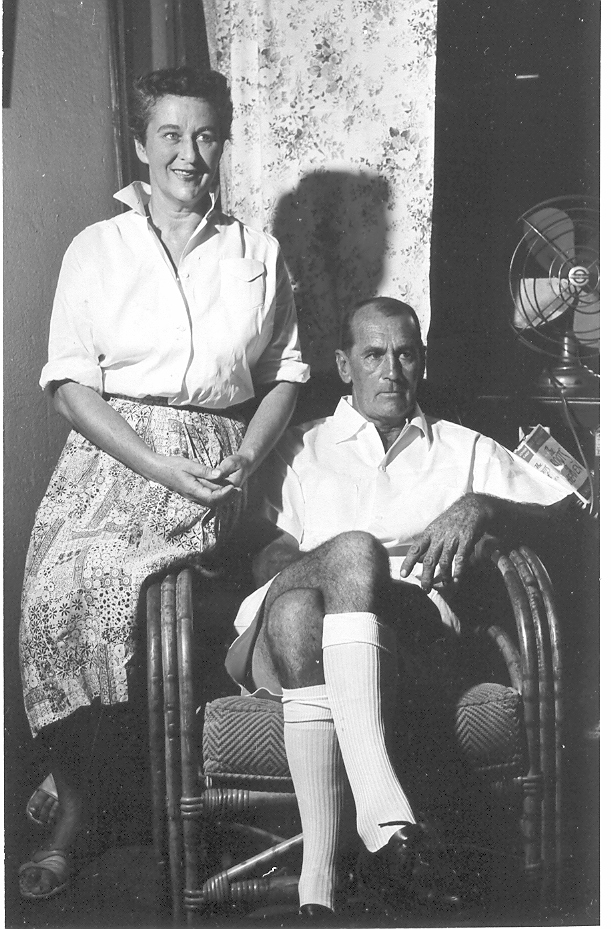
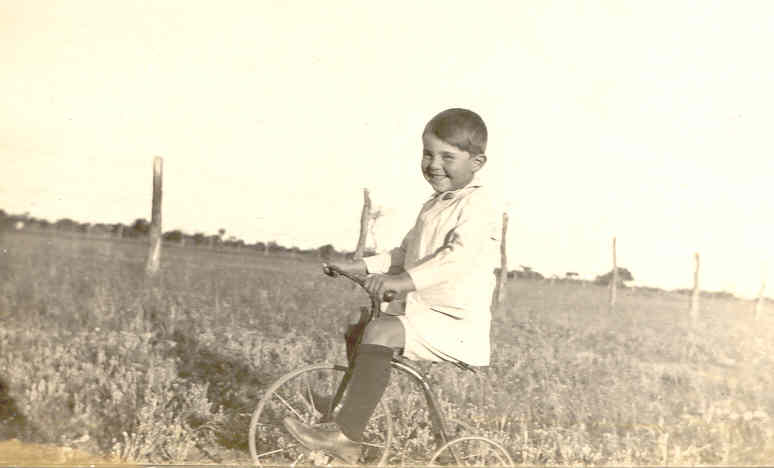
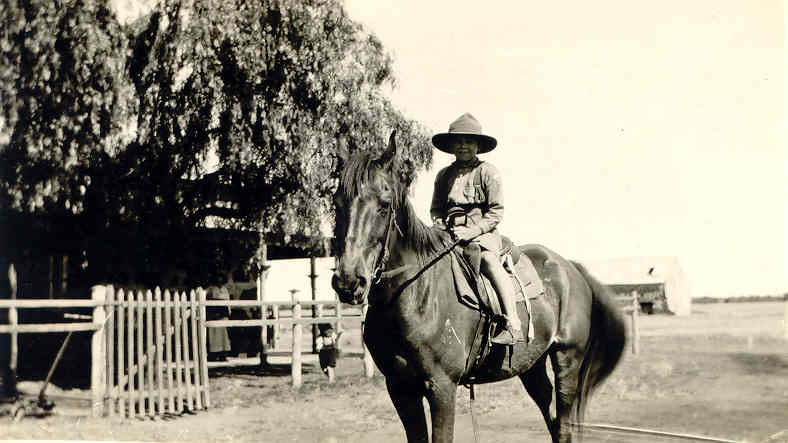
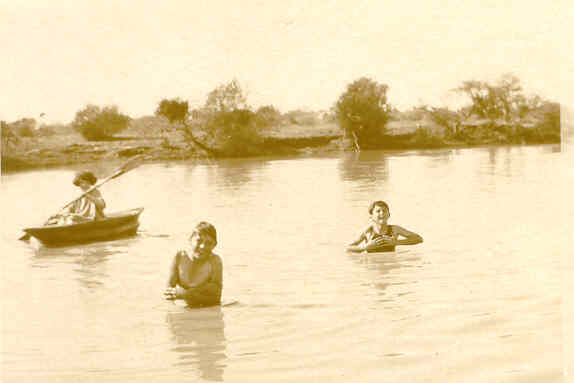
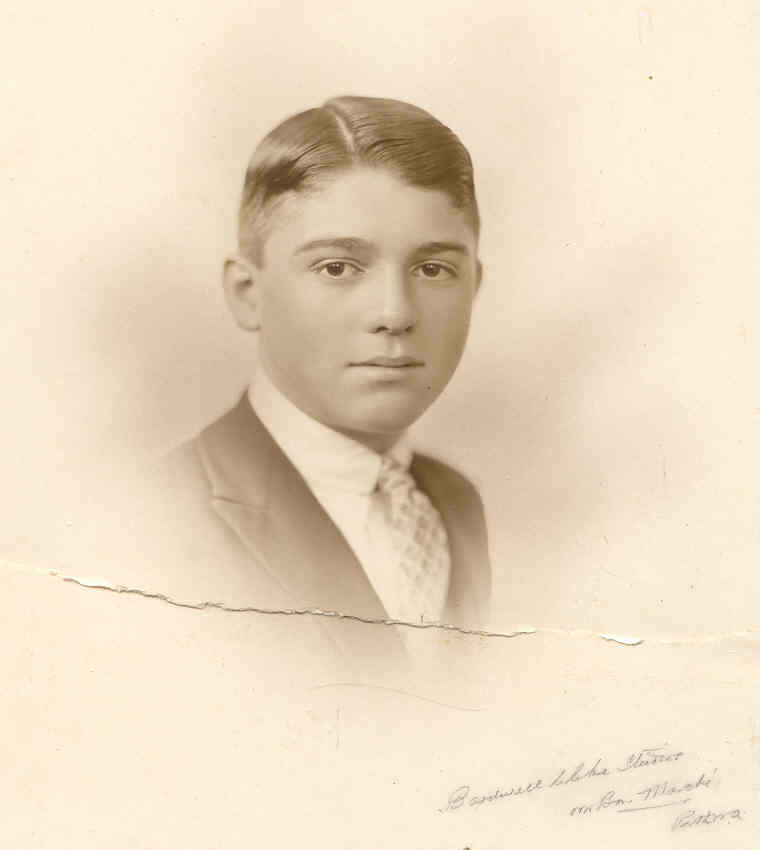
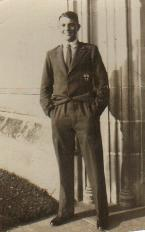
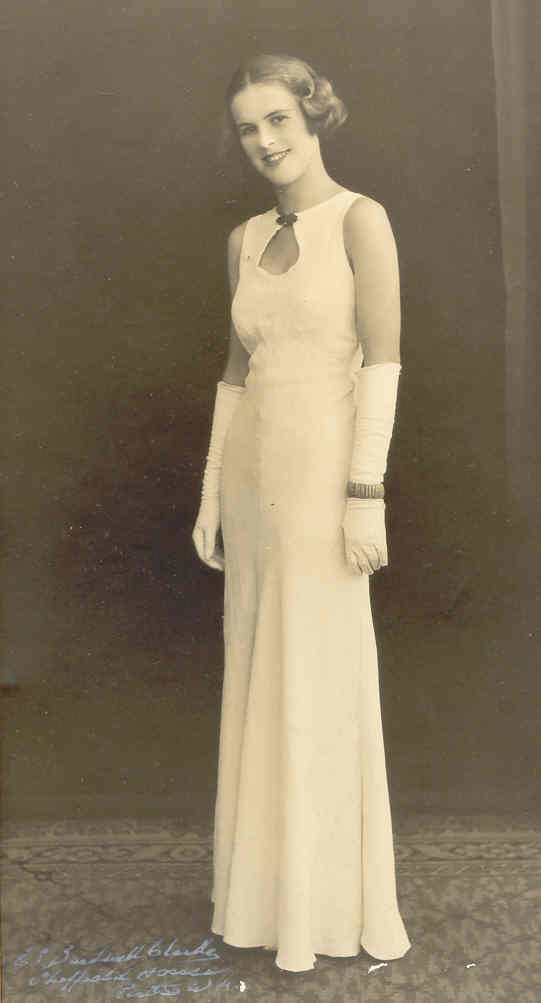
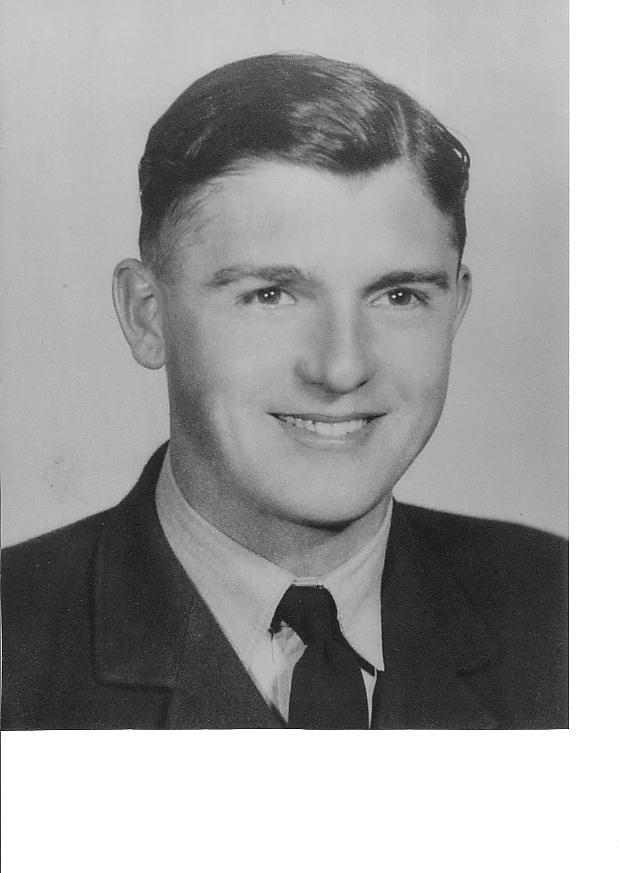
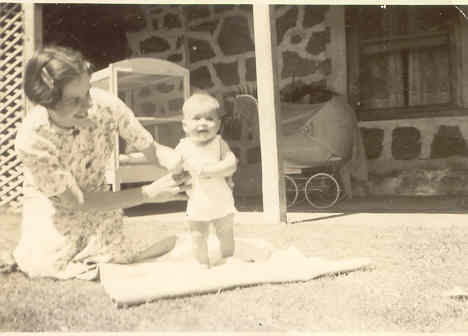
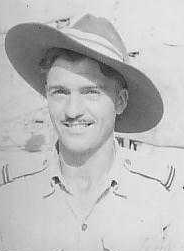
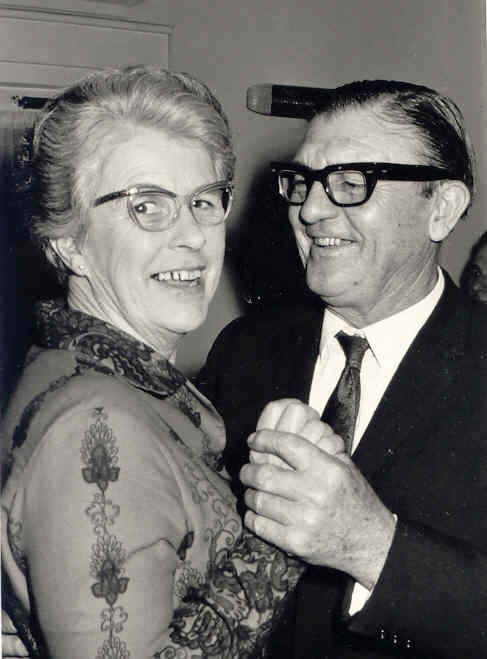
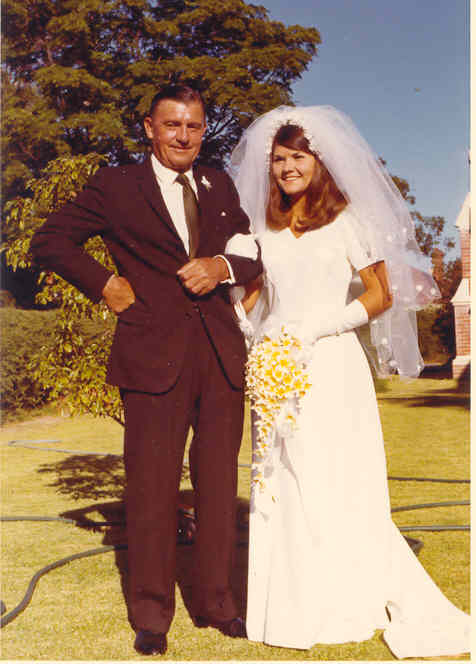
Donald (Don )was born on 25th August, 1879 in Copmanhurst N.S.W. to Alexander (Sandy) and Euphemia Beaton. The ninth child and sixth son, he would still have been a babe in arms when the family left and moved to Adelaide . After moving to Adelaide S.A. with the family , Don remained there with his mother , brother James and his sisters until November 1892 when they arrived in W.A. on the S.S. Polynesian and travelled by coastal ship to Geraldton and then road to ‘Beatonsfield’, Yandanooka. Don married Irene May Purchase on 22nd December, 1906 in ‘the house of Alexander Beaton near Yandanooka.’ Don and Irene had three children Helen,Duncan and Donald. Donald and Irene Beaton
Donald BeatonIrene Beaton
Book page 266
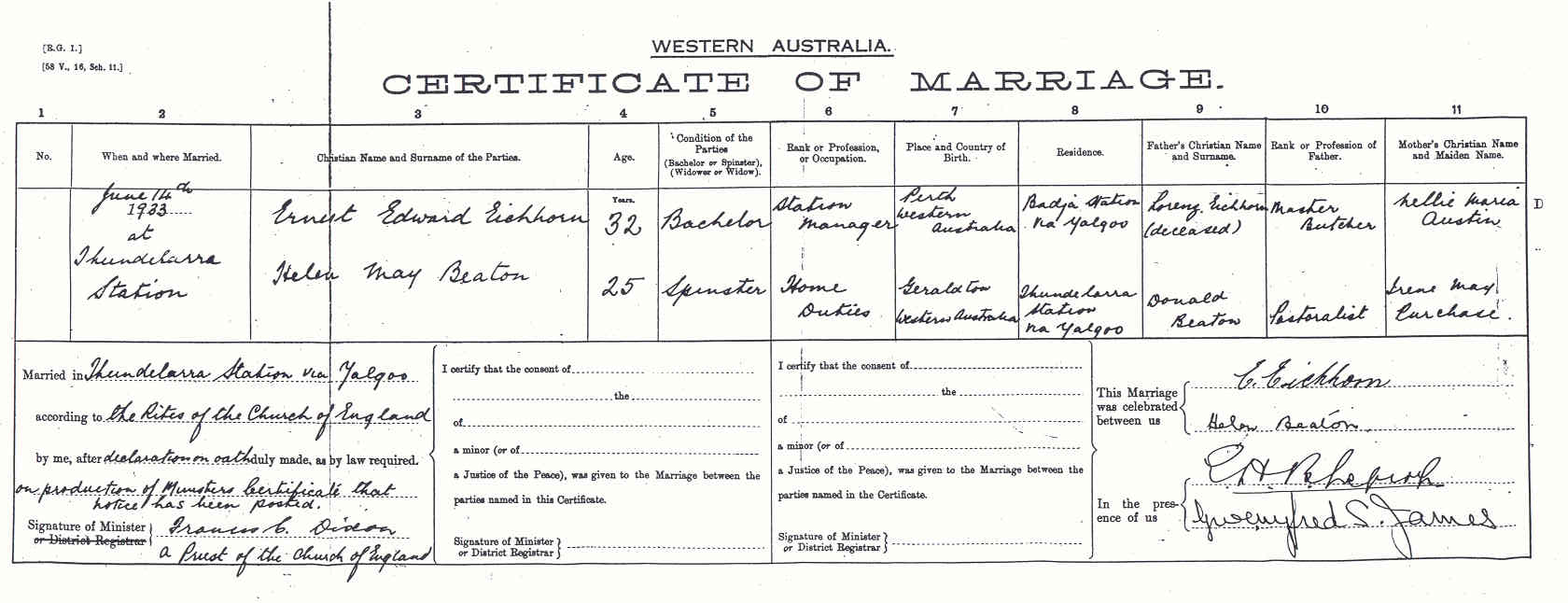
The Marriage Certificate Of Donald and Irene. Held by Pan Falck.
Marriage Certificate Don Irene
Book page 267
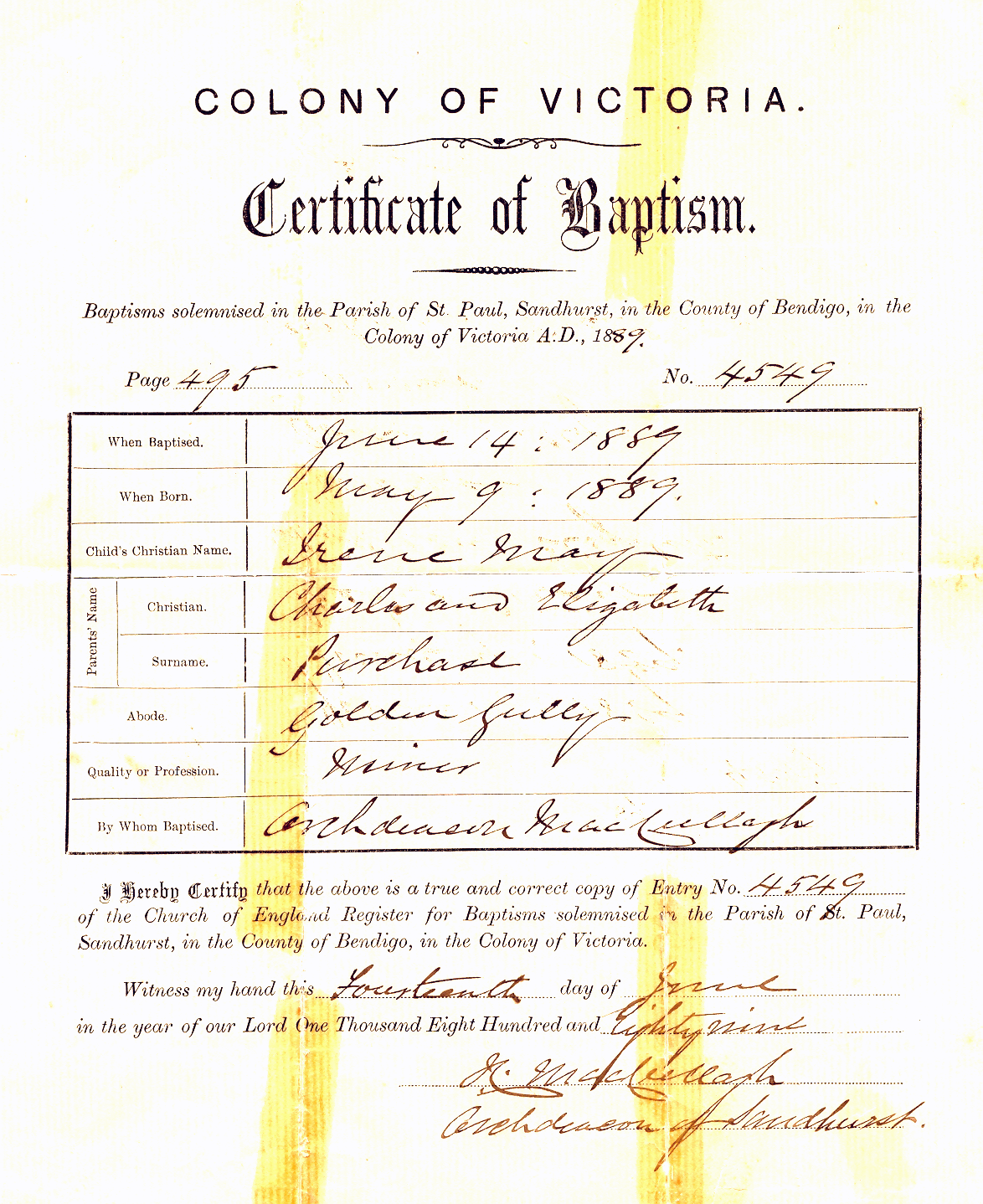
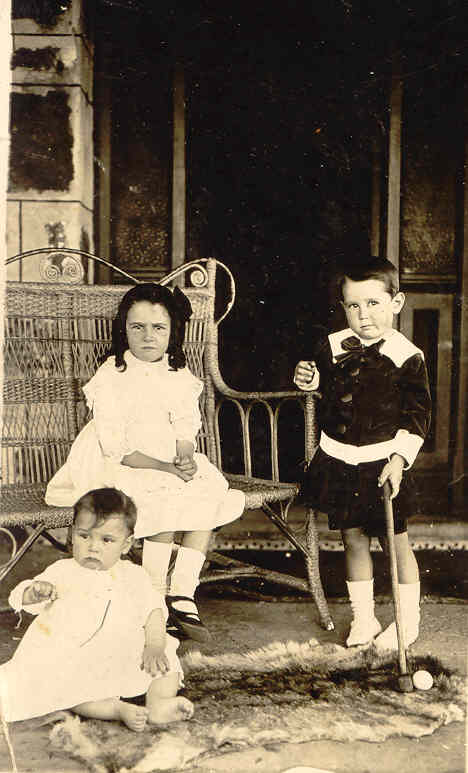
Irene was born on 9th May 1889, at Bendigo, Victoria, the daughter of Charles and Elizabeth Purchase. At the time of their wedding Irene’s father was deceased and her mother was listed as Elizabeth Lewis. Irene’s address was given as Fields Find, Yalgoo, and her occupation as companion. Helen, Don and Duncan. Thundelarra 1913.
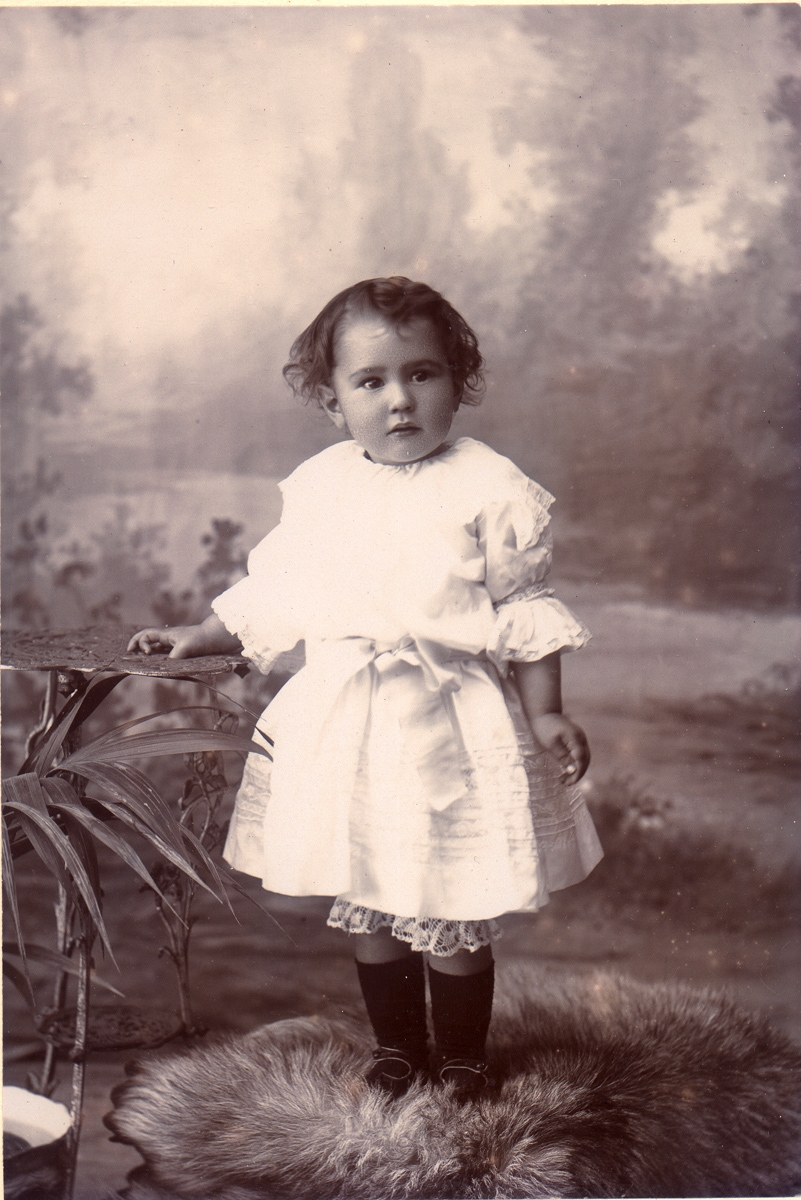
Certificate of Baptism IreneIrene May BeatonHelen Don and Duncan Thundelarra 1913Helen May Beaton
Book page 268
Don’s Service in the Great War.
Donald joined the Australian Imperial Forces on 22nd May 1916 at 36 years of age . The original papers were dated 5th May in Geraldton but actual enlistment papers are dated 22nd of May. At thirty-six he was above the enlistment age but family folklore has it that he may have used ‘friendship in high places’ to succeed with his application although there is nowhere on the application asking for the applicants date of birth. Information from the Canberra Archives Donald’s number was 6275 in the 28th Battalion of the A.I.F. He listed himself as a Grazier, married to Irene May Purchase then crossed that out to write Beaton ? His address was Thundelarra Station, via Yalgoo. This was signed at Belmont before Lewis Silverston His medical Examination Certificate from Geraldton lists his description as Date From whom received Record Place Date O/C Troops Embarked Fremantle 29/12/1916 Disembarked Devonport : 3/3/1917 L/Col Brazier Admonished “A 34”Persic 5/2/1917 App.
Sgt(VO) in Aust. 11/3/17 7th Tng Bn M.I from Aust Rollestone 3/3/1917 11/3/17 7th Tng Bn VO/Sgt Reverts to ranks Rollestone 4/3/1917 11/3/17 7th Tng Bn Pte to be EDP/Cpl Rollestone 6/3/1917 1 / 4 /17 7th Tng Bn Sick to Fargo Hosp P.U.O Fargo 28/3/1917 6 / 4 /17 CCHosp.Fargo Discharged to Depot England 6 /4/1917 15/4/17 7th Tng Bn EDP/Cpl sick Fargo Hosp Rollestone 8/ 4 /1917 8/ 4 /17 CC Hosp Adm. Mil Hosp Influenza Fargo 16/4/1917 16/4/17 CC Hosp Disch. To Depot Fargo 16/4/1917 22/4/17 7th Tng Bn Marched in from Hosp. Rollestone 16/4/1917 25/6/17 7th Tng Bn Proceeding O/seas. France S/hampton 25/6/1917 29/6/17 No.2.ADBD EDP/Cpl Reverts to Pte Havre 26/6/1917 29/6/17 No.2.ADBD Admitted from England Havre 28/6/1917 29/6/17 No.2.ADBD To be A/EDP/Cpl Havre 29/6/1917 26/7/17 No.2.ADBD Proceeded to join unit Havre 26/6/1917 21/7/17 C.O. 28th Taken on strength France 18/7/1917 21/7/17 C.O. 28th Revert to Private on Join Batt.
France 18/7/1917 16/10/17 C.O. 28th Appointed L / Cpl Field 30/9/1917 3 /10/17 C.O. 28th Wounded in action Field 2/10/1917 2 /10/17 3rd Canadian C.C.Station Adm. GSW Foot & Legs to Train Field 2/10/1917 2/10/17 32nd Staty Hsp Adm GSW Foot & Multiple Wounds Legs Wimereux 2/10/1917 17/1/18 2nd Aux Furlo 17/1/18 -31/1/18 & report to 2nd Aux Southall 14/2/18 2nd Aux Adm ex furlo Southall 14/2/18 7/3/18 2nd Aux Furlo 7/3/18 to 21/3/18 & report 2nd Aux Southall 9/4/18 2nd Aux Adm -Discharge to Depot Southall 12/4/18 I.B. 458 R L/Cpl returned to Aust. Per “Durluce Castle” for discharge (Multiple W.Amp.Rt.Leg) 25/4/1918 Age 36 Height 5 ft 7inches Weight 140 lbs Chest Measurement 36/38 Complexion :Medium Eyes : Light Brown Hair : Dark Brown Religion: Presbyterian Distinctive marks: Appendictomy cicatrix The following information is recorded on his Army Form B103 5th M.D. Casualty Form - Active Service Regiment : 28TH Battalion Regimental Number 6275 Rank: L /Cp Beaton Donald Date of promotion to present rank : 16/11/1916 The Commander appointed him to 18th/28th at Blackboy Hill
Book page 269
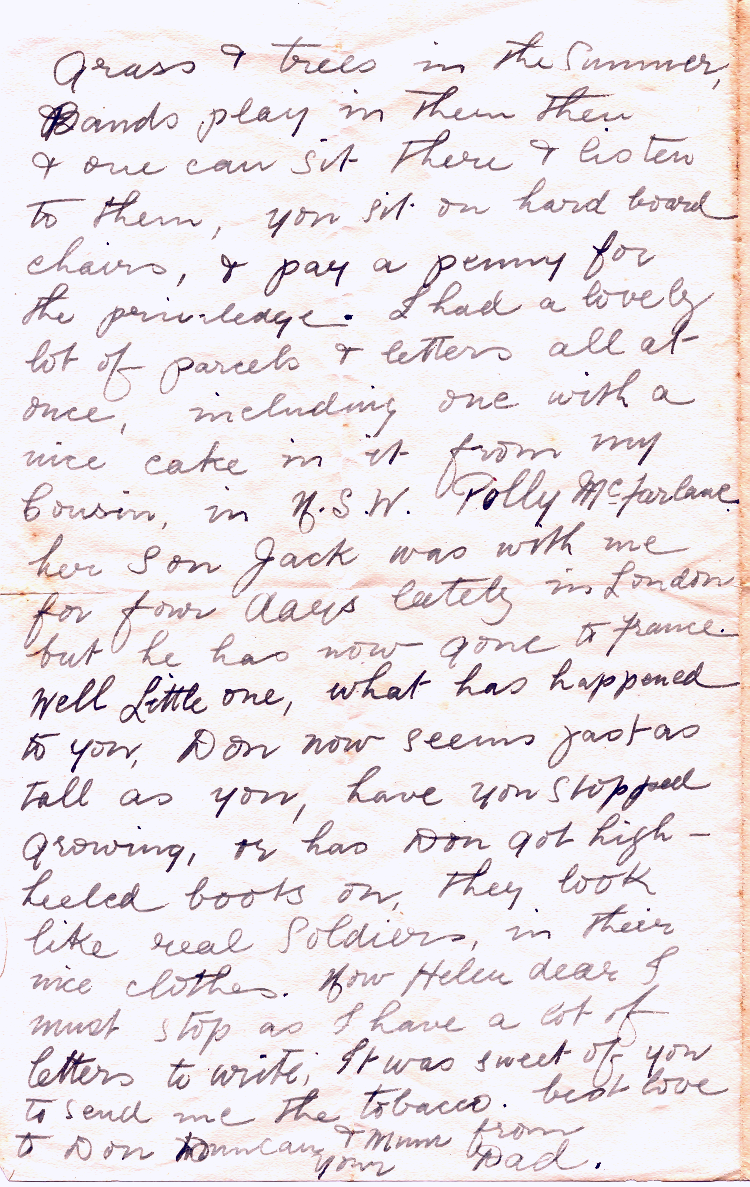
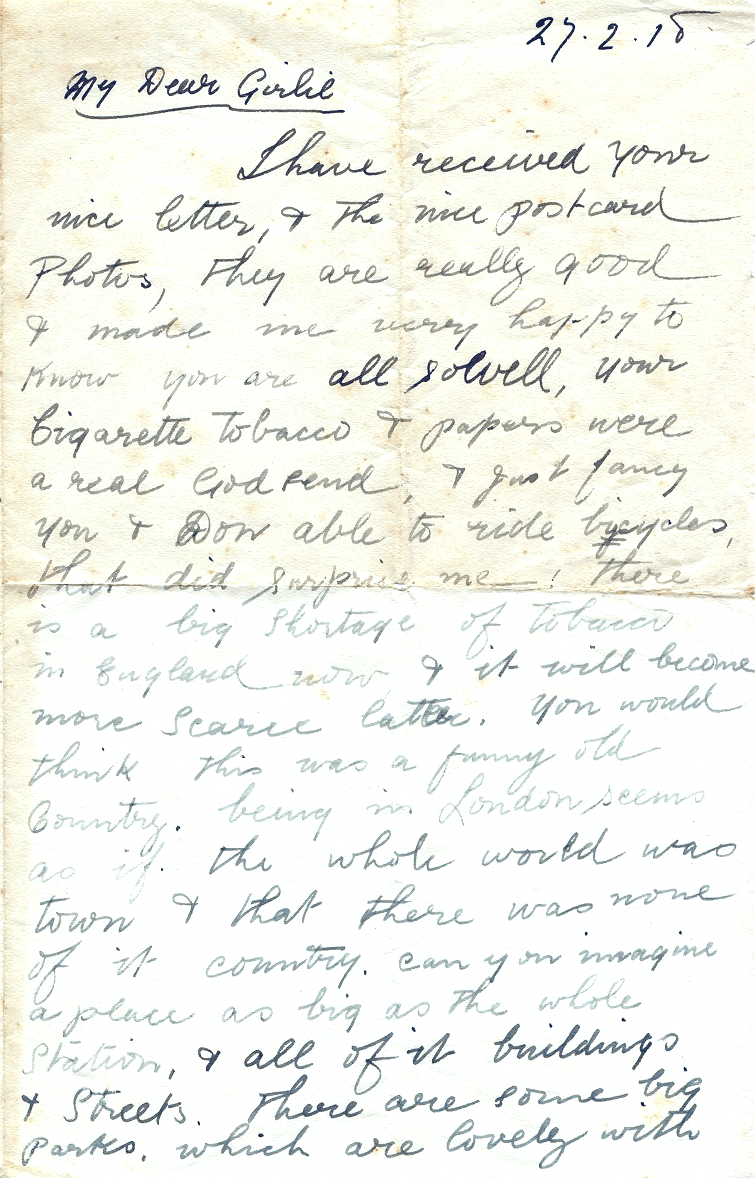
Records show the 28th Battalion relieved the 33rd Battalion on line west of Zonnebeke on the 1st of October. On the 2nd they in turn were relieved by the 25th and moved back to Bellewaarde Ridge. Helen’ s letter from her father( Don Snr) in London. 1918.
Helen’s letter from her father( Don Snr) in London. 1918.Helen’s letter from her father( Don Snr) in London. 1918.
Book page 270
Records show Donald wounded on the 2nd . Donald was transferred to the 2nd Aust Field Hospital on 27/11/1917 for amputation of his right leg. Donald returned to Aust on the ‘Karoola’ which left Suez on 27/4/1918. Medals: The British Army Medal The Victory Medal The Star Medal. From 26th May 1916, the day Donald signed up to serve King and Country until he returned to Australia during May 1918, was a period of just two years. Don returned to take up family, social and station life, albiet with the restrictions placed on him by his artificial leg. Research at DOLA reveals Donald held blocks of land at Yandanooka for some time. Murchison Times. 27/7/1930 Personal Column Messrs Don Beaton (Thundelarra Station) & M Williams spent a few days in the Cue district last week during which time they visited the new find at Behring Pool. Block numbers 80, 21 and 22. Inspectors Book entry: 1329 Beaton Don Area 922.2.28 acres Yandanooka 21& 22 no Inspection / corres / Remarks 1330 Beaton Don Area 20.1.17acres Yandanooka 80 Inspection 28/12/1923 £100.00.0($200) £170.00.0 ($340) imp include 20/1819 Corres No 988/19 Remarks:Fenced £418.03.6 ($836.35) Judy, Irene and Dot Kirby.
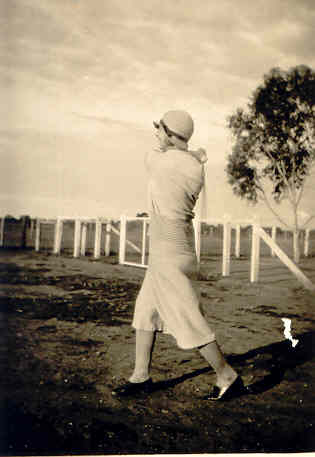
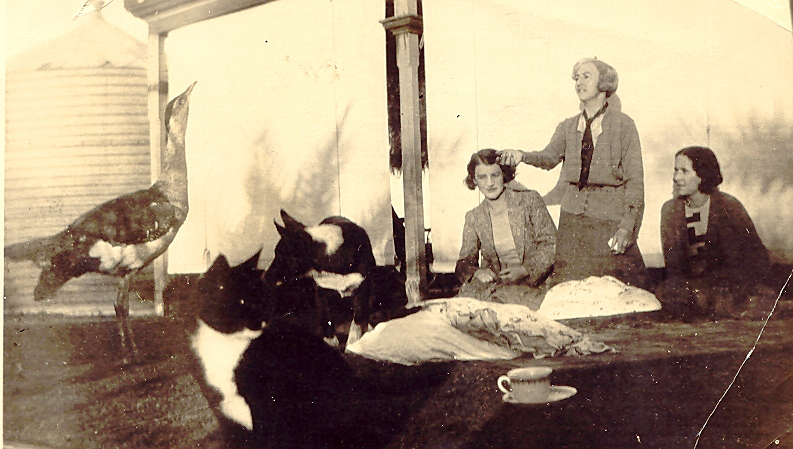
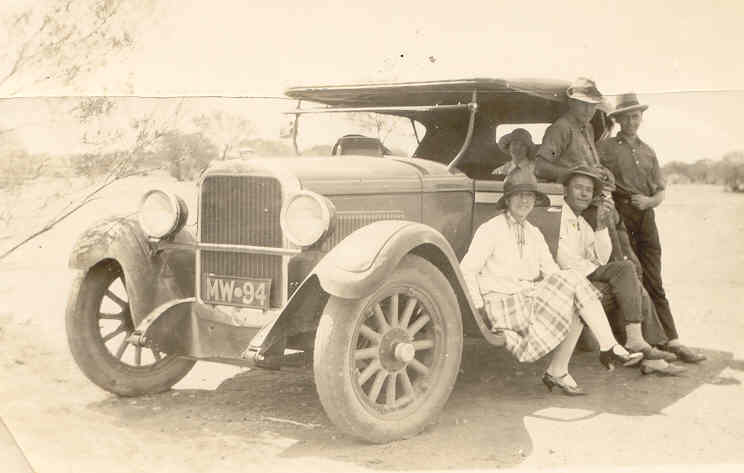
Feeding the bush turkey at Thundelarra Irene golfing at Thundelarra. Irene and Don seated on running board, Don Jnr leaning back against car. Is that Helen in the back seat ?
Irene Golfing at ThundelarraJudy, Irene and Dot Kirby. Feeding the bush turkey at Thundelarra.Irene and Don seated on running board, Don Jnr leaning back against car. Is that Helen in the back seat ?
Book page 271
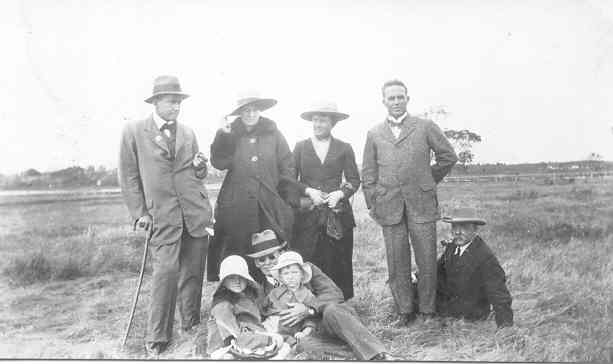
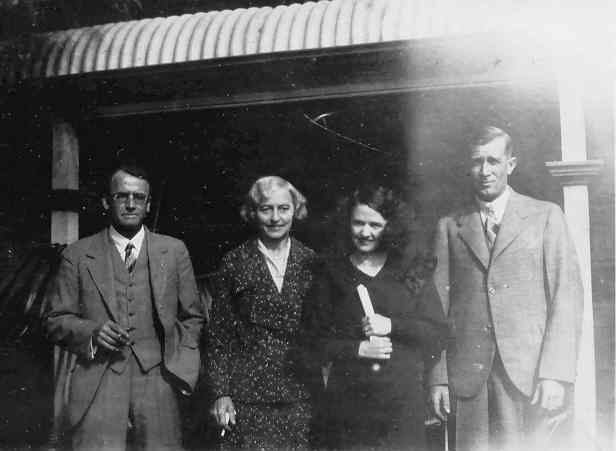
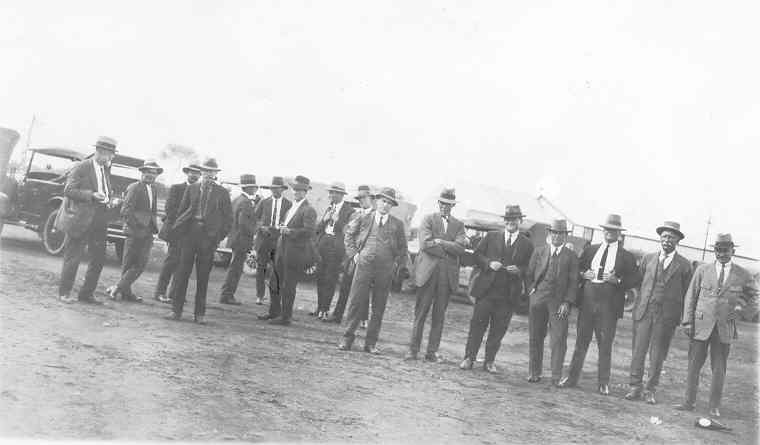
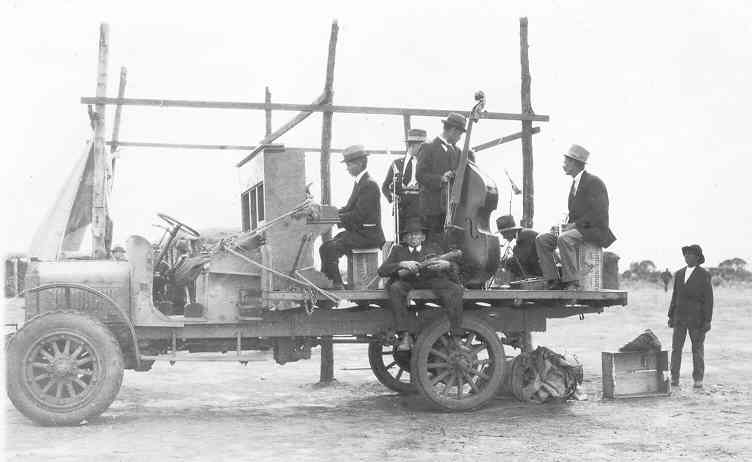
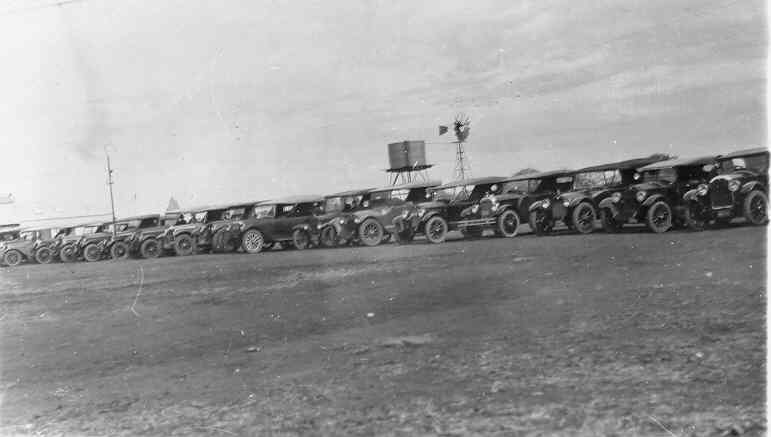
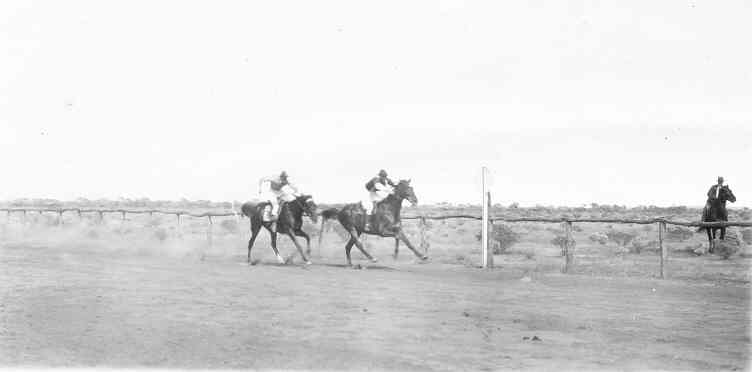
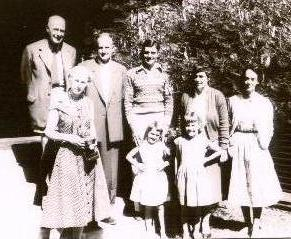
Group of friends, Don Snr on left. Don, Irene, Helen and Ernest. Thundelarra Helen’s Wedding Day. Yalgoo Races – 1920’s. From a collection of 27 photographs – all unnamed.
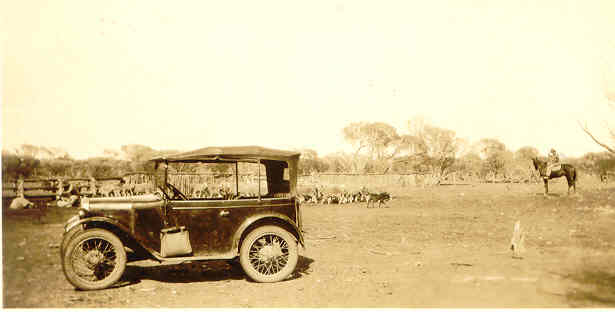
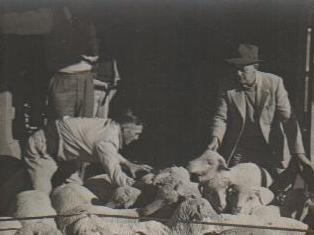
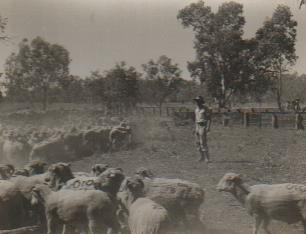
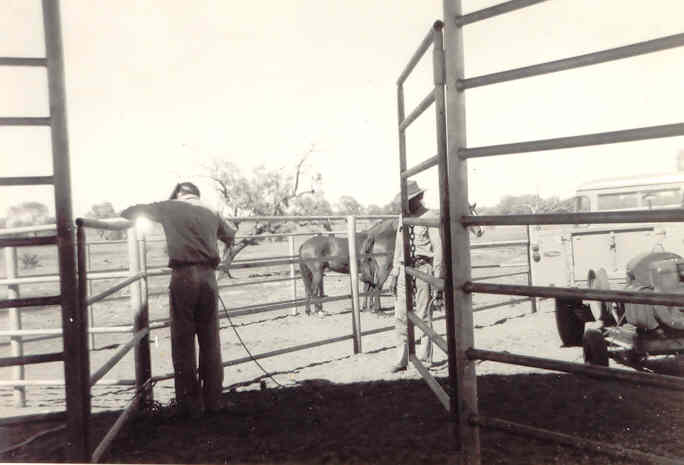
Group of Friends Don Snr on leftLife at Thundelarra - sheep, dogs, horse and rider, carDon, Irene, Helen and Ernest. Thundelarra Helen’s Wedding Day.Yalgoo Races – 1920’s. From a collection of 27 photographs – all unnamed.Yalgoo Races – 1920’s. From a collection of 27 photographs – all unnamed.Yalgoo Races – 1920’s. From a collection of 27 photographs – all unnamed.Yalgoo Races – 1920’s. From a collection of 27 photographs – all unnamed.
Book page 272
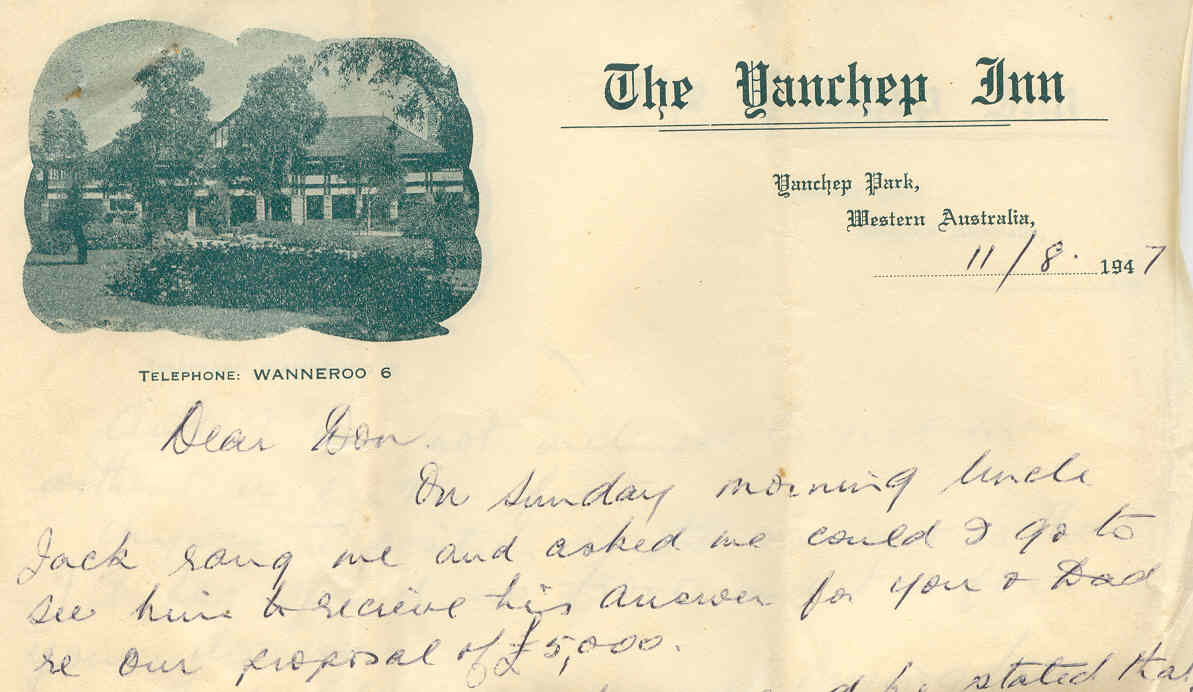
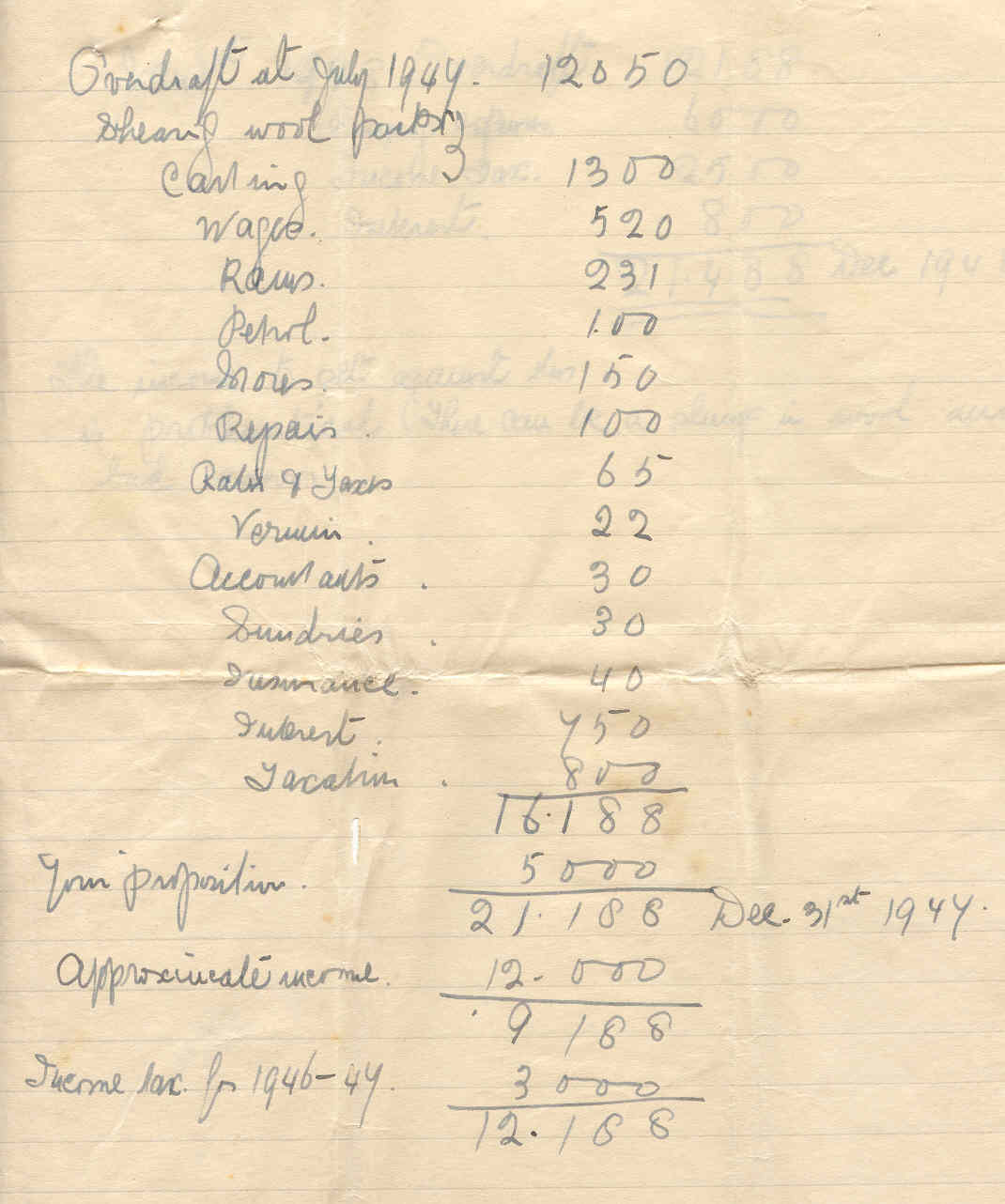
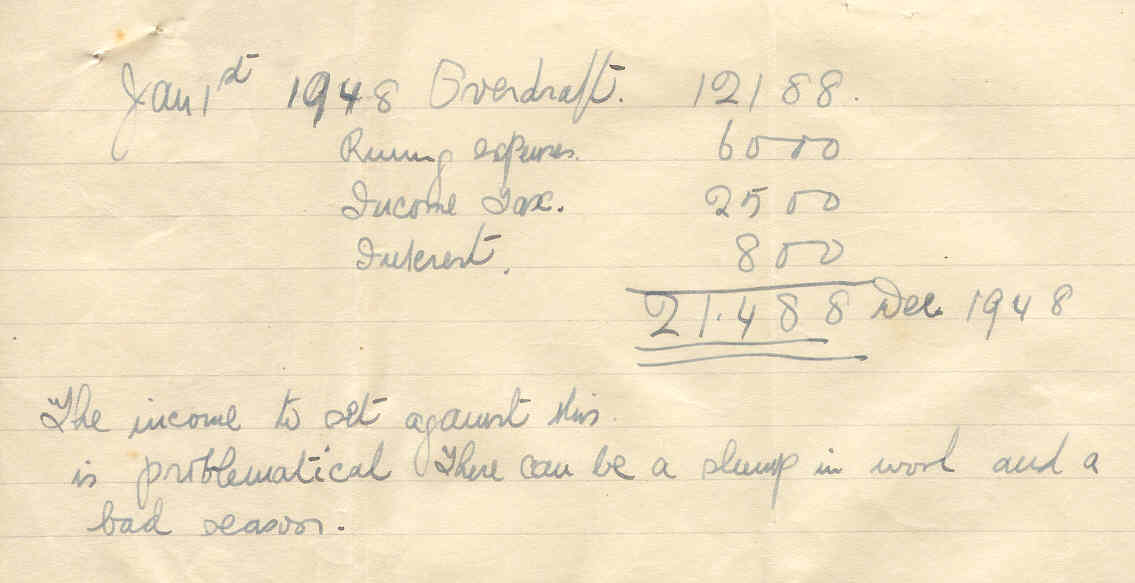
The full text of the above letter reads:- Dear Don, 11/8/1947 On Sunday morning Uncle Jack rang me and asked me could I go to see him and receive his answer to you and Dad re our proposal of £5,000 ($10,000). I went straight down and he stated that he had gone into the situation fully and was willing to raise 5000 for us but that Elders would not advance the money. Their reason (he put it as his reason) being that at the end of next year the overdraft would be back to where it was this year as shown by their working out listed attached by J.A. You will note that they have put this years income down at £12,000 ($24,000). “very conservative.” I said nothing and in fact just accepted his message that He thought they would advance him £3,000 ($6,000) for us and he offered that. I then went and saw Dad who is inclined to think that they will come at the £5,000 ($10,000) and I am not inclined to give in without a further fight.
Anyway the position at the moment is that J.A. has offered us £3,000 ($6,000) and it is for your decision. Maybe Elders will come at paying £3,000 in cash now with 2000 shares in Elders to be signed over as from this year, next year, or even later. My idea being that £1,000 for Helen and Dad, £2,000 for yourself. The £2,000 shares to come being in my name. Dad to get the interest as with your £2,000. Maybe they would come at that. I do think that they will go higher than 3,000 especially if they knew that 2,000 of it would not be cash going out. That is as it stands Don and I will be here at Yanchep until next Friday night, South Perth Saturday and Sunday. I can probably get Monday off if necessary. However my idea is that we should ask for the £3,000 cash and 2,000 to come later-anytime preferably in Elders own shares which could be the share which is eventually to come to me. Do you think there’s any possibility in that ?
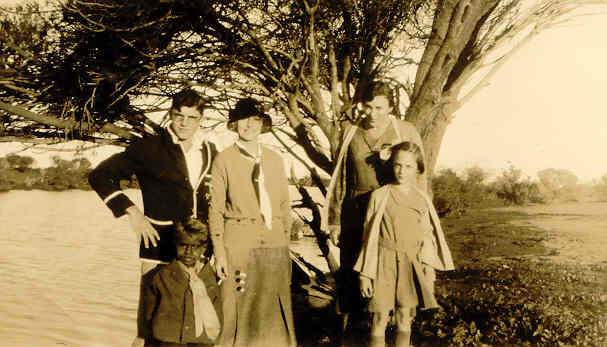
George Mawley reckons if they’ll pay 3000 they’ll pay £5,000. He says stick out for it. Well Don you can contact me by phone letter or wire here until Friday & at Karoo St. Saturday. Would like to hear from you by then before I go back bush. Attached please find Uncle Jack’s figures. My love to Mick and the kids. All the best Duncan Dad will be waiting on you re the above but there’s no terrific hurry except to get on while they’re hot. Love Dunc. Duncan , Irene and Belle with Daly and Laurie standing in front.
Yanchep Inn letterhead to Don from DuncDuncan , Irene and Belle with Daly and Laurie standing in front.
Book page 273
After moving to Perth, Don and Irene lived at “Varsity Flats”, Stirling Highway, Nedlands and Don was for some years was employed as a lift driver for Boans Department Store.
Jack’s figures given to Don Snr, Don Jnr and Duncan in August, 1947.Jack’s figures given to Don Snr, Don Jnr and Duncan in August, 1947.
Book page 274
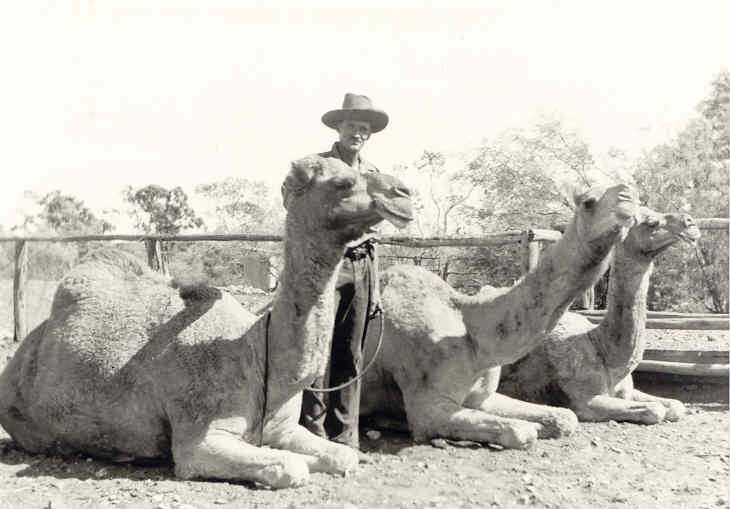
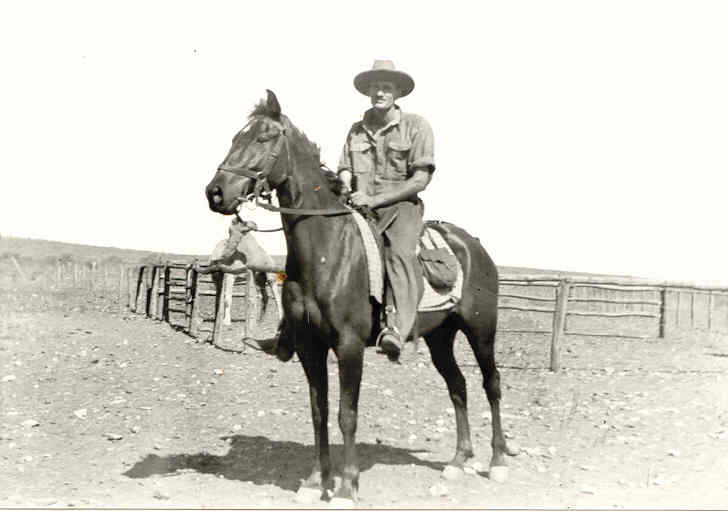
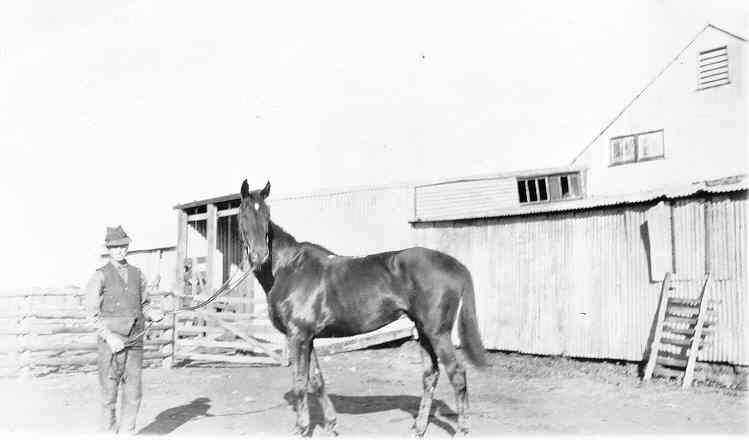
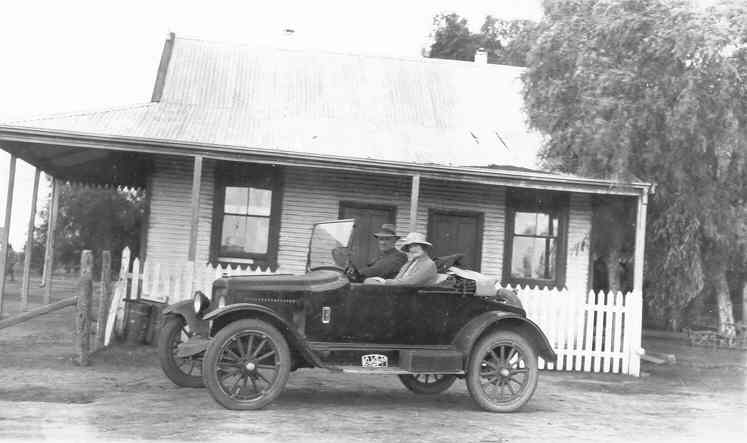
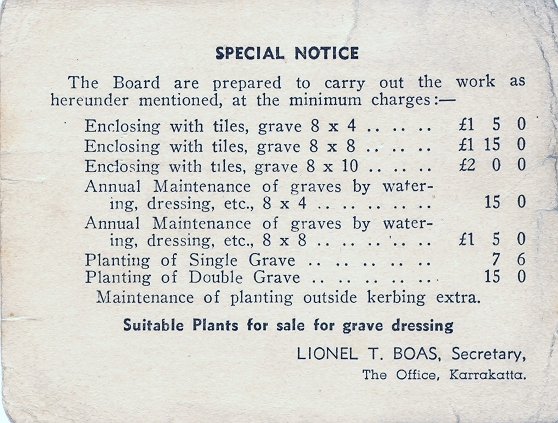
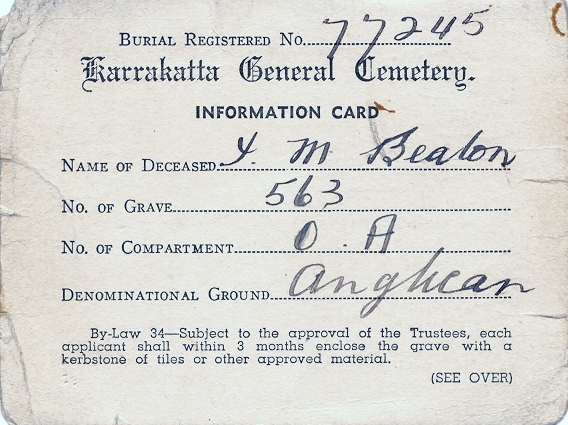
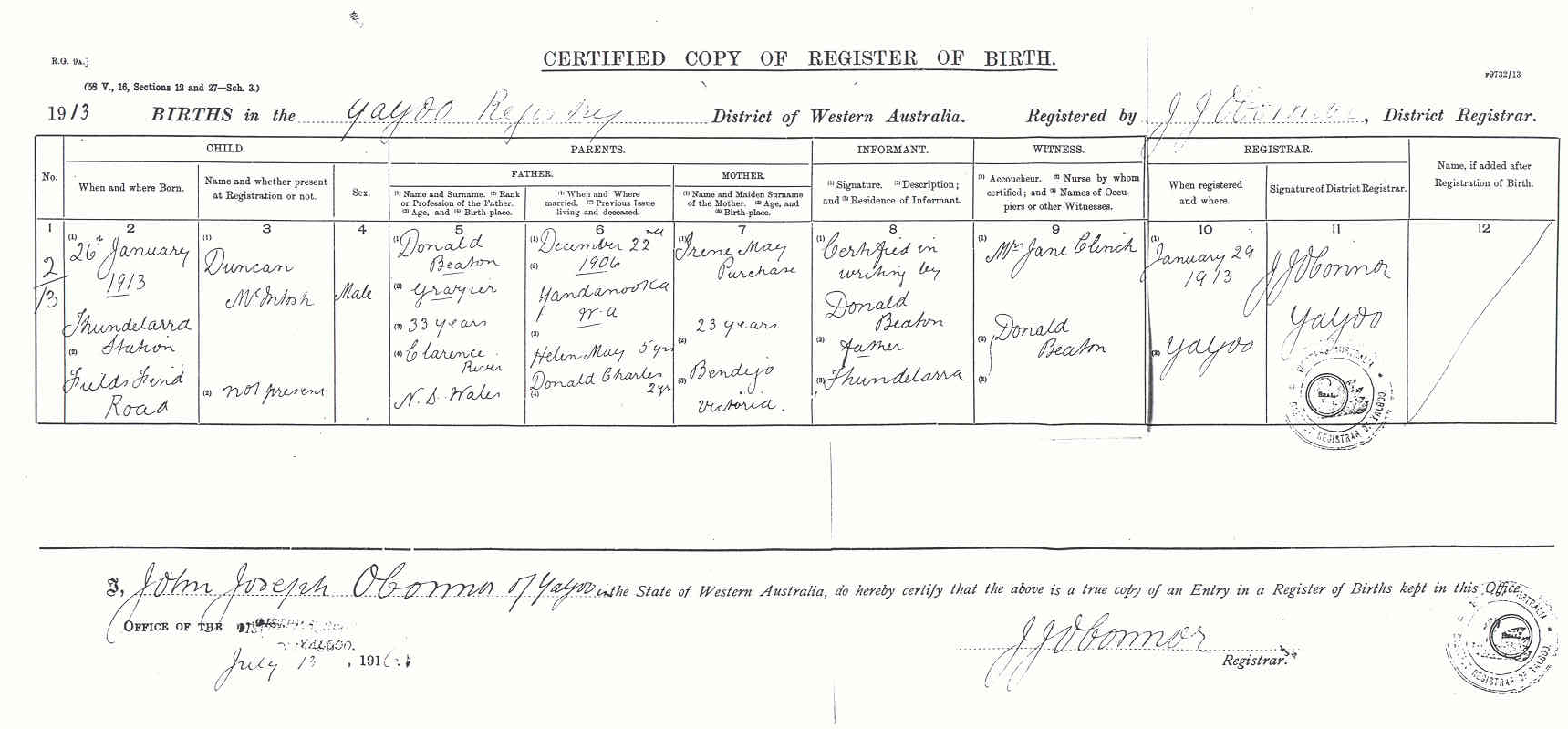
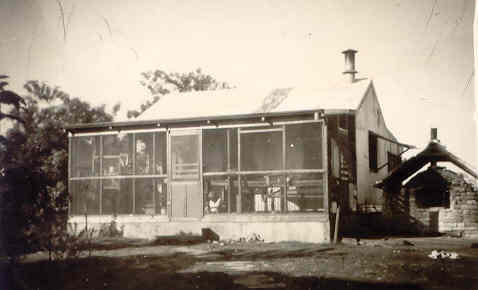
After Irene’s death Don lived for some time with Don and Mickey on their farm in Northampton before passing away in Claremont in 1954. Donald was born on the 25th August, 1879 at Clarence River NSW Married : Irene May Purchase on the 22nd December 1906. Children : Helen May born 14th November, 1907. Donald Charles born on the 6th July, 1910. Duncan McIntosh was born on 26th January, 1913. Irene died from cancer and is buried at Karrakatta. Donald died : 16th June 1954 and is buried at Karrakatta. Scenes of the Thundelarra Stables, yards, camels and horses. Cottage at Thundelarra.
Scenes of the Thundelarra Stables yards camels and horsesScenes of the Thundelarra Stables yards camels and horsesScenes of the Thundelarra Stables yards camels and horsesCottage at ThundelarraSpecial NoticeKarrakatta General Cemetary Location nocie
Book page 275
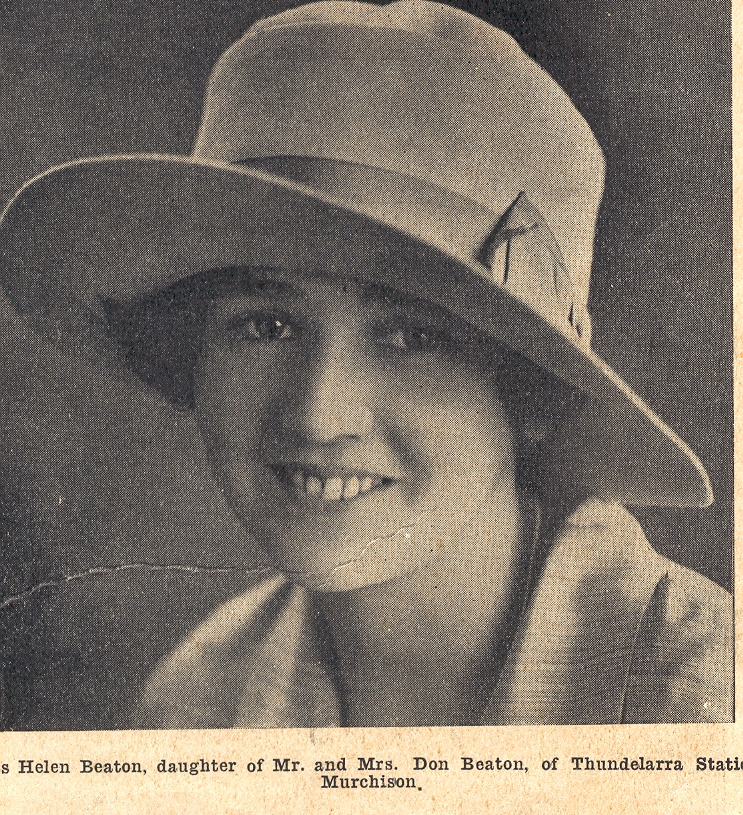
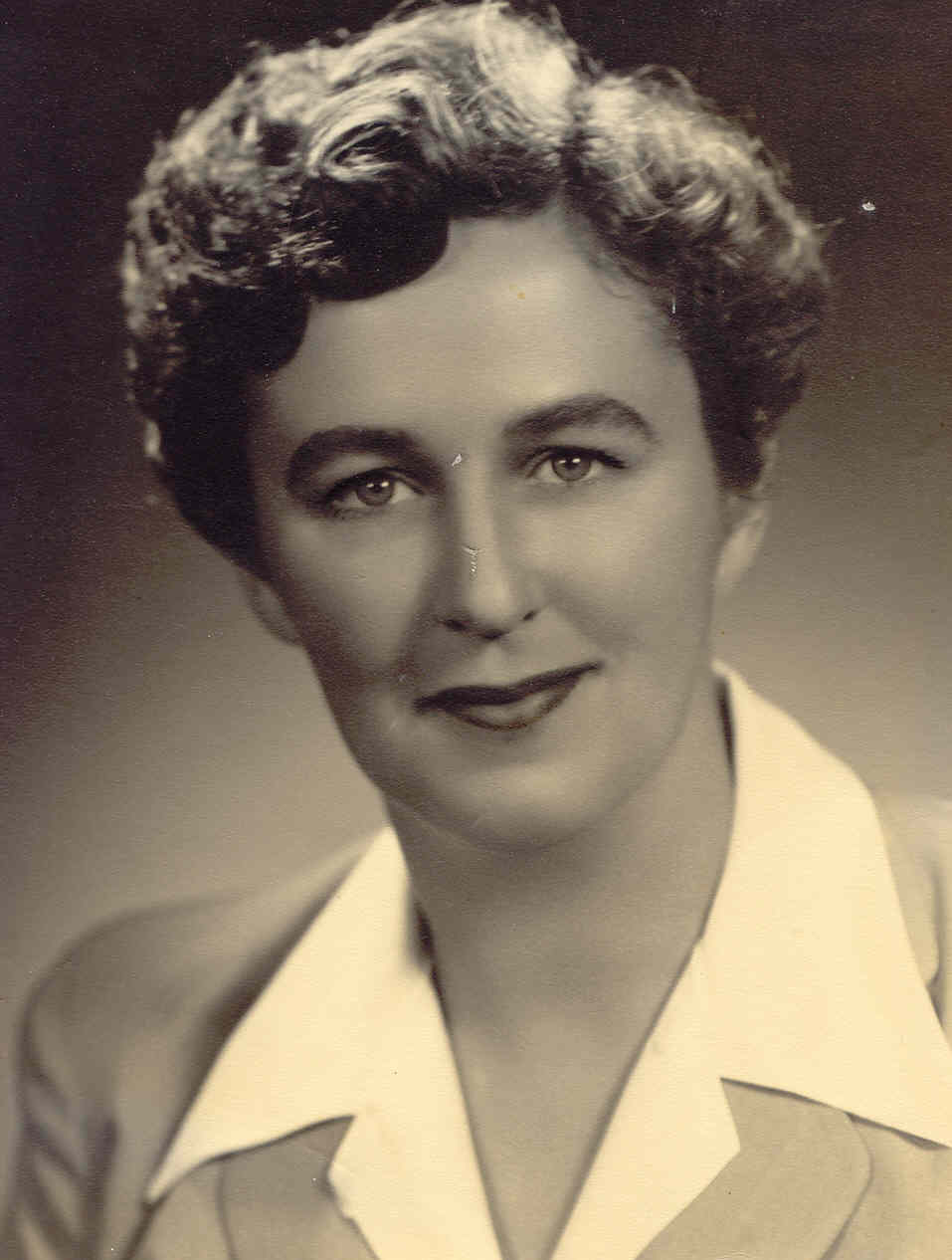
Helen May Austen (nee Beaton)
Helen May Austen (nee Beaton)
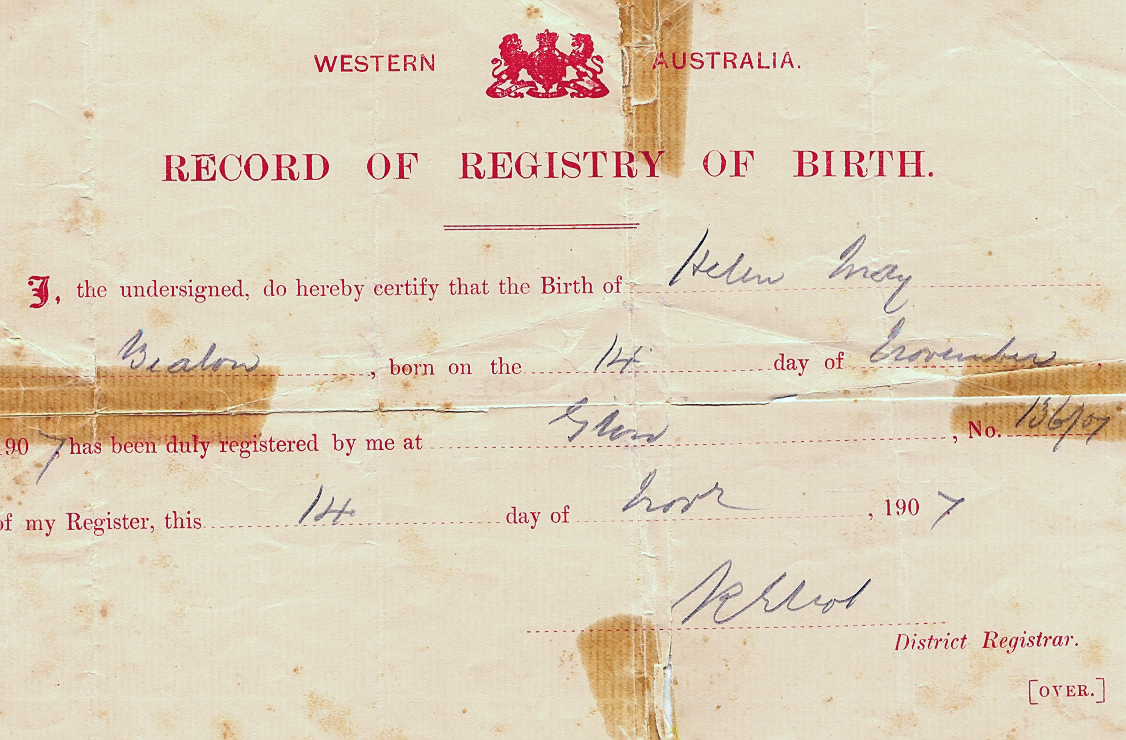
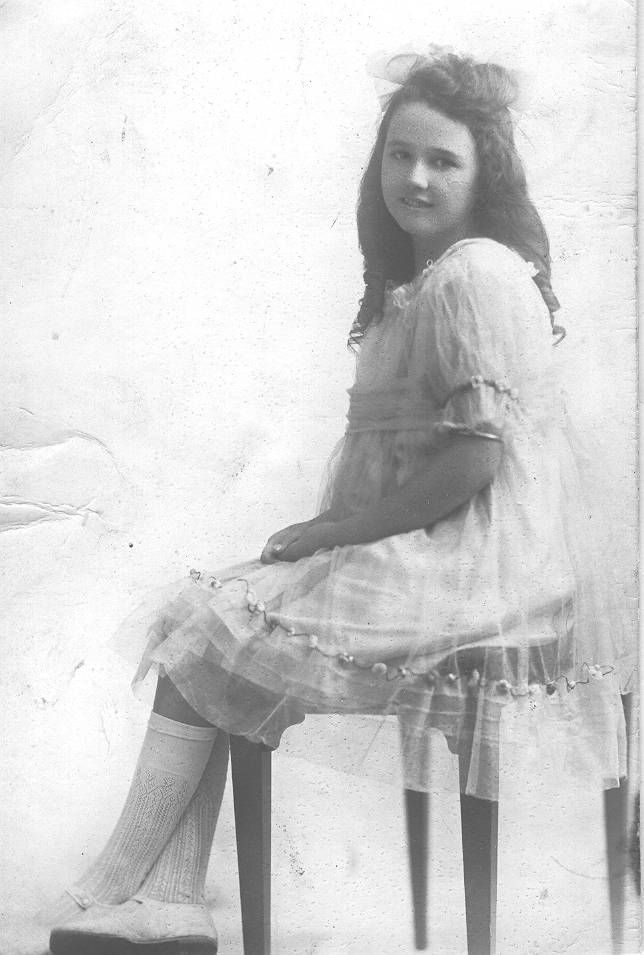
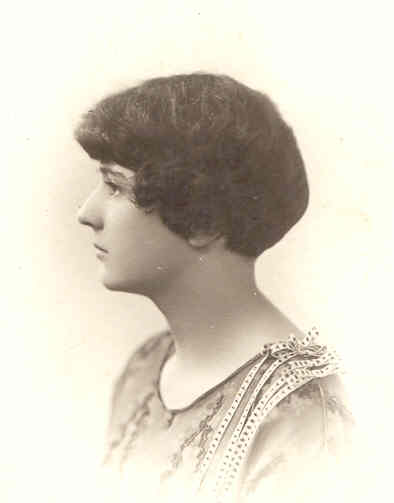
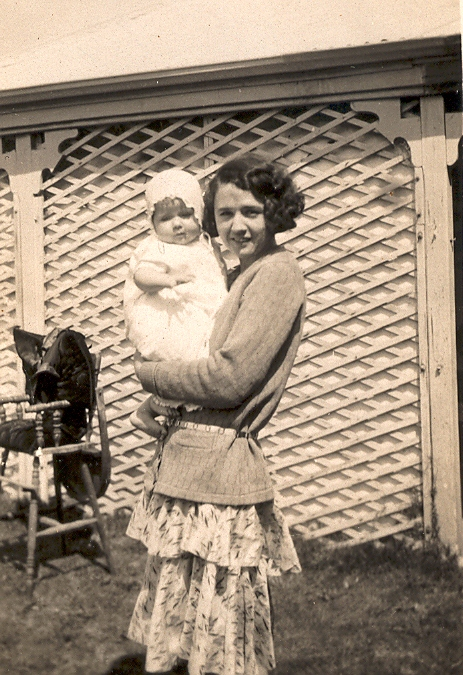
Helen May Beaton was born on the 14th November, 1907 in Geraldton. The eldest child and only daughter of Donald and Irene. Helen had the company of her cousin’s (Charles and Lottie’s children) Edith, Alex, Charlotte, Barley, Margaret, Jean and Ron until 1918, when their father left the partnership.There were also her own brothers Don and Duncan. Later there were Jack and Belle’s children, Ian and Laurie. Helen also attended boarding school in Perth. Always a petite lady Helen enjoyed the social life of the pastoral and graziers communities in the country centres and the city. Helen Beaton holding Helen Lines. (named after her) Helen May Beaton.
Record of Register of BirthHelen May BeatonHelen May BeatonHelen May BeatonHelen Beaton holding Helen Lines (named after her
Book page 276
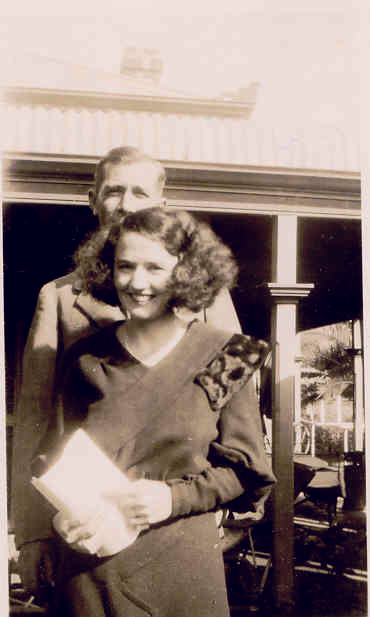
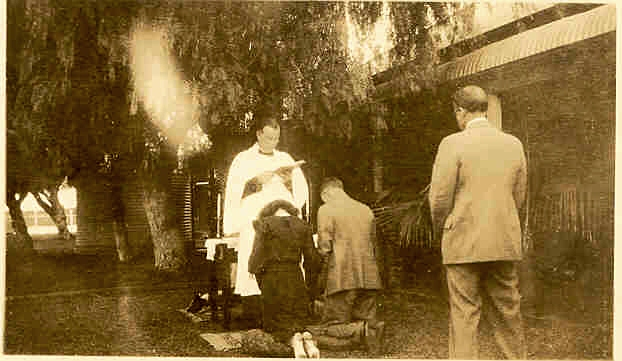
From the social pages. Helen and Ernest Edward Eichhorn were married on the lawn at Thundelarra on 14th June, 1933 by the Reverend Francis C. Dixon of the Church of England. Above : Kneeling before the Minister and Don Beaton standing behind. Right : The happy bride and groom.
From the social pagesFrom the social pagesCertificate of MarriageHelen and Ernest Edward Eichhorn were married on the lawn at Thundelarra on 14th June, 1933 by the Reverend Francis C. Dixon of the Church of England.Above : Kneeling before the Minister and Don Beaton standing behind. Right : The happy bride and groom.
Book page 277
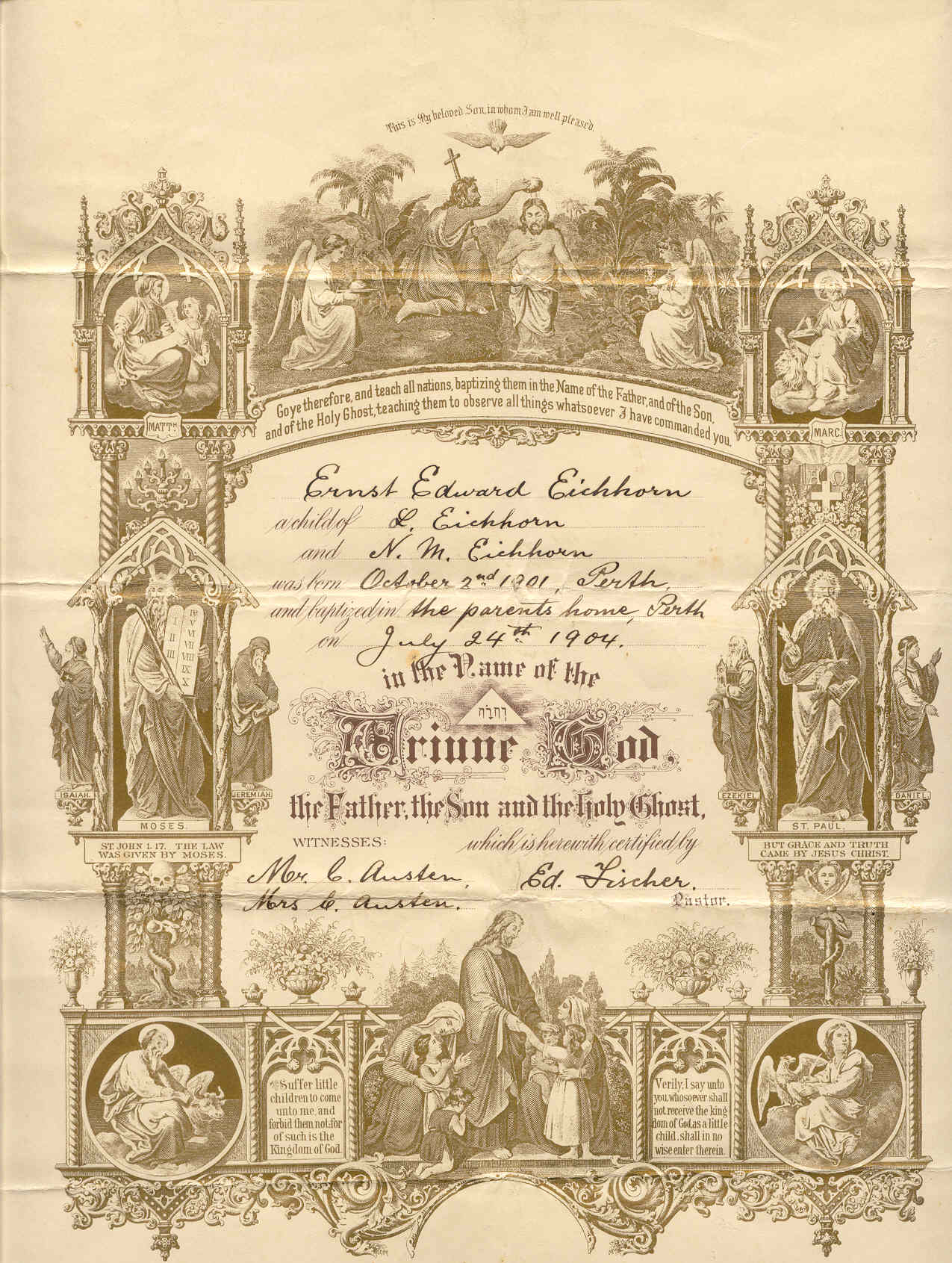
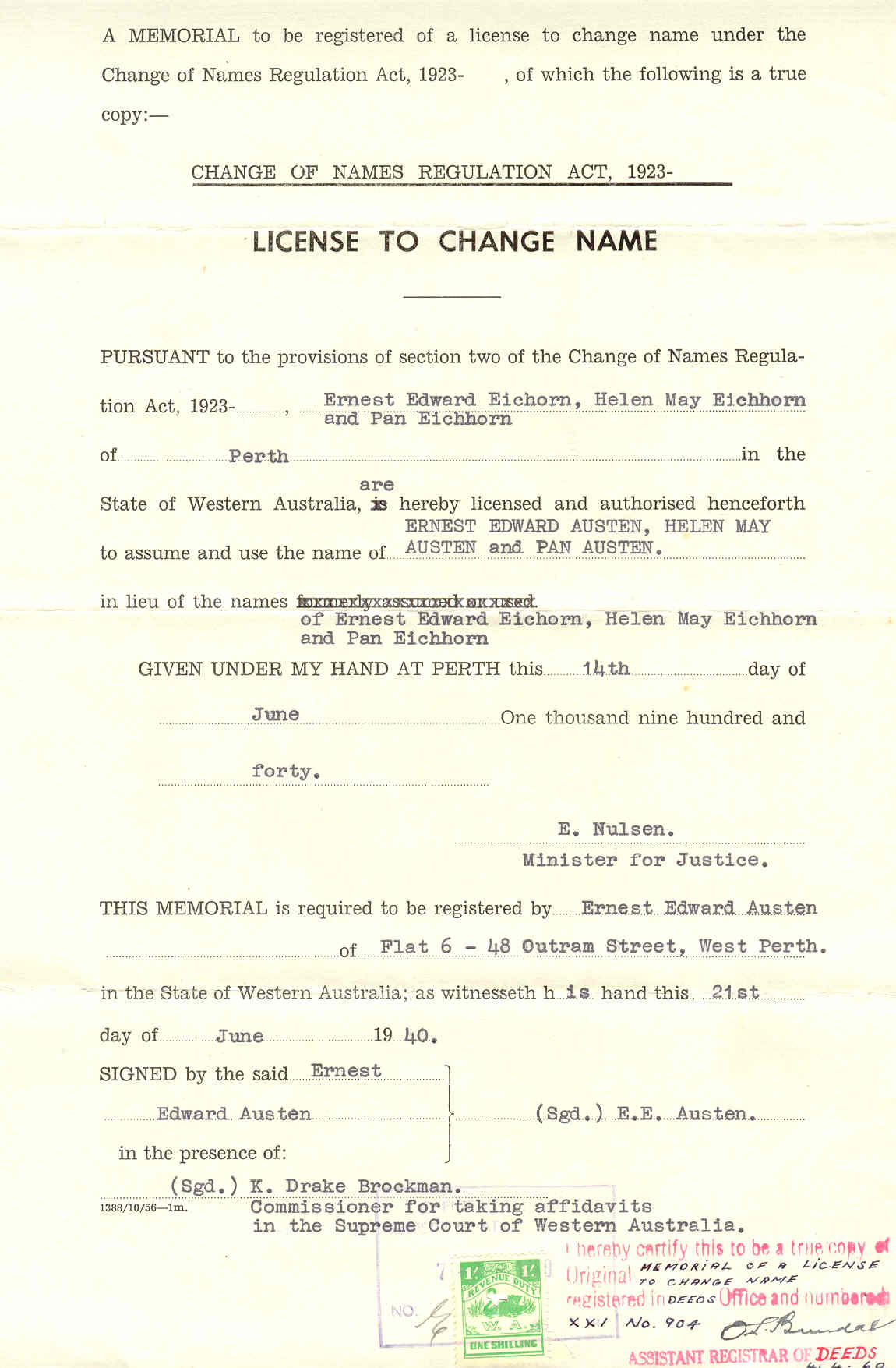
Ernest Edward Eichhorn was the Manager of Badga Station via Yalgoo at the time of his marriage to Helen and was still employed there when Pan was born on the 6th April, 1934. Pan was born at Tresillian Hospital, Tyrell St, Perth. Their only child. On the 14th June, 1940 he had the family name changed from EICHHORN to AUSTEN which had been his mother’s maiden name. His feeling was that he couldn’t go and fight the Germans with a German name. Ernest enlisted in the Army for War Service on 23rd June, 1940.. Ernest’s Baptismal Certificate
Ernests Baptismal CertificateLicense to Change Name
Book page 278
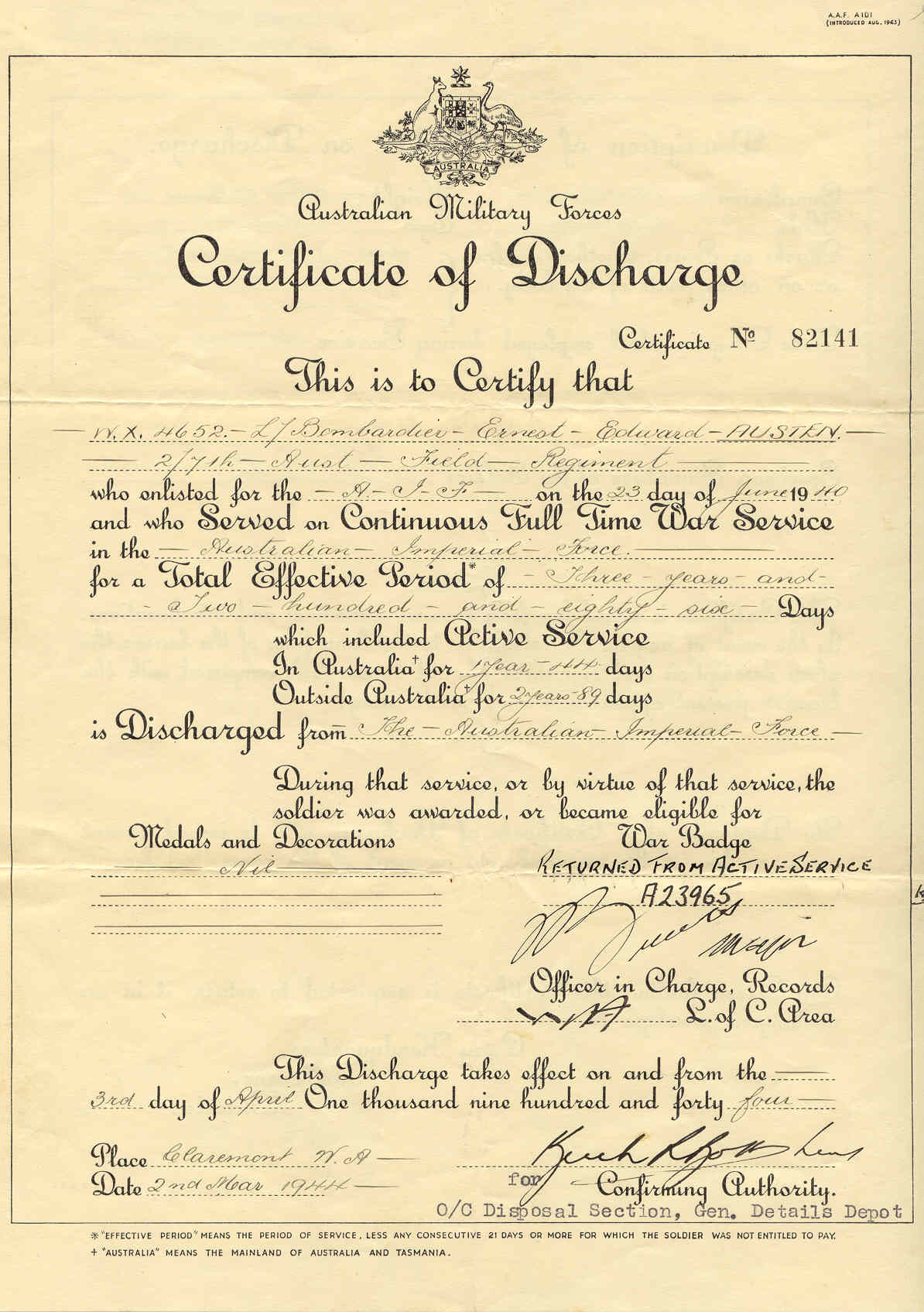
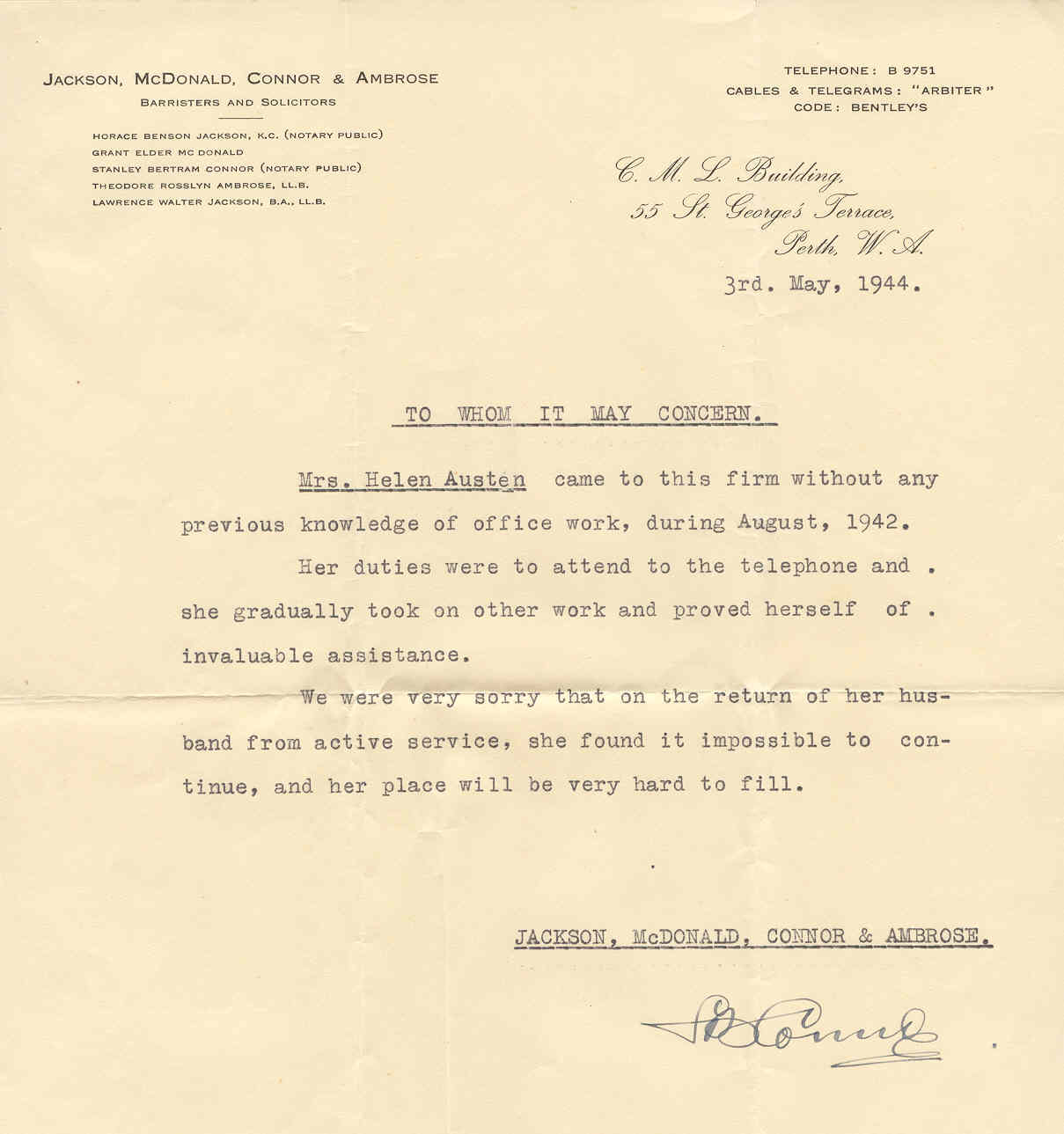
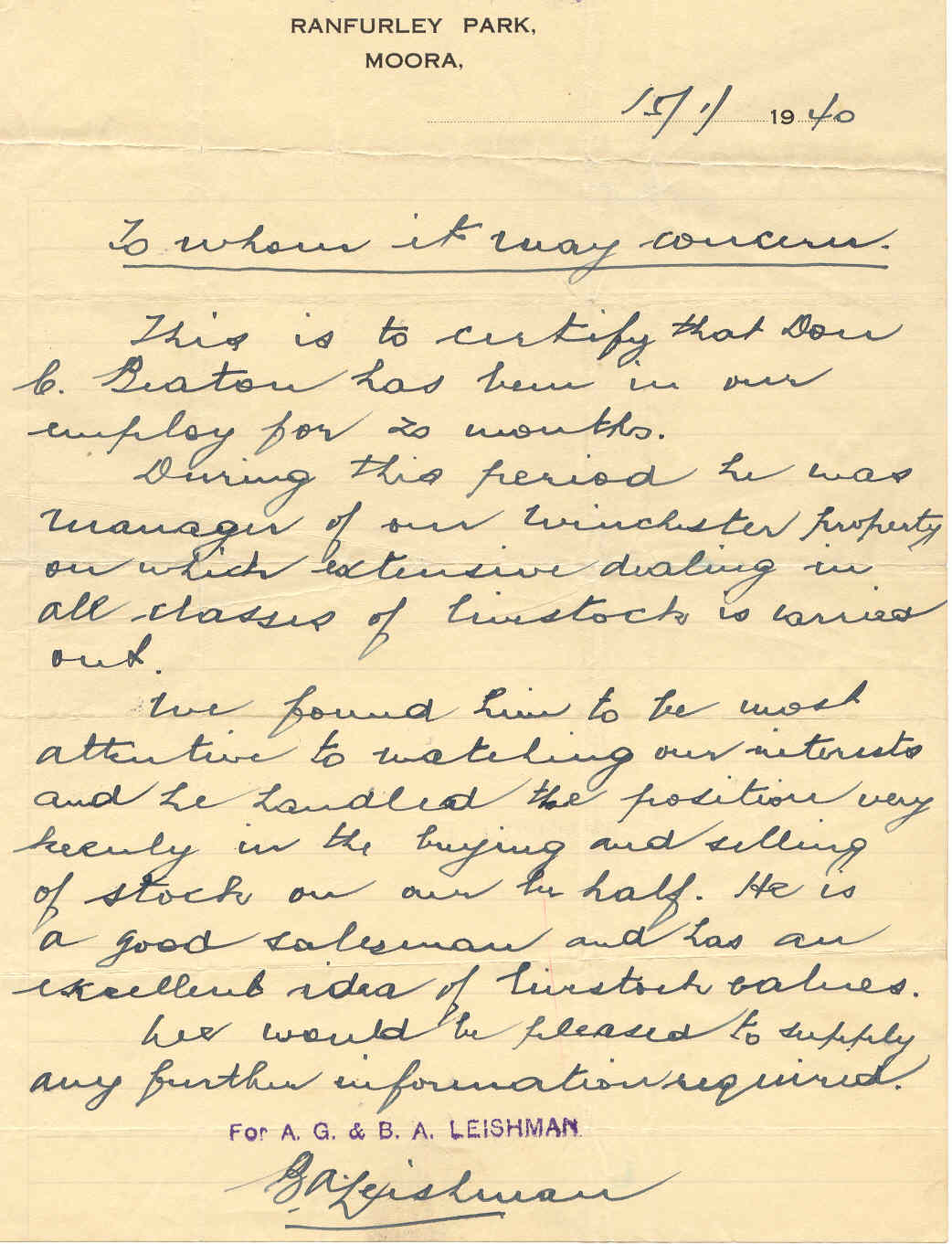
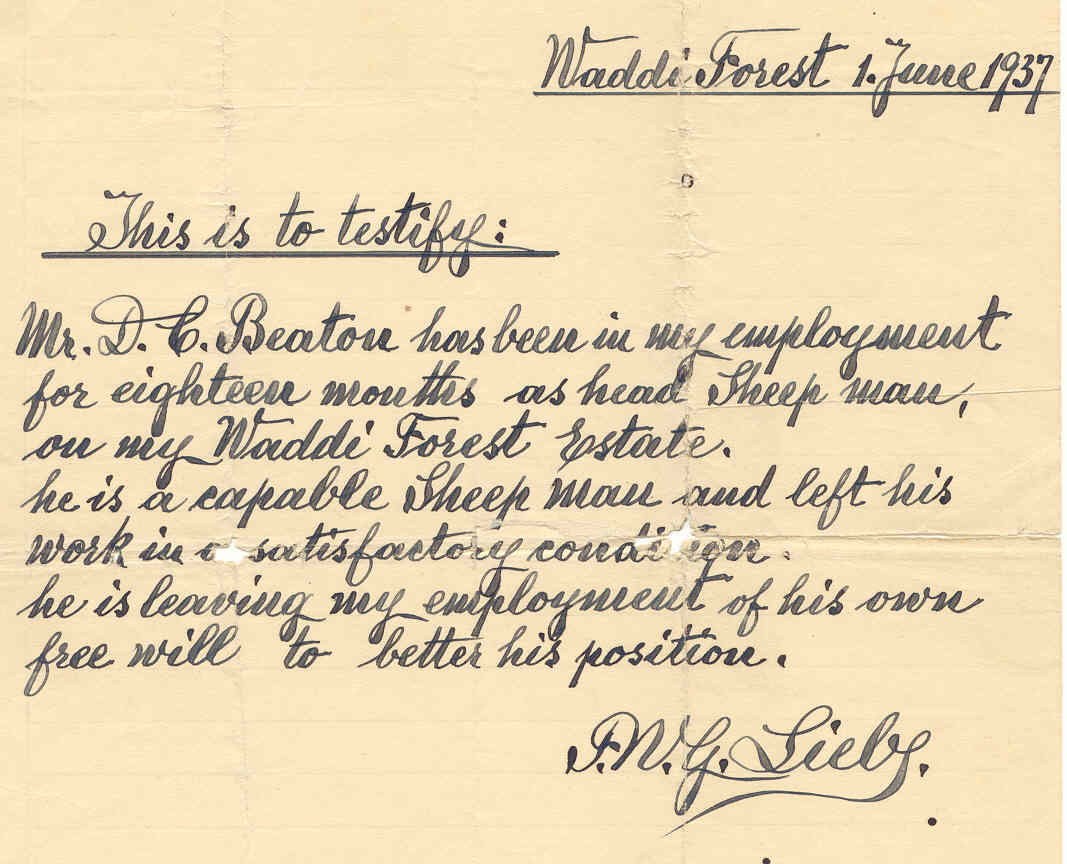
Ernest AUSTEN enlisted on 23.6.1940 His number was WX 4652 2/7th Australian Field Regiment Training at Northam Served in Australia for 1 year and 44 days and Outside Australia for 2 years and 89 days. Rank of Lance Bombardier Discharged on 3.4.1944 Helen was listed at three different addresses in Ernests’ pay book over the period of his service. They were Flat 6, 1320 Hay St, Perth , 48 Outram St, W.Perth, and 4 Richardson St, W.Perth. After the war Ernest completed his “Sheep and Woolclassing Certificate” through the Australian Army Education Service on 21st March, 1946. He then worked for Dalgety’s at the Woolstores in Fremantle until his retirement. During the War Helen was employed by Jackson, McDonald, Connor & Ambrose, Barristers and Solicitors, CML Building, St Georges Tce,Perth. On resigning in May, 1944 she received this reference.
Certificate of DischargeReferee report helen
Book page 279
Helen, Pan and Ernest, 14th July, 1956. Applecross. W.A. In 1946 Helen and Ernest bought a half acre of land at 122 Matheson Rd, Applecross for £80 ($160) and Ernest and Pan went out there every weekend to clear the block. They lived in the house built there until moving to Sydney in 1960 to join their daughter, Pan and her husband Warwick Falck who had moved there with Warwick’s employment. Missing their two grandsons, Helen and Ernest decided to follow and never returned to live in the West but their residence in New South Wales was called “Thundelarra”. Helen with Pan. At Thundelarra and Badja Stations
Helen with Pam Thundelarra and Badia StationsHelen with Pam Thundelarra and Badia StationsHelen and Ernest 1956helen Pam Ernest 1956
Book page 280
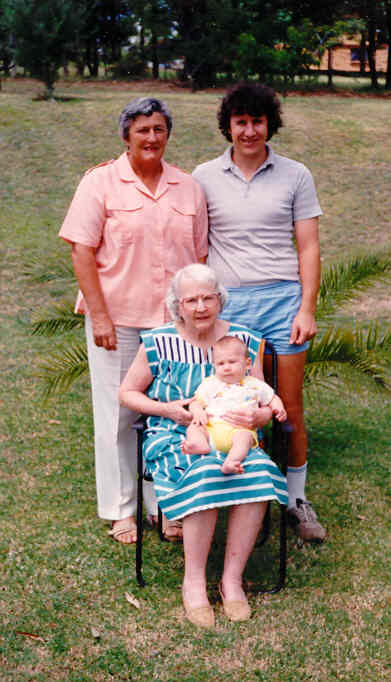
Helen May Born: 14th November, 1907 at Marine Tce,Geraldton Married Ernest Eichhorn (Austen) on 14th June, 1933 at Thundelarra Station. Service by Frances C. Dixon ,Priest of the Church of England. Born 2nd October, 1901 in Perth Parents:Lorenz Machal Eichorn and Nellie (Austen) Died:4th March, 1971 in the Repatriation Hospital, Concord. NSW. Children : Pan born on 6th April, 1934 at Tresillian Hospital, Perth. Helen passed away on the 12th April, 2002 at 94 years of age. Pan married Warwick Thomas Falck on 14th July, 1956 at Applecross. Children: Rodney Warwick born 7th May, 1957 in Perth W.A. Married Lynette Carol March On : 1st February.1980 at St Swithun’s Church, Pymble Children: Anthony born 10th July, 1987. Mia born 4th December,1990. Terry Thomas born on 6th July, 1960 at Hornsby. N.S.W. Four Generations Pan and her son Rodney, standing, Helen seated nursing her great-grandson, Anthony.
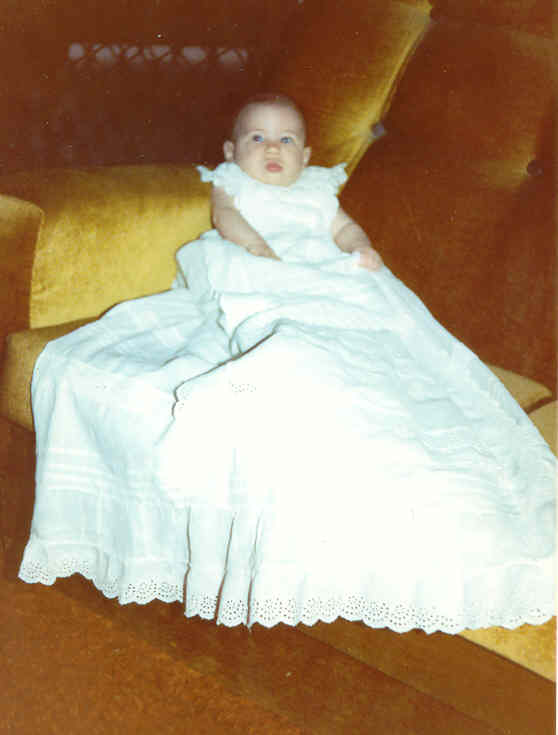
Mulgoa, N.S.W. December 1987. Helen’s great-grandaughter Mia in the christening gown made for Helen by her Aunts Ann and Nell in 1907.
Four Generations Pan and her son Rodney, standing, Helen seated nursing her great-grandson, Anthony. Mulgoa, N.S.W. December 1987.` Helen’s great-grandaughter Mia in the christening gown made for Helen by her Aunts Ann and Nell in 1907.
Book page 281
Donald Charles Beaton
Donald Charles Beaton
Donald Charles Beaton was born on the 6th July, 1910 the second child and eldest son of Don and Irene spent all his young life on Thundelarra only leaving to attend school . A boarder at Guildford Grammar School, his records show the following: House: St George’s Entered : 1919 Left : 1926 Form V Scholarships and Exhibitions : Choir Sport 1st Teams Sports Colours 1st XVIII 1st XVIII ATHLETICS ATHLETICS SHOOTING Academic Prize Physical Training Prize 1923 - Level 111A 1925 1926 1925 1926 1926 FULL - FOOTBALL FULL - ATHLETICS Henn’s House, Guildford Grammar School, East Guildford, W.A. 3/5/40 To whom it may concern, Donald Charles Beaton came to Guildford Grammar School (Preparatory School) in 1919. He transferred to the Senior School in 1923, and left at the end of 1926. During this period his work covered the usual school curriculum : though he passed no public examinations, he left the school from the 8th Form, and was doing Leaving Certificate work, having done the Junior Certificate course.
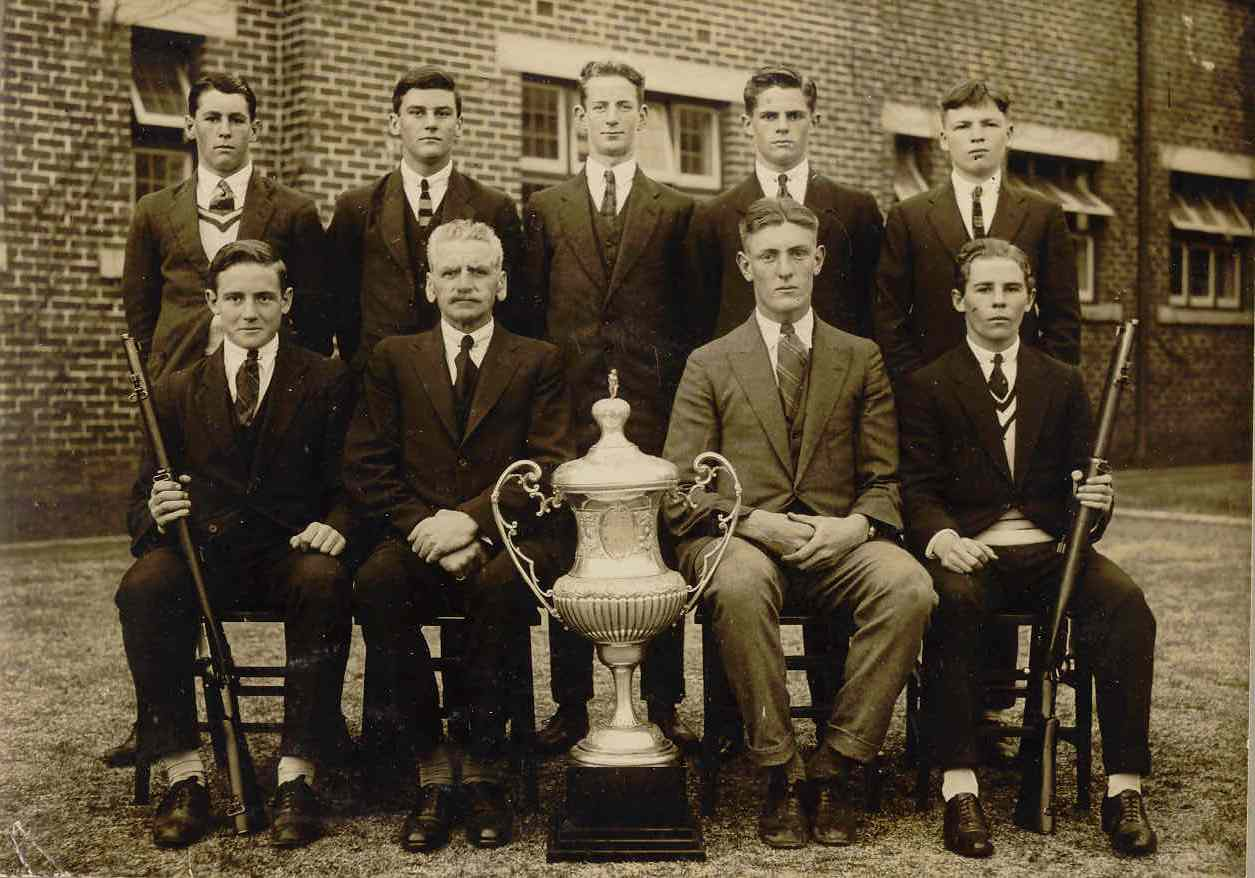
He is not lacking in ability, & I have no doubt that he could have passed the Junior Examination in the usual subjects (Mathematics, Physic’s etc); but his interest was in station life, & examination results seemed to him, of little importance. Mr Beaton took his full share in the life and activities of the school, & distinguished himself on the playing fields, representing the School in Cricket, Football, Shooting & athletics, besides being the best boxer of his time. His conduct and general character were alike good. The present Head Master took charge of the school in 1928, & has no personal knowledge of Mr Beaton, who therefore applied to me for a testimonial. His school career showed that he is capable of loyal and efficient service, & I have no hesitation in giving him my personal recommendation. D.M.Collison Senior Master, Guildford Grammar School. Guildford Grammar Shooting Team.1926 Standing Left: Don Beaton,T Hammand, K.Rae,T.Hardie,R.Darragh.
Seated Left:O.Fry, G.Douglas,John Lefroy,I Matson. Don holding Duncan
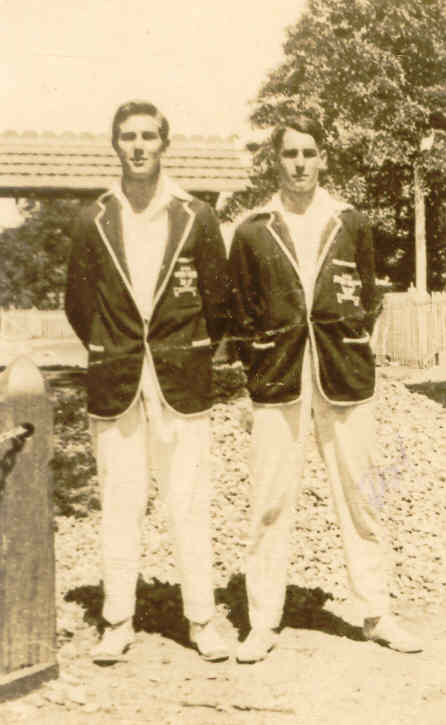
Don hoding DuncanDon on right, in cricket gear.Guildford Grammar Shooting Team.1926 Standing Left: Don Beaton,T Hammand, K.Rae,T.Hardie,R.Darragh. Seated Left:O.Fry, G.Douglas,John Lefroy,I Matson.
Book page 282
In later years a State Governor recounted stories of the fine time school mates had when holidaying at Thundelarra. Smoke filled rooms where card games went into the wee small hours, and drinking of course. The journeys home on the train with all the young people of the district cemented friendships and love of their way of life. First Don and then his brother Duncan both managed Thundelarra Station for periods of time during the 1930’s. Don continued with Station and Farm management around the Mid-West area. He married Amy Michelle (Micky) Dyke 1937.
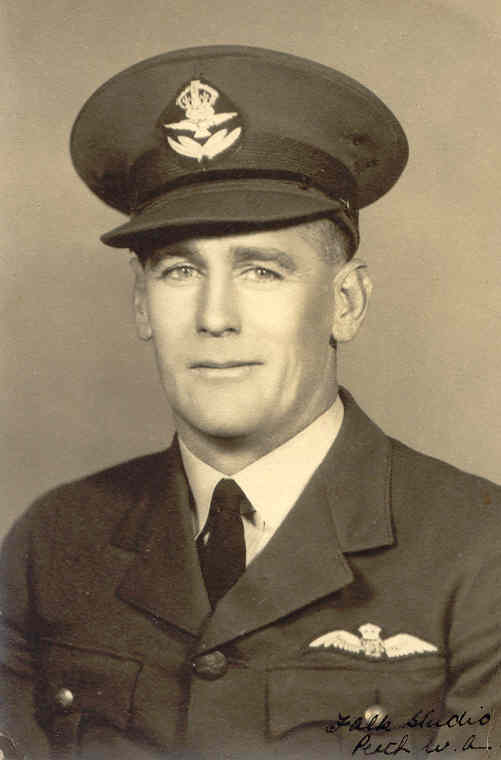
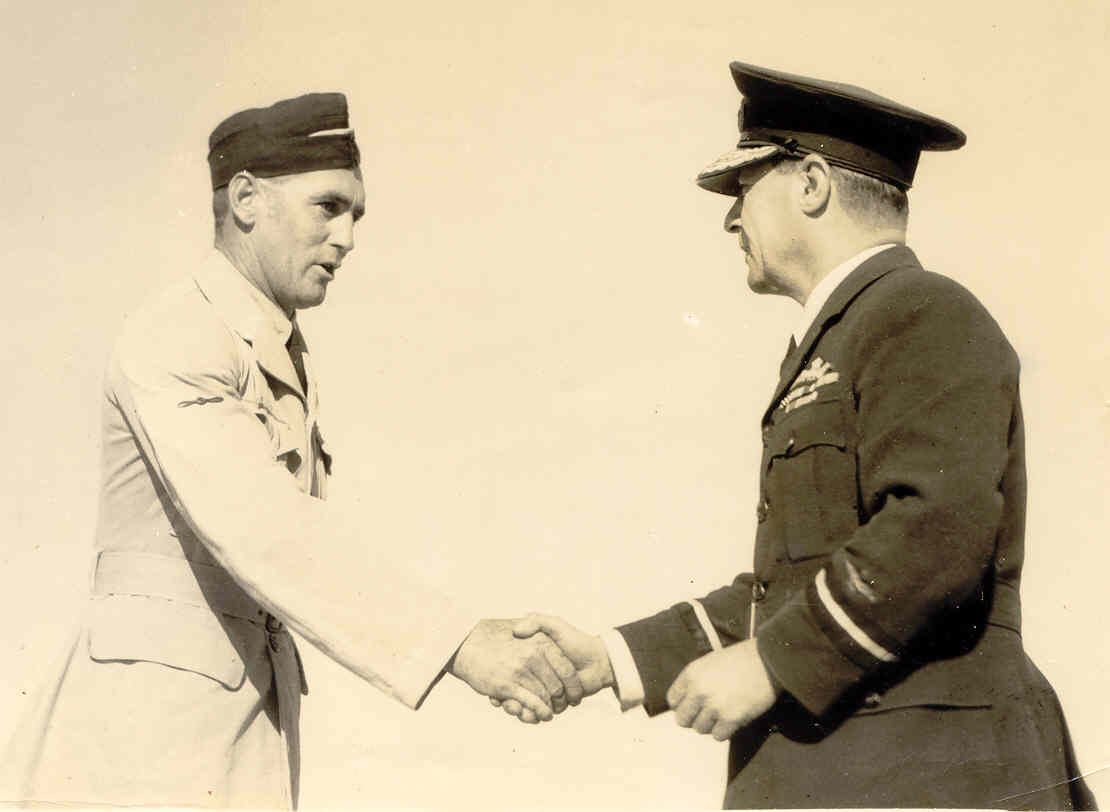
Referee Report DonReferee Report DonMickyFlight Sergeant Donald Charles BeatonDon receiving his wings at Cunderdin Air Base..
Book page 283
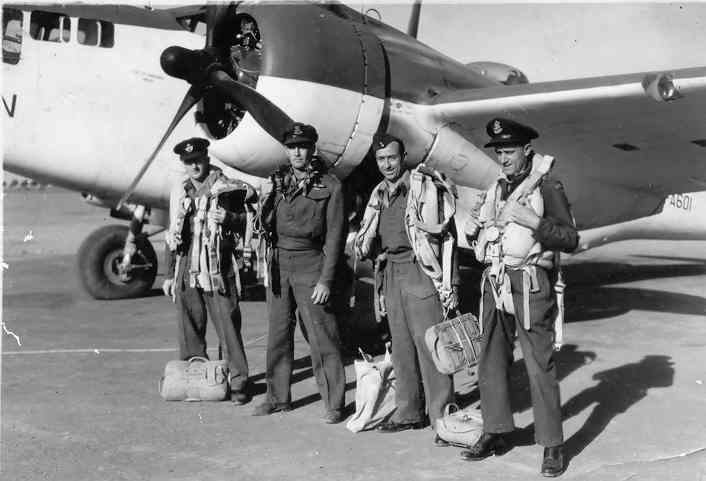
War was declared and although Don was over the age of enlistment as a pilot, the ex-WW I man in charge of enlistments was well known to Thundelarra and so - he got in and went on to win the DFC. Canberra Archival papers reveal : Donald Charles Beaton enrolled in the Royal Australian Air Force Reserves on 25th June, 1940. He listed himself as a Station Manager, truck driver. Residential address was 27 Havelock St, West Perth. Business address: Thomsons Ltd , Hay St, Perth. Over the war years Micky’s address was given as “Varsity Flats”, Nedlands, Geraldton and Kellerberrin. His enlistment papers for the Royal Australian Air Force are dated 11th November, 1940. Description as Age 30 years 4 months Height 5 ft 11inches Weight 155 lbs Chest Measurement 33 ½ / 37 ½ Complexion :Dark Eyes : Grey Hair : Brown Religion: Presbyterian Don was appointed to No.5 Initial Training School, Pearce, W.A. Service Number : 406370 Flying Badge 2/5/41 Discharged from the R.A.A.F.
“on being granted a commission” 1/7/ 41 ASFTS 46/41 No 8 Aircrew Course 26.6.41 Pass 4 SFTS 47/41 Rank L.H.C. Character V.G. Aircrew P 7/7/41. Aircraft flown: Lockheed Hudson, Baltimore. A report in Don’s file under, Assessing Officer’s Statement , the officer has written:- Squadron Leader BEATON has served at GRS for the past three months, first as SAO and for the past month as C.O. During this time , he has proved himself to be thoroughly reliable, and is considered to be a valuable officer. With more experience, he should develop into a sound Commanding Officer. Signed :………..15/10/45. Demobilisation: 14th December , 1945. Medals : Distinguished Flying Cross, 1939-45 Star and Rosette, Africa Star. Returned from Active Service Badge. Certificate of Service No. 14235. Don and his cousin Ron Beaton, sailed on the same ship to England, Don as a flying officer Ron as ground flight maintenance staff.
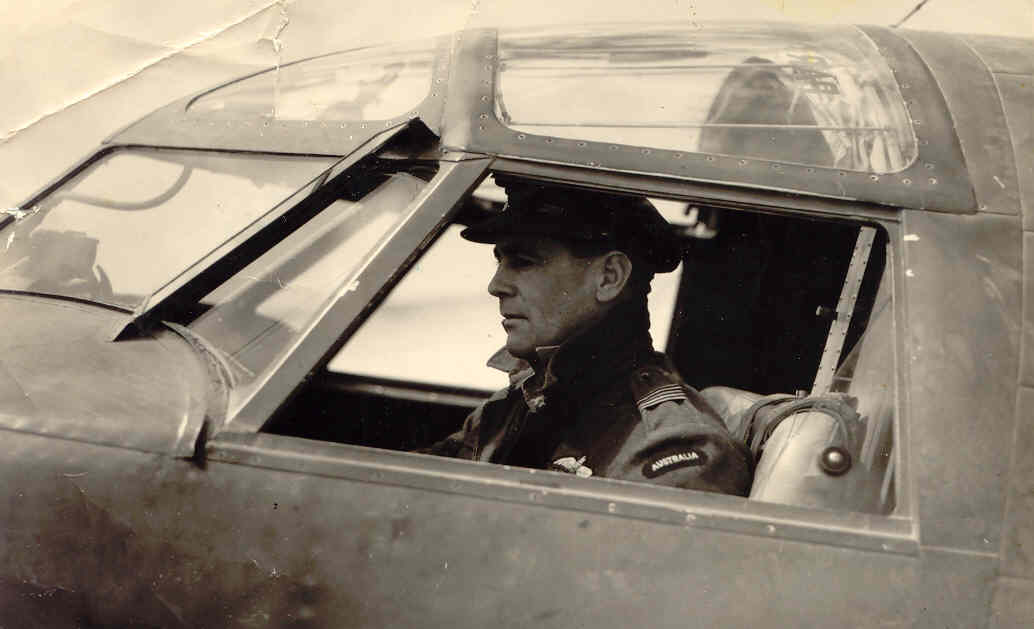
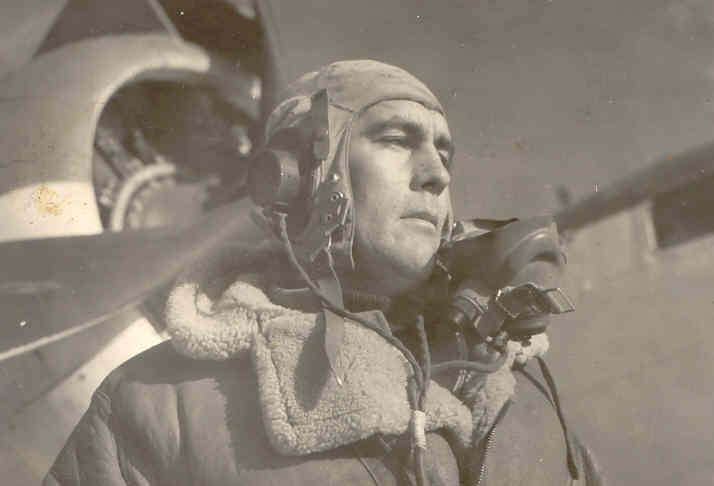
Movements: Embarked for overseas 17/7/1941 Disembarked U.K. 2/9/1941 Departed Gibraltar 14/4/1942 SORS RAF Station North Front Embarked Egypt, Disembarked Italy 26/7/44 Disembarked 1 p.d. 28/3/45 ex M.E. Reason for return Cat “A”. Attachments : 233 Sqadron, H.Q. RAFME, R.A.A.F. HQ(DT). Don completed the No.1 GD Officers Senr. Admin. Crse held from 19/5/1945 to 8/7/1945 and held the rank of Squadron Leader and S.A.O from 10/7/45 and C.O. from 20/9/45 . Ready to fly.
Don in CockpitReady to FlyReady to Fly
Book page 284
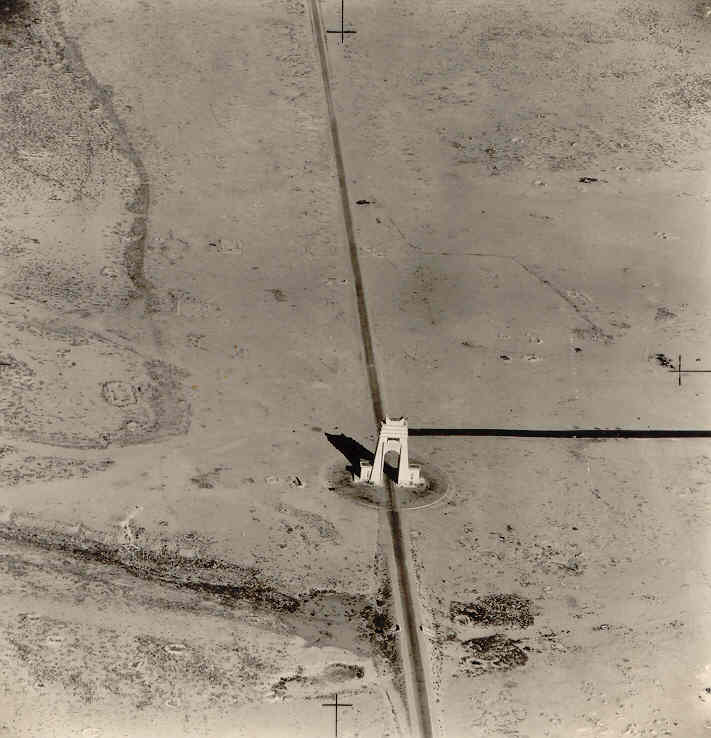
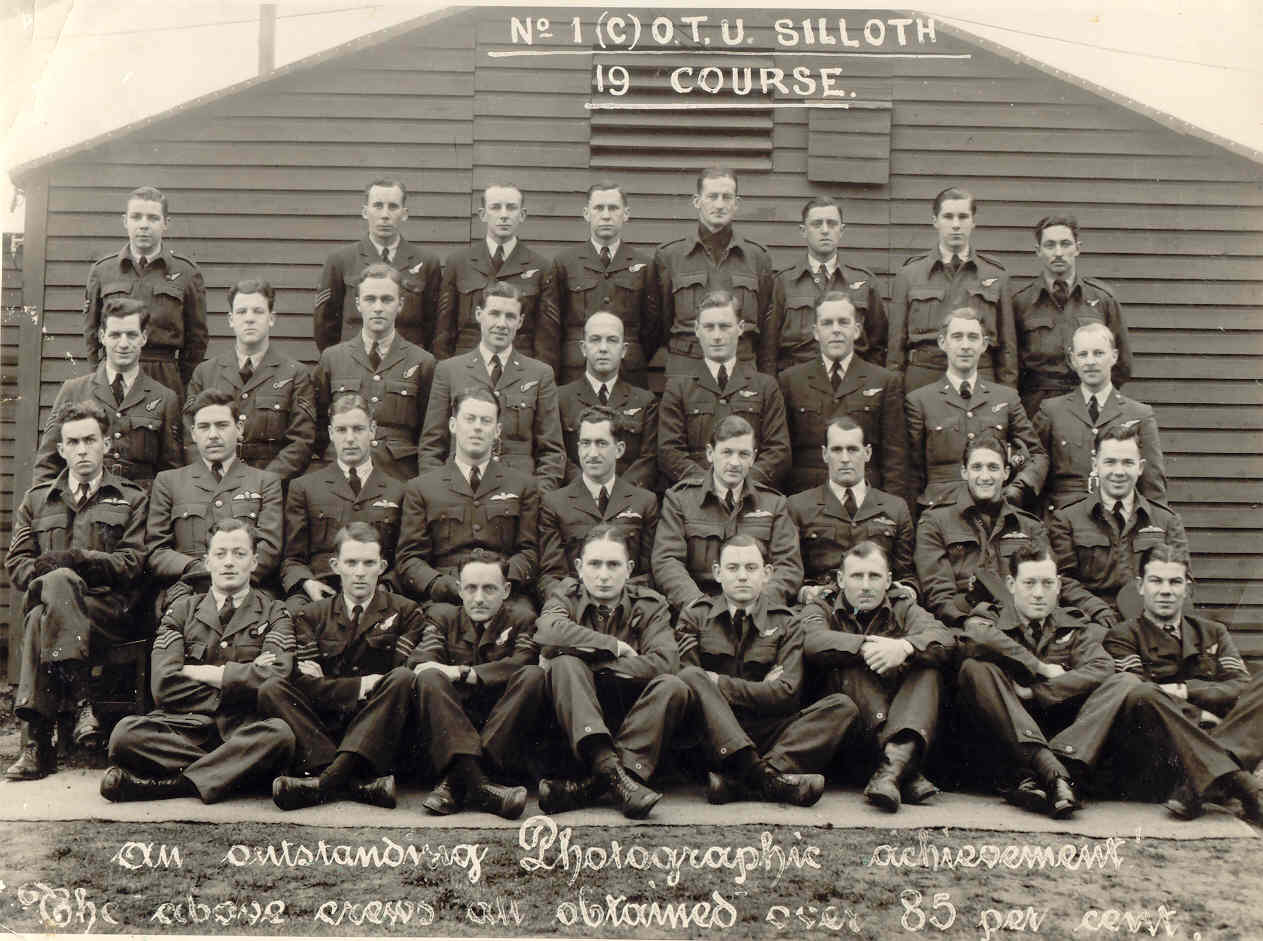
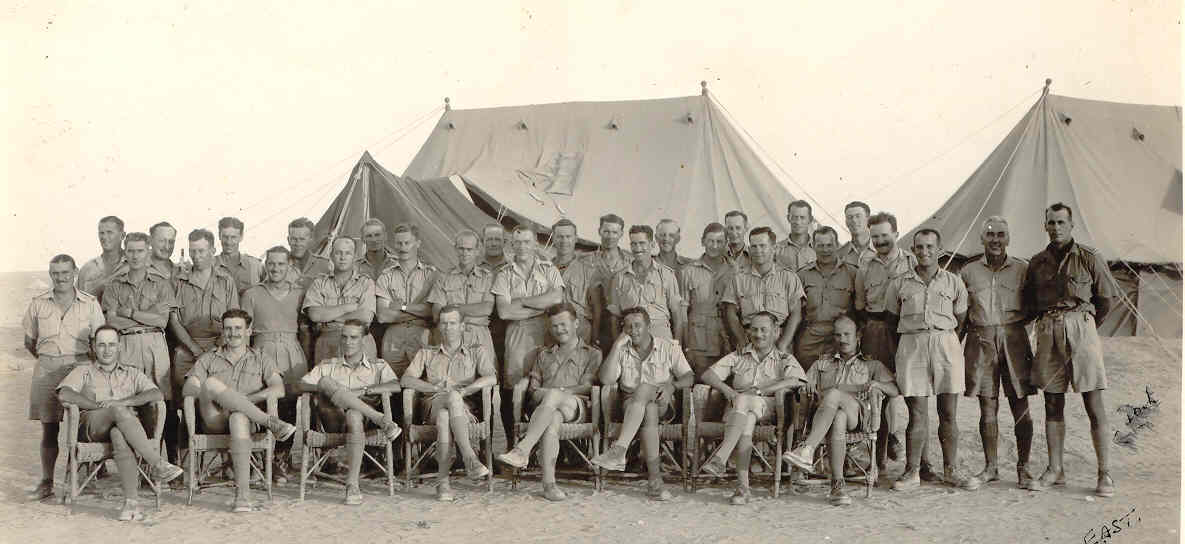
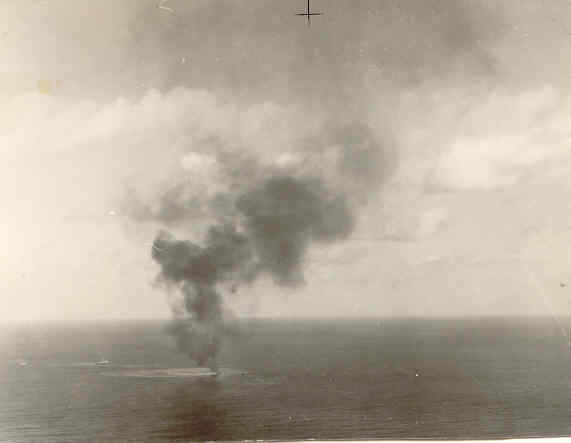
Don, third from right, second row. Cunderdin . Above and below : Marble Arch in the middle of the desert. In the desert. Don is standing on the right. Aerial Photo of burning ship. Believed to be the bombing for which Don received the DFC.
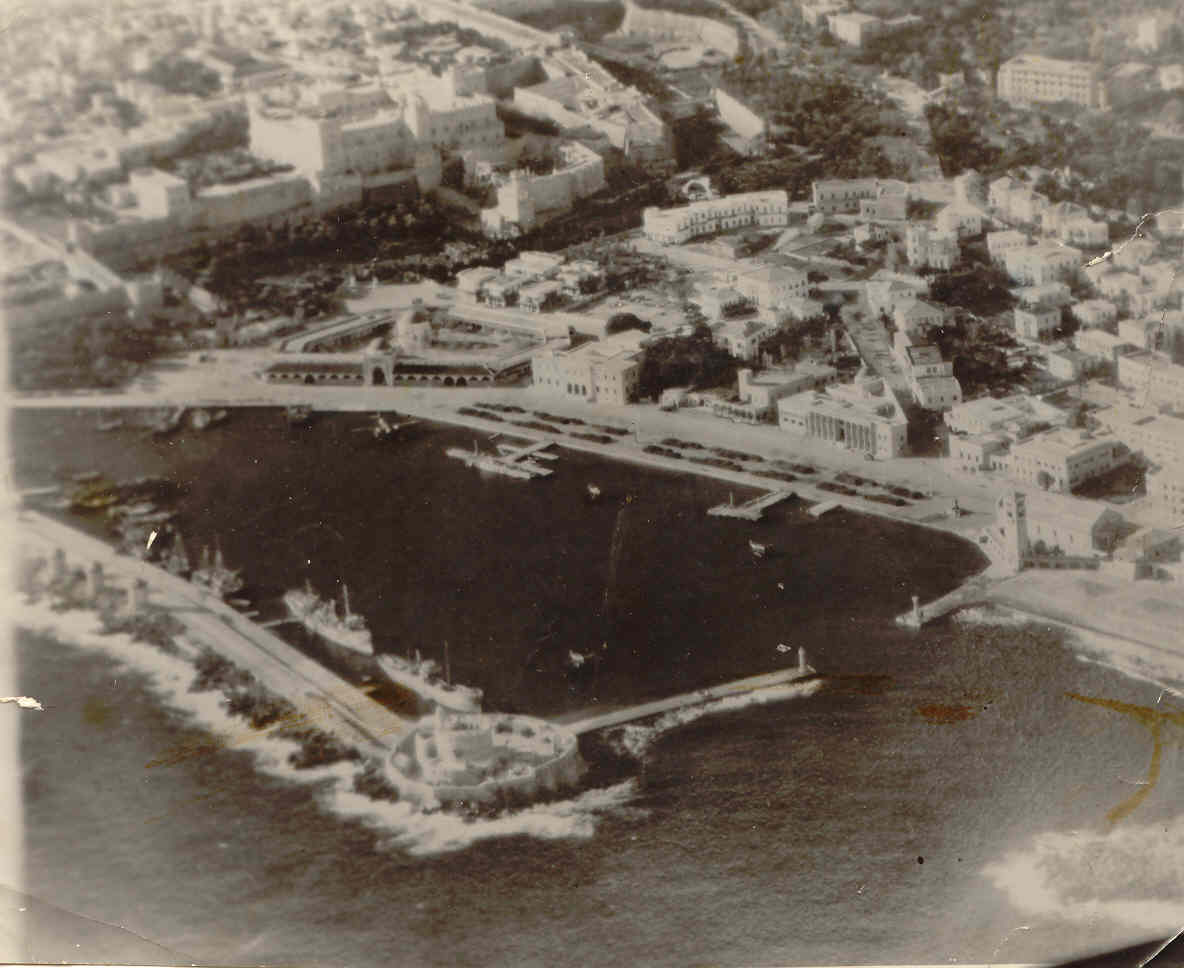
Marble Arch in DesertDon third from right second row CunderdinIn the desert. Don is standing on the right.Marble Arch in DesertRhodes Harbour in enemy hands.Aerial Photo of burning ship. Believed to be the bombing for which Don received the DFC.
Book page 285
Undated Newspaper cutting under the Heading WA Pilot Bombs, Hits Destroyer. Daily News Correspondent John A. Hetherington. CAIRO, Thurs - Most notable single achievement of any pilot in an R.A.A.F. Hudson bomber squadron which has just come out of the desert for a rest was by West Australian Pilot Officer Don Beaton. He is credited with having probably sunk an enemy destroyer-“probably” because nobody actually saw the destroyer go down. There is little doubt that the destroyer is now at the bottom of the Mediterranean. Pilot Officer Beaton was patrolling 20 or 30 miles from Tobruk when he came on two enemy transports which were ablaze after an attack by British bombers. He cast about seeking other units of the convoy and sighted two destroyers. They opened up on him but Beaton dived down and went in against one in a swerving attack. He released his bomb load whenflying just sufficiently high to enable his Hudson to clear the destroyer’s funnels.“There was a terrific explosion and a burst of flame,”Wing Commander Keith Hennock, who commands the squadron, told me.“The fire could be seen from 30 miles away.” Pilot Officer Beaton was in the news recently when reports of successful attacks he had made on enemy barges operating along the Libyan coast were published.
He is a son of Mr and Mrs D.Beaton of Varsity Flats, Nedlands, and brother of Sergeant Duncan Beaton, also in the R.A.A.F.and now at a northern operational station. Don Beaton was born at Thundelarra Station, Murchison, educated at Guildford Grammar School and is well known in pastoral circles in Western Australia. He is married, with two young children. A Unique Record Although the Carnamah Football Club, towards the latter end of it’s existance was nearly always “scratching” to get a team, it never the less holds a record which is possibly unique to any football club in the State. We refer to the fact that Don Beaton and Alan Forrester, both of whom were playing members of the club at the same time, have been awarded the DFC. This is an achievement of which the club will no doubt be justly proud when it is reformed after the war. A newspaper clipping from one of the Mid-West papers given to me by Alan Forrester.
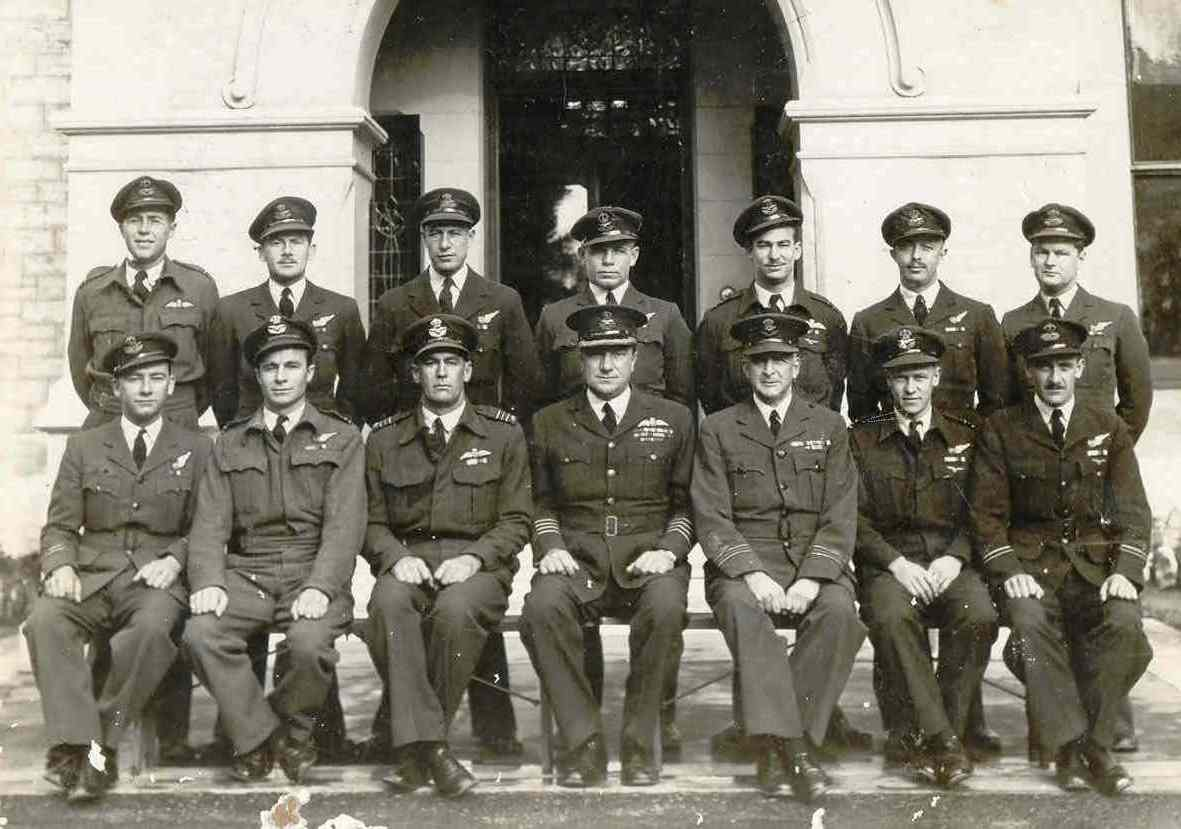
He remembered Micky teaching him to play the violin and piano. Bairnsdale, Victoria. Don, O.I.C.,third from left, front row.
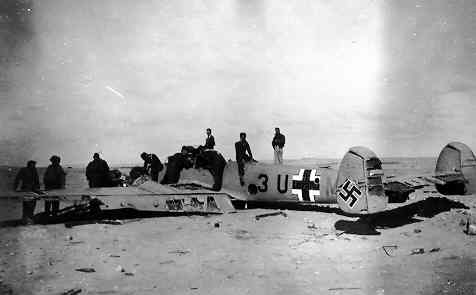
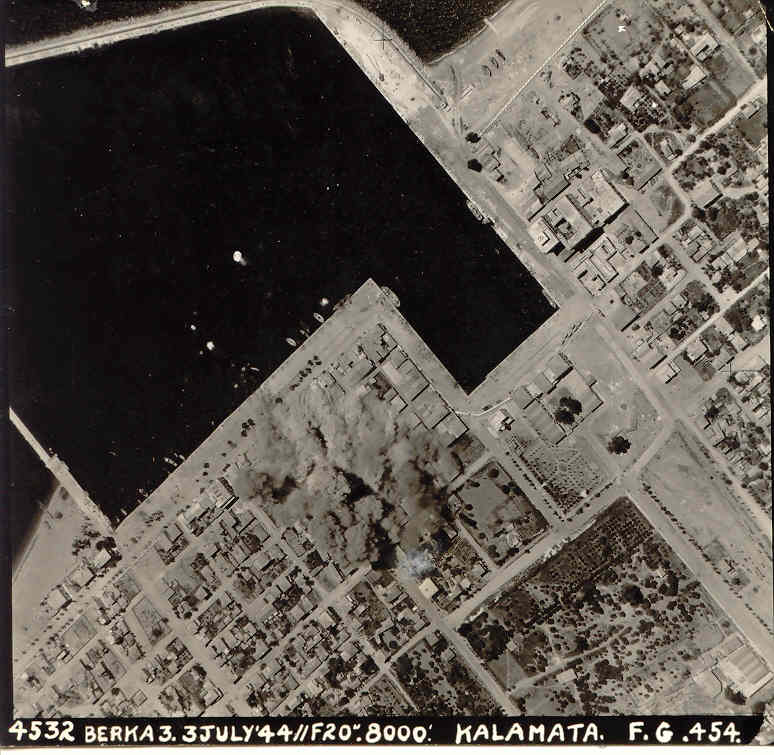
Downed German plane.Bombing at Kalamata Harbour 3rd July 1944.Bairnsdale, Victoria. Don, O.I.C.,third from left, front row.
Book page 286
Wing Commander D.C. Beaton, DFC.
Wing Commander D.C.Beaton, DFC. 1919-1926 From “For God King and Country ”by Peter Firkins. The Wartime Records of past students from Guildford Grammar School. Don’s story was written by his son, Bruce. Born at Yalgoo in July 1910, Don was brought up on Thundelarra Station, a property of 600,000 acres in the North West outback on the Murchison River between Cue and Paynes Find, which came into the family after Don’s grandfather, Alexander Beaton made a hugely rich gold strike at Nullagine in the 1890’s. Don’s early life was taken up with riding horses to swim with his younger brother and sister in the long river pools, herding sheep with dogs and enjoying the almost feral freedom a small, strong boy has in sheep station life. Guildford Grammar must have come as a massive culture shock to young Don when, aged 8, he became a boarder at the Prep School in 1919. The old fashioned, strict school rules along with living in a boarding house were such a contrast to his early freedom.
Yet, at the same time it added the overlay of discipline and team consciousness which was to be so useful to him at important times in years to come. He also learned impeccable table manners which continue now, as a family trait, down the generations to his grandchildren. He entered Henns House in the Senior School in 1923 and took part in all aspects of school life. he passed no public examinations. The Senior Master of the time, Mr D.M.Collisson wrote of his academic work: “He is not lacking in ability, and I have no doubt that he could have passed the Junior Examination in the usual subjects (mathematics, physics etc) but, his interest was in Station Life, and examination results seemed, to him of little importance….” The “Nor Westers” were known as a tough lot at Guildford and Don distinguished himself winning medals on the playing fields, representing the School successfully in cricket, football, shooting and athletics.
He was the best boxer of his time and won a gold medal for boxing in 1922. His close friends in these years included Wallace Kyle. Don left school in 1926, aged 16 to return to Thundelarra where he began working as a stockman under the management of his father “Old Don”. After three years he was appointed overseer, then manager. His time as manager was during years of severe drought in the area. He left the station in 1933 when his younger brother Duncan was ready to take on the manager’s role and went to work in the agricultural area of W.A., first as manager of a mixed wheat and sheep farm, then as a specialist livestock manager breeding, buying and selling sheep. In 1937, he married Michel at Geraldton and his first son, Gregory was born in 1940. Although he was a farmer and therefore in an exempt occupation, in October 1940 he joined the RAAF. Flying school saw him at Pearce, then Cunderdin then Geraldton.
Commissioned from flight school as a Pilot Officer, he embarked for the war in Europe in early 1941, leaving his wife pregnant with their second son, Bruce, who was born in April 1942. In England he trained at Blackpool for four months on aerial photography and ‘shipping control’, then was posted to 459 squadron for a tour of duty in North Africa as a flying Officer. From North Africa he flew missions as the captain of a Lockheed Hudson bomber over the Mediterranean and African coastline. The task was to photograph strategic locations such as ports and fortifications on the coast and search for and, where possible, destroy enemy shipping. This was the era when the North Africa land battles for Tobruk and El Alamein were being fought with the German forces led by General Rommel and the Allies by General Montgomery. During early 1942 Don’s crew sighted two armed enemy ships laden with ammunition and supplies approaching the North African coast.
He made two very low bombing runs, risking his aircraft and crew, but, sinking both ships whilst under heavy aircraft fire. For this he was decorated with the Distinguished Flying Cross, which he received from King George V1 at an investiture at Buckingham Palace. Acting Flight Lieutenant DC Beaton, attached to No.459 Squadron was awarded the DFC on 29 December 1942 the citation reading: In January 1943 he was promoted to Squadron Leader and posted to reconnaissance and anti shipping duties in 454 squadron in the Middle East generally and later based in Italy. In the role he prepared many young men for flying duty and saw significant numbers of them killed in action. A very sensitive intelligent man, he was haunted by the certain knowledge that his effective reconnaissance efforts resulted daily in the death of many from the bombing raids he helped to plan. Around this time he began to drink more alcohol, as did many others, to help dull the loneliness of being away from his family and the distress was brings.
“This Officer has displayed exceptional courage and initiative. One morning in September 1942, he attacked an enemy destroyer near the North African coast. Despite intense opposing fire he pressed home his attack, obtaining hits which caused a large explosion followed by a fire. In air combat, Flight Lieutenant Beaton has destroyed two enemy aircraft. His excellent leadership and unfailing devotion to duty have set a fine example.”
Book page 287
His tour of duty in Italy ended in November 1944 and after a brief period at RAAF Middle East Headquarters he was posted back to Australia to Bairnsdale (Victoria) where he arrived in March 1945. At Bairnsdale, after several months training, he was quickly promoted to Commanding Officer. He left the Air Force from this position in December 1945 and returned home. Back in Western Australia Don applied for a grant under the War Gratuity Act (1945) and secured two and a half thousand acres of good wheat and sheep farming land close to the town of Northampton. The property had been allowed to run down by the previous owners and there was a broken down weatherboard house, no farm machinery or tractor and no stock. The bathroom, laundry and toilet were all dirt floored and out in the yard. Lighting was from kerosene lamps and candles. Transport was an aged 1920’s Ford T utility. The first year he seeded and harvested five hundred acres of wheat using a team of ten Clydesdale carthorse horses, animals unwanted by another farmer.
After the war, commodities prices began to rise and the wheat crop was good. The profits from the first crop were invested in an ancient Fordson Major tractor, an old, but real truck and the luxury of a 32 volt electricity generator. The ice box and the ‘Coolgardie Safe’ were replaced with a kerosene powered refrigerator. Don and his family prospered on the farm. He was the most senior officer from the armed forces in the area and always marched at the head of the Anzac Day Parade. Within three years he added another two thousand acres of leased land, stocking it with sheep and cultivating wheat in rotational cropping. He used innovative farming methods such as contour ploughing to stop washaway of soil; he selectively bred and traded merino sheep to improve stock quality and let part of the land to market gardeners for tomato cropping. The old house was renovated with a proper bathroom and a fireplace in the sitting room.
A small house was built for a permanent hired hand. A brand new 1949 Standard Vanguard car became the family transport. Don sold the farm in 1950 for a good profit and moved to live in Perth. In 1951 Don was appointed Deputy General Manager of the DeGrey River Pastoral Company. The company produced both cattle and sheep. In this position he managed Mulyi Station, inland from Port Hedland, with the task of improving the sheep and cattle stock through a planned breeding program. Family life on the station was fairly easy going. Endless strings of hot days punctuated with repairing windmills, moving sheep, catching, riding and releasing horses, sleeping in the heat of the afternoons to rise to the fresh air of the late afternoon and evening. About each three months there was more excitement from a major event like a trip to Port Hedland - it took a whole day to travel 100 kilometres -, the annual race meeting at Marble Bar - three days of partying - or the annual cattle muster.
In this period it became increasingly apparent that alcohol was taking a heavier toll in his work life and in 1952 he left Mulyi to take the family back to Perth so his two sons would have better access to education. For the next three years Don worked as a real estate valuer and salesman, particularly of rural properties. He valued and sold leases, agricultural freehold and conditional purchase wheat and grazing land, baby beef, dairy and irrigated cattle country, tracts of virgin plain and forest, orchards, vineyards and banana plantations. His next work was as a surveyor with the Hill 50 gold mine at Mount Magnet where his Air Force navigation training gave skills which were essentially those required in surveying. He did surveying field work and the underground survey work peculiar to mining. In 1957 he began work at Port Hedland Airport managing the airport stores. He lived in Port Hedland again with his wife, Mick, and took a keen interest in community activities, pioneered the building of Port Hedland’s first basketball court and the founding of it’s first teams.
The court surface was made from pounded termite nests. Play was in the cool of the night; lighting being constructed from anything that was available. This was the period when rapid, substantial development of the North West minerals and gas was happening. There was little on site media reporting so Don became, part time, the Port Hedland journalist for the West Australian and the ABC. He reported on the expansion of Port Hedland Harbour, the developments on the continental shelf and made one of the first calls when Port Hedland was connected direct to Perth by telephone. He left Port Hedland in 1962 for a series of farm management jobs which lasted a few years each, and settled for periods on farms at Mingenew and Bindoon, finally moving to manage a small baby beef property at Pinjarra. In mid 1966 he became seriously ill with leukemia which was attributed to exposure to chemicals during the war.
He was sent to Hollywood Repatriation Hospital where his illness was recognised as terminal. He died in the presence of his wife and two sons on May 14 1967. He was 57 years old. Don was brought up in the North West outback to be tough and Guildford Grammar probably smoothed his rough edges, showed him how to work in a team and also taught him very good manners. Going back to the station, and soon station management when he left school, he moved on in his twenties to have a broader view of agricultural life. his years in the Air Force, in spite of the horrors of war, were probably his finest. Serving his country in air surveillance, he was decorated for outstanding bravery and promoted to positions of higher responsibility. The cost, however, was very high. After the war he returned to the rural life he had always known and worked largely with livestock or related agriculture. It seemed though that he never really settled again, moving on from each new opportunity after a few years, with a progressively increasing problem of ill health.
In 1996 we recognise this behaviour clearly as the untreated consequences of chronic stress resulting from the trauma of war. Don was cremated at Karrakatta in May 1967. His eldest son, Greg, spread his ashes on a long pool in the Murchison River near Thundelarra in the station country that Don loved . MICKY BEATON Excerpt from ‘Unsung Hero and Heroines of Australia’ written by Susie Baldwin. Printed in 1988 by Greenhome Publications for Bi Cenntenial Authority.
Book page 288
Is there an Aboriginal problem? “Yes. There is also a white problem.” What’s the problem ? “People.” Mrs Michelle Beaton, District Officer for the Community Welfare Department in Geraldton was reminiscing on her impending retiremement. Recently more than 80 people from as far away as Onslow and Perth had gathered in a Geraldton Motel to farewell a woman whose business has been people. The speeches flowed with the tears - with the latter giving the more eloquent testimony. Mrs Beaton, known from Moora to Meekatharra as “Micky”, joined the former Native Welfare Department in 1964 when mature married women were a rarity in the workforce. Particularly so in the bush when the job (as Female Welfare Officer) required long periods alone in difficult situations far away from towns and settlements. The interviewing officers of the department were impressed with Micky’s personality, dedication and qualifications, but not with her age and marital status.
As the grazier’s and farmer’s wife she knew the bush and it’s people backwards. She had worked in the city and the country, from the Pilbara to the South West. Specifically she knew Aborigines and they knew her. In good public service style, Micky was told that the department intended to look for somebody younger and single. If they couldn’t find an appropriate person, say in six weeks - they would offer her the job. Micky responded with the acid observation that the opportunity to see workings of government departments was indeed a lesson in itself- but not to bother with the job because she would be employed elsewhere long before six weeks expired. She walked out and went home. In those days telegrams were delivered with alacrity. The offer to start work immediately overtook her and was waiting her return. Micky Beaton, now a widow, first worked from the department’s Mullewa office. She suffered from the dust, so in traditional government style was offered a transfer to Meekatharra.
Later she moved to Moora. When the Native Welfare Department was broken up, she went to Geraldton with Community Welfare. Originally from South Australia, the daughter of a Presbyterian minister, she came to Kellerberrin in W.A. aged 9 and lived in many country towns. She married Don Beaton from Thundelarra Station in the Murchison. After the war they farmed at Northampton. One son, Bruce lives in Fremantle. Her elder son Greg is well known in the Murchison and Gascoyne where he works as a dogger. At the farewell party in Geraldton friends had collected cheques and cash totalling $1850 so Micky can take a long hoped for holiday in Greece. “It’s been a wonderful time to have been associated in welfare work,” she said. “The last decade has been most exciting. Though there are still isolated pockets of bitterness in the bush there is much more tolerance than before. Of one thing I’m certain - there can be no real progress while the reserves exist.
Proper housing is essential. How can you say - do well and become part of the community - when there is no proper house in which people can prepare a decent meal, keep themselves clean and study to better themselves? Of course there will sometimes be problems. Aborigines like to live in the open. They are friendly, warm, responsive and outgoing people. So many are now living in towns and nobody talks about the situation any longer. Aborigines are very wise people.” Micky Beaton has been supervisor of the Homemaker Scheme since it’s inception about 10 years ago. The department now employs 12 Aboriginal and white women part-time to help black and white disadvantaged families make the transition from humpy or shack to a house in town. The scheme, which was developed overseas, but suggested for Western Australia by WA University agricultural economist Dr Henry Schapper, has been an outstanding success.
“It works because the scheme does not attempt to superimpose ideas on people, but rather help clients realise their own goals as they see them,”said Micky Beaton. “It helps people gain status and self esteem as citizens. You know that there are people nine parts black who think like whites and people nine parts white who think like blacks. I often tell my Aboriginal clients that they should notice the enormous differences between the whites. A Scotsman has different attitudes, expectations and behaviour from, for example, an Italian.” What makes a good social worker ? “The ability to empathise. Training is essential, but the basic skills are never learned.”
Micky Beaton
Book page 289
Donald Charles Beaton born : 6th July,1910 at Geraldton Married : 20th August,1937 in Geraldton To: Amy Michelle (Micky) Dyke born 3rd July, 1914 in South Australia. Children: Donald Finlay Gregor born 28th August,1940 St John’s Subiaco.W.A. Bruce Alistair born 2nd May, 1942 at Kondinin Hospital. W.A. Donald Finlay Gregor (Greg) born: 28th August, 1940 Married : Glennis Smith on 9th May, 1969 in Moora Children : Sheldon Gregor Beaton born 20th February, 1972. Murray Stuart Beaton born 19th April, 1974. Divorced : 1976. Re-married : 1st October, 1976 in Geraldton. To: Maxine Egerton-Warburton born 7th May, 1955 in Narrogin. Children : Joseph Finlay born 19th March, 1978 Carnarvon. Donald Peter born 19th January, 1980 Carnarvon. Joseph Finlay born 19th March, 1978 Carnarvon. Married: Skye Richardson (b 18th Dec,1980 )9th January, 1999 Emerald Q. Bruce Alistair Born: 2nd April, 1942 Married: Jill Annette Ward on Friday August 13th, 1967.
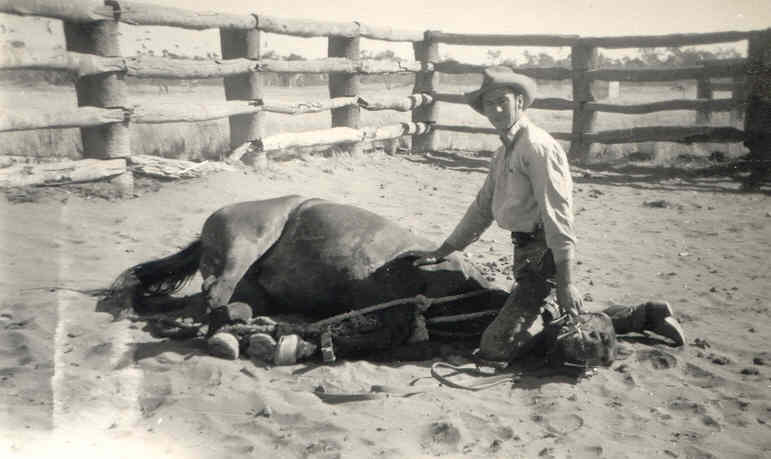
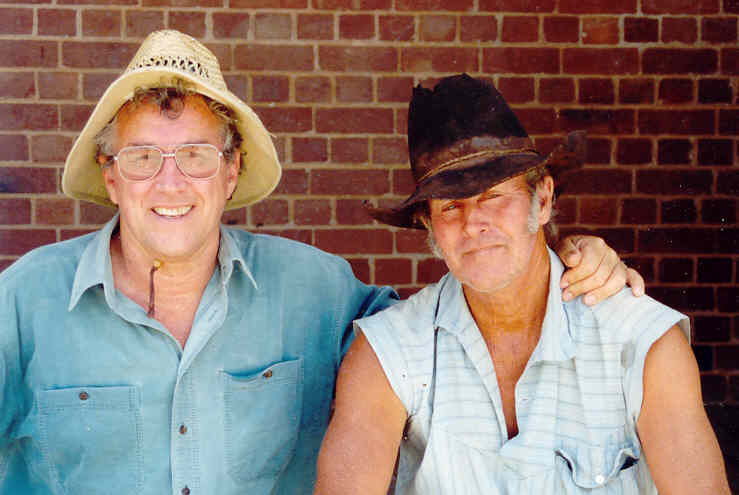
Children: Ben Chay born 3rd June, 1972. Marriage Dissolved: 1976 Partner : Penelope Joan Temperley Children :Finlay Temperley-Beaton born 3rd July 1978. Partnership Dissolved Married: Evana Alexandra Eliopulos (b 14th April, 1956 W.A). Children : Isabella Charlotte born 28th December, 1986. Antonia Emily born 22nd January, 1989. Ben Chay born 3rd June, 1972. Married : Helen McGuire on 23rd September, 2000. Children : Max McGuire born 30th March, 2000 Duncan McIntosh Beaton Duncan McIntosh Beaton was born on 26th January, 1913 at Thundelarra Station. Greg and Bruce c 1943 Classic Greg, with horses. Memories of a past career for Bruce. Bruce and Greg. Northampton School Reunion 1999
Greg and Bruce C 1943Memories of a past career for BruceMicky and DonClassic Greg with horsesBruce and Greg Northhampton School Reunion 1999
Book page 290
Duncan McIntosh Beaton
Duncan, 24th September 1917.
Duncan , 24th September 1917. From Postcard sent to his father overseas.
Register of birth Duncan BeatonDuncan , 24th September 1917. From Postcard sent to his father overseas.Duncan riding at ThundelarraHelen, Don and Duncan enjoying the waters at Thundelarra.
Book page 291
Records from Guildford Grammar School show the following: House : St George’s Entered : 1922 Left : 1930 Form VI Positions of Responsibility : 1930 Captain of St George’s House. Scholarships and Exhibitions : Choir ACADEMIC PRIZE Woolclassing (A.D.Stewart’s Prize) 1928 - Level V Sport 1st Teams 1st X1 (Cr) 1930 1st XV111 1930 SHOOTING 1930 1st X1 (Cr) 1927 1st X1 (Cr) 1928 Sports Colours FULL - CRICKET FULL - FOOTBALL FULL - SHOOTING CAPTAIN SHOOTING - 1930 Above: A young Duncan. Left: In Guildford Grammar Uniform. Below Left : A young man. Below: Miss Ethel Mawley.
A young Duncanin Guildford Grammar UniforMiss Ethel MawleyDuncan_a_young_man
Book page 292
As public school students the Beaton grandsons mostly enlisted in the Airforce and their preferences were to become pilots, unfortunately Duncan, because of colour blindness, could not be accepted for pilot training so went into engineering, for which he had a natural aptitude. There is a hand written (by Duncan) application for a Commission. This holds interesting information regarding Thundelarra, he went straight from there to the RAAF. Application for a Commission in A & S.D. (Engineering) Date of enlistment: 6th April, 1940. Number 16137. Rank T/Sgt. Unit: 77 Squdn Area or Group: 9 O.G. Educational Qualifications: Passed West Aust Junior Certificate in Maths A and Maths B, English and physics. Reached Leaving Certificate standard in 1930, being unable to sit for it on account of illness. Details of Airforce Service: 6/4/40 to 10/10/40 passed through training at Laverton, West Melbourne, Ascot Vale.
From To Rank Unit Where served 10/10/40 1/3/41 ACI 25 Sqdn Pearce W.A. 1/3/41 1/6/41 LAC 25 Sqdn Pearce W.A. 1/6/41 1/8/41 A/CPL 25 Sqdn Pearce W.A 1/8/41 16/3/42 T/CPL 25 Sqdn Pearce W.A 16/3/42 1/4/42 T/CPL 25 Sqdn Pearce W.A 1/4/42 6/7/43 T/SGT 25 Sqdn Darwin and New Guinea Details of any service or flying experience prior to present enlistment. Approx 40 hrs flying as passenger on Test Flights and to repair forced landed aircraft whilst in 25 Sqdn. I flew as Passenger a number of times from Perth to Thundelarra where we have a landing strip. Present mustering: Fitter 11 E Experience in mustering: Top overhauls, complete assembly and maintenance on Cheetah 1 x, Kestral, Wasp, Gipsy Minor, Gypsy Major and Allison Engines while also studying and helping on their airframes. Civil occupation : Pastoralist. Left : Ethel and Angela at Thundelarra. Duncan married Ethel Mawley in 1938 and when he enlisted they had two daughters, Angela and Mary.
Canberra Archival papers Duncan McIntosh Beaton enlisted in the Royal Australian Air Force on 6th April, 1940. His trade is listed as : Pastoralist Ethel’s address during the war years 23 Karoo St.Sth Perth. On his Medical Examination Form it lists the following Description as Age 27 years 2months Height 5 ft 10 inches Weight 140 lbs Chest Measurement 37 ½ Complexion :Medium Eyes : Brown Hair : Brown Religion: Presbyterian Duncan was appointed to No.1 Recruit Depot, Laverton, Vic.
Ethel and Angela at ThundelarraDuncan Uniform
Book page 293
Position held , and Nature and Scope of Duties: Manager of Thundelarra Station, Yalgoo, West Aust. (My Father’s Property). My duties being to personally supervise the practical work of running sheep on the (400,000 acre )property. To handle and work up to 25 men. The work covering a wide scope of trades. To keep all station books and accounts and generally see that the maximum wool production was achieved with minimum expenditure. The wool clip on one occasion reaching a value of 20,000 pounds ($40,000) Have you previously applied for a commission : Yes - In May 1942 Pearce - Dec 1942 Darwin. Brief particulars of any experience or Qualifications which you consider support your application : After leaving school in 1930, I worked at Thundelarra Station until joining the RAAF on 6.4.1940. During that time I learnt all the necessary phases of wool production to fit me for the management of the property.
During that time I studied Automotive Engineering, Electrical Engineering and Radio. Whilst I had sole care of 5 Motor Vehicles doing all the maintenance on them myself. Also I helped and later supervised the erection of windmills, buildings, fencing, the laying of electric lighting plants, shearing machinery, Station Blacksmith shop and Workshops. I always preferred to run and fit all bearings and do all overhaul work on our machinery, as it was always vastly interesting to me. Since 14/10/40 all my R.A.A.F. Service has been in service party’s of 25 and 77 Sqdns. In this mobile Sqdn I have therefore had first hand experience of shifting, setting up, operating and keeping maximum serviceability in Active Service. My Personal job being the supervision of the maintenance and inspection of all Allison Engines of this Sqdn since it has been on active service operations. Signed: D McIntosh Beaton 6/7/1943.
Recommended : Signed by O.C.Service Flight. In the Commanding Officer’s Statement is included: F/O Beaton is a very promising Officer, possessing a good service outlook and above the everage amount of ability in the performance of all duties assigned to him. On Duncan’s Record of Service there are the following details: Date of discharge as airman 14-7-44 on being granted a commission. Date of appointment as Pilot Officer 15-7-44. Nature of Service: Fitter 11E 21-6-40 A & SD 15-7-44 On Discharge Duncan worked for Shell Oil Co. as a sales representative, first in Merredin and then Kalgoorlie. Ethel’s father George Mawley owned extensive station properties in the North West and Duncan became the manager of Nookanbah Station in September 1949, and remained so until the property was sold and he and Ethel retired to Perth in 1969. Postings and movements: 4 RC Perth 6-4-40 1 RD Laverton 9-4-40 1 ST Melbourne 12-4-40 1 ES Ascot Vale 23-6-40 25 Sqn Pearce 19-10-40 77Sqn Pearce 16-3-42 Moved Dunreath 14-4-42 Moved Guildford 1-6-42 Moved Batchelor 12-8-42 Moved Livingston 16-10-42 Moved Townsville 26-1-43 Moved Milne Bay 16-2-43 Moved Goodenough 15-6-43 5 ED Subiaco(WA) 29-11-43 4 AD Kalgoorlie 8-1-44 Sch of Admin Carlton 22-5-44 25 Sqn Pearce 24-7-44 1 ES Ascot Vale 23-9-44 4 AD Kalgoorlie 10-1-45 1 ES Ascot Vale 24.5.45 3 RP Charters Towers 28-7-45 22 RSU Labuan 8-8-45 3 RPP Morotai 7-11-45 5 PD Subiaco 8-11-45 Appointment Terminated 7th January, 1946 – On Demobilization.
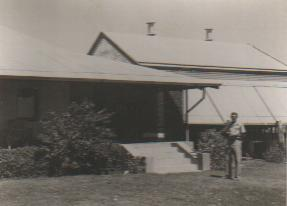
Medals : 1939-45 Star, Pacific Star, War Medal 1939-45, Australia Service Medal 1939-45, Returned From Active Service Badge. Promotions: AC 1 6-4-40 LAC 1-3-41 A CPL 1-6-41 CPL 1-8-41 SGT 1-4-42 FLT SGT 1-12-43 Pilot Officer 15-7-44 Flying Officer 15-1-45 Left: Duncan outside the front entrance to the house. Above : The old kitchen with the outside baker’s oven.
The old kitchen with the outside baker’s oven.Duncan outside the front entrance to the house.
Book page 294
Left::Duncan counting sheep. Right : Duncan on left, penning sheep. Below: Duncan on the left. The irrigation system pump for the lucerne paddocks. On the steps at Noonkanbah. From left: Sir Charles Gairdner, Lady Gairdner, Jack Lee, Duncan, Ethel, Gwen MacDonald, Carolyn and Jocelyn.
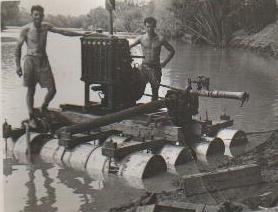
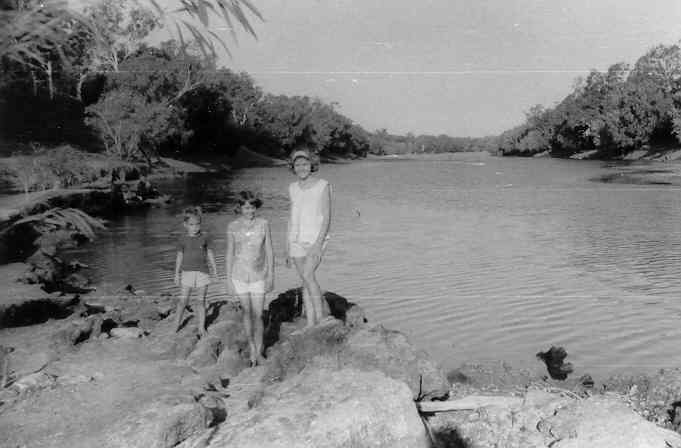
Duncan on left penning sheepDuncan counting sheepThe horseyardsDuncan on the left. The irrigation system pump for the lucerne paddocks.On the steps at Noonkanbah. From left: Sir Charles Gairdner, Lady Gairdner, Jack Lee, Duncan, Ethel, Gwen MacDonald, Carolyn and Jocelyn.Andrew, Jocelyn and Carolyn at the Fitzroy River.
Book page 295
The Chapter from ‘Cape York to the Kimberleys’
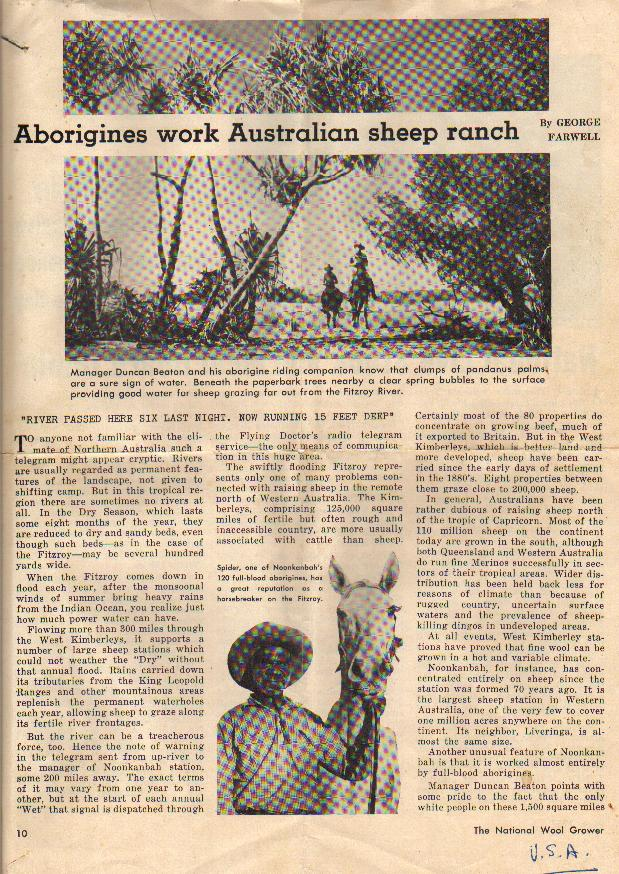
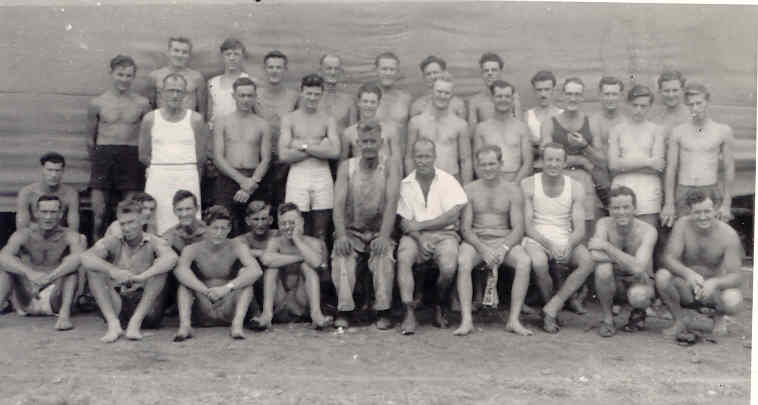
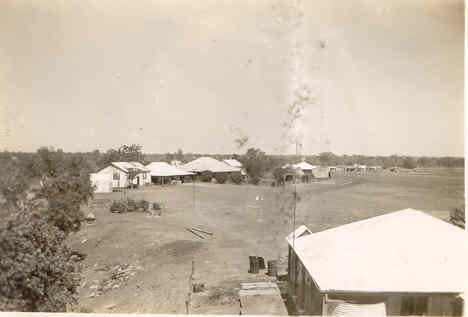
The Chapter from ‘Cape York to the Kimberleys’ published in an American magazine ”The National Wool Grower”. The ‘Synnot and Dunbar’ shearing team 1951 Roof in foreground is the mens quarters. 1st and 2nd houses top left are store houses 3rd with large roof is the main homestead house. Duncan with his beloved Humber Snipe.
The Chapter from ‘Cape York to the Kimberleys’ published in an American magazine ”The National Wool Grower”.Duncan with his beloved Humber Snipe.The ‘Synnot and Dunbar’ shearing team 1951Roof in foreground is the mens quarters. 1st and 2nd houses top left are store houses 3rd with large roof is the main homestead house.
Book page 296
FROM ‘CAPE YORK TO THE KIMBERLEYS’
By George Farwell Published in 1962 by Rigby and included here with their kind permission. Chapter 16 SMOKE SIGNALS ON THE RIVER In the homestead at Nookanbah the manager showed me a curious telegram. It had come over the radio at the start of the last Wet season. The message had come from another station 200 miles up the Fitzroy River. To a stranger the wording sounded rather odd. “River passed here six p.m. last night,” it began. To Duncan Beaton the thing made perfect sense. He did not happen to be a southerner who regarded rivers as a permanent feature of any landscape. The Fitzroy was something different. Sometimes it was a great swirling torrent nearly half a mile wide; sometimes it was a dry bed you could walk across without wetting your feet. Hence a wire like this arriving in December or January could be a piece of all-important news. Besides, the rest of the message said that the Fitzroy was then running fifteen feet deep at the sender’s end.
This meant that a pretty solid wall of water was sweeping down the river, likely to cause a great deal of damage on Nookanbah unless they prepared for it - which entailed shifting their sheep at once to higher ground. I was rather surprised to find sheep being raised out here at all. It seemed to me very much cattle country, too large and too wild for the endless supervision required for handling sheep. Duncan would not subscribe to this at all. His, he said, was one of several stations in the West Kimberley that had shown that sheep could be grown in so hot and variable a climate. He told me that Nookanbah had concentrated entirely on sheep since that place was formed eighty years ago. It was not only one of the two most northerly sheep properties in Australia - its neighbour, Liveringa, being the other -but it was one of the few still to cover a million acres. Another remarkable fact was that the place was worked almost entirely by aboriginal labour.
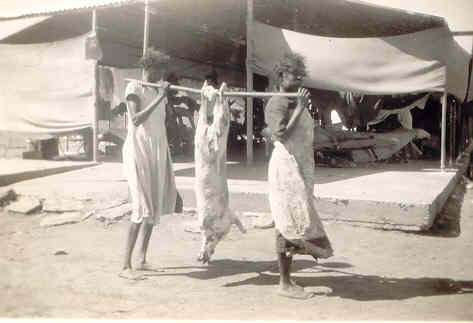
The only whites on the place, he said with some pride, were his wife, their two small children, an overseer, a book-keeper, a mechanic, and a man who was sinking dams on contract. There were six half-castes who held key jobs, such as driving trucks and looking after windmills, dams, and fencing. For the rest, the handling of more than 60,000 sheep was done by natives. There were more than a hundred of these on the station books. These blacks, still not far removed from nomadic tribal life, were the people who really kept the station going. They watched the sheep in the huge paddocks, tailed them by night, shifted them to fresh water on new pastures, mustered them at shearing time, classed the wool, built hundreds of miles of fencing, sank dams, and once each year drove fat wethers 150 miles to Derby for shipment to Singapore. Their womenfolk, too, had become expert at picking over the “pieces” in the woolshed at shearing time, and also classed them according to quality.
The actual shearing was done by white workers brought up from the South. They were flown in more than 1,500 miles from Perth each year, usually in a specially chartered plane. Because other stations, like Liveringa, were obliged to shear at exactly the same time - during March and April - it was not possible to use the same team, which meant that travelling expenses could not be reduced by sharing them. It was essential to have the sheep off the shears by the end of April, because that was when the wool reached its peak, before the failing of the natural waterholes began to make the sheep lose condition. There was another nasty problem, a thing called corkscrew grass. And a very different, more deadly type it is than the southern grass that goes by the same name. It starts coming up early in the Dry, growing two to three feet high. The seed, which is four inches long, has a sharp point covered by a curly sheath.
As soon as the seed catches in the sheep’s wool the sheath starts to unwind, the sharp point working deep into the animal’s flesh, finally killing it. Losses have sometimes been severe. As a result, great care has to be taken in travelling sheep through paddocks where corkscrew is known to grow. A paddock has to be carefully inspected before stock are put out to graze. All the same, this is one of the very few hazards of sheep-raising in the Kimberleys. Graziers have a far easier time of it than in southern areas, for diseases like scabby mouth and foot-rot are unknown. As the fertility of the land varies widely, properties cannot be stocked to the same extent as good sheep-country in the South. Nookanbah averages one sheep to thirteen acres, compared to one and a half or two sheep to the acre in the best areas of New South Wales, or Tasmania. Along the river frontage of the Fitzroy, Nookanbah carries one sheep to six acres, but only one to twenty in its back country, which is largely pindar scrub and spinifex.
There are few natural waters away from the river, apart from swamps and billabongs that dry up during the prolonged Dry. This means the sinking of bores for sub-artisian water, perhaps several hundred feet underground. The water is then stored in earth dams or tanks until it is needed. Nookanbah has over fifty bores, with more planned for the future. They represent a considerable outlay of capital. “All the same, we are pretty well off here,” says Duncan Beaton, an energetic youngish man whose early training was on his father’s property in the Geraldton district. “In a good season we can keep as many as thirty thousand sheep on natural waters. We have a number of lakes, springs, billabongs, and swamps well back from the river. But in a dry year we have a pretty big job trying to keep our sheep well spread out. We have to keep black stockmen tailing them all the time in little mobs, making sure they get sufficient grass and water.
“There are other tricky points to watch, too. As the water-holes begin to dry out they get very boggy round the edges. If you’ve ever tried to pull sheep out of that sticky mud you’ll know just what a job it is. Again, dingoes can cause a lot of trouble. As soon as we find there’s a wild dog ranging the country we get the blacks to track him, and have him poisoned or shot. One dingo might kill thirty or forty sheep in a night. Last year we caught about fifty on Nookanbah.” Fencing, too, means a great deal of expense in country so large. The holding is at present divided into some fifty paddocks, requiring more then 600 miles of fences, which have to be regularly inspected and repaired. When the flooded Fitzroy River spills out many miles from its main channel, anything up to a hundred miles of fencing may be swept away. Then effective control of the sheep becomes impossible until the fences have been repaired.
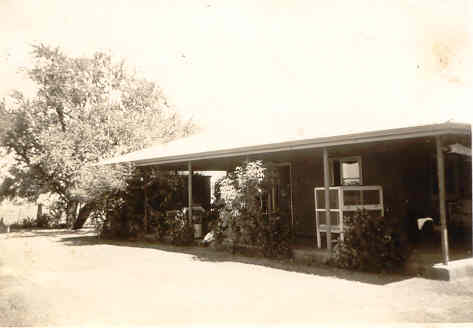
The river itself is the decisive factor in this country. It determines how a property shall be run, how paddocks are to be sub-divided, and when sheep can be grazed in different areas. That urgent wire announcing the start of a flood up-river immediately sets in train a new series of events. Duncan with the house and bough shed in background.
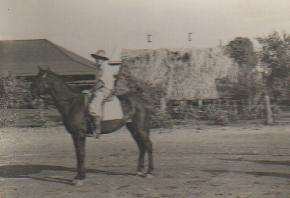
Duncan with the house and bough shed in background
Book page 297
Before the Flying Doctor Service reached the Kimberleys, in 1936, there was no means on communication, except a telegraph line that linked the few small towns. Flood warnings were sent by more primitive methods. Settlers borrowed the smoke signals of the native tribes. Nookanbah would post an aboriginal at the little township of Fitzroy Crossing, eighty miles up-river, about the time the rains were due to begin. When the slow-moving wall of water reached the township the native would light a smoke signal. A second post down-river would pick up the signal and relay it to a third, whose smoke would be seen on the horizon by Nookanbah’s manager camping at the top end of his run. Today managers of cattle stations further up the Fitzroy and its big tributaries transmit messages from their two-way radios as the river reaches them. As a result, it has become almost possible to pinpoint the hour of the river’s arrival further down, and the sheep can be moved to safety in time.
To see these Kimberley rivers come down in flood is a fantastic sight. First there is only the wide and sandy bed, dry as desert. Then comes a wall of water, perhaps four feet high, sweeping before it a swirling mass of foam, dead timber, debris, drowned animals, the bones of cattle. It moves relentlessly on, travelling about three miles an hour, rising slowly to the level of the steep, tree-lined banks, forty or fifty feet high. “You don’t want to let that water beat you,” Duncan Beaton says. “Your sheep would be marooned for months. In the Dry we always graze our sheep on the south side. That’s country liable to flood so you can use it during the Wet. We have to cross them over to the other side before the flood comes down. There’s a big danger in holding them too long. But you never know when the first rains are going to come, and you want to make the most of that feed while it’s there.
It calls for a great deal of judgment, I can tell you. All November and December we are watching the skies. After all, when it does start you might get ten inches of rain, or even twelve, in a single day. You can’t do much after that !” Once the sheep are mustered and safely across on the northern side of the river, there is no need to worry unless the river overflows its banks. A really big flood will spread out many miles from the river, over the flat plains beyond. Then the sheep have to be shifted into the back country, with its artificial waters and its swamps and billabongs. Mustering begins late in March, when the sheep have to travel many miles to the big shearing shed near Nookanbah’s homestead. Once off shears, the breeding ewes are put back into paddocks on the river frontage, sweet now with new grass. Until July the river continues to flow, and there is no way of crossing it. Then the ewes are drafted in improvised yards, the lambs are cut and tailed and sent to join their mothers on the south side of the river.
The tailing occupies about three weeks, lambing numbers averaging 15,000 to 16,000 every year. It is a smoothly flowing cycle of work that has continued from one year to the next for more than a century. But no longer is the wool transported to ships at Derby by donkey team as it was until twenty or less years ago. Better roads have brought heavy motor trucks into the country, though some sheep are still travelled down the Fitzroy stock route by aboriginal drovers for live shipment to Singapore. None the less, there is a good return from the wool clip, which comprises about a thousand bales. In 1951 Noonkanbah averaged $246 a bale for its whole clip, a price that made it worth the owners’ while to ship the wool direct to Britain. Like the other West Kimberley stations, Noonkanbah has a pure merino flock, though in size and appearance they differ a little from the large-framed merinos of the southern States.
“Each station up here seems to have developed a slightly different type of sheep,” Beaton says. “I think it’s due to the different parent-stock in each case. Ours have some Peppin blood. The early flock brought up in the eighties has developed away from the parent strain. Compared with sheep in the southern States, ours would be rather small, but they would be well woolled, even if they carry only seven pounds of wool each in contrast to about eleven pounds down South. The average wether here will kill at forty to forty-two pounds. The Noonkanbah sheep are small-boned, fairly deep in the body, close to the ground underneath. The carcasses, again on the small side, carry a large amount of first-class meat. This is probably due to the way they lose condition towards the end of each Dry period, then quickly pack on new meat with the Wet. Sheep mature late in this country, just as cattle do. This is why our policy is not to mate the young ewes, but to wait until they are two and a half years old.” Noonkanbah wool, he points out, is finer than that produced in most regions of Western Australia.
Although a fair amount of superfine wool has been produced in recent years, the Noonkanbah Pastoral Company is really aiming for fine wools. Rams are imported from the leading South Australian merino stud, Collinsville, and shipped from Adelaide, 2,500 miles away. The limiting factor, as always, in this country remains the everlasting problem of distance- distance from markets, distance from centres of supplies and other human contacts, distance from the stimulating developments of the modern world. All the same, this 1,500-square-mile property is one of the most attractive places I have seen. It has considerable beauty. There is , above all, the magnificent Fitzroy River, mile after mile of it winding between avenues of great trees, sometimes turbulent in flood, sometimes reduced to long, mirror-clear waterholes where wild duck, geese, ibis, cranes, and pelican cruise along undisturbed. There are wide, open plains where mirages shimmer on the skyline, picturesque little springs where fresh water seeps from the soil beneath quaint pandanus and paperbarks.
There are the crumpled and bare red peaks of the St George Range away in the distance, a kind of natural barrier to block off the desert to the south. We rode out towards that range one day, as Duncan wanted to see how many sheep were feeding on the spinifex plains. With us went Watty, one of the old men who was said to be still an important tribal influence. We made our dinner-camp near a place called Skeleton Hill. It was here, Duncan told me, that a tragedy had occurred in the early days when the blacks were still actively resentful of the white man’s encroachment on their hunting grounds. When a stockman’s son disappeared one day while looking for cattle the father, jumping to conclusions and assuming that the blacks had speared him, called a vengeance party. This was led by the late Sergeant Pilmer, who rode out with black-trackers and several white settlers from Fitzroy Crossing. They caught a large number of tribesmen crossing the open plain, chased them into the hills and rode in on each side of them.
They shot every man and boy they could find. Later - too late - the body of the stockman’s son was found. He had died of thirst. The bones of the aborigines remained , bleaching in the sun on Skeleton Hill for many years, and the place became a well-known landmark. One day, not too many years ago, the whitened bones disappeared. They had been taken away by the local tribe and buried in caves, no one knows just where. We rode slowly past Skeleton Hill, the three of us, that afternoon. Watty, the old man of the tribe, was the only one who spoke. “The old people,” he said, and he spoke with surprising gentleness, “they still remember ……….” From ‘Across the Board’ With the permission of the author,Valerie Hobson. Personal experiences told by shearers who worked in the North-West during the 1950’s and 60’s.
Book page 298
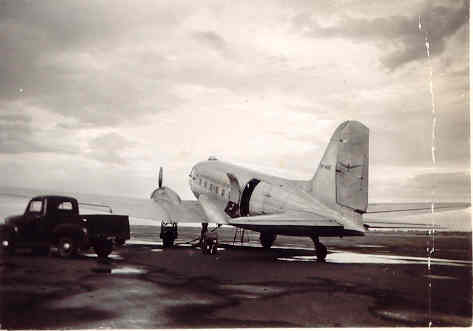
Excerpt from Colin Christensen’s Story P. 41 I..went with Synott & Dunbar to Noonkanbah in the Kimberley. The team flew on a chartered plane and landed directly on the station.( Peter Cleaver on Page 61..Planes used then were DC3’S )It was an all weather strip put down by the forces during the war. Left Perth early on a Sunday morning towards the end of March and arrived midafternoon. Heat was a shock- not a breath of cool air. Couldn’t shear a full day, had to start with 2 hours working up each day until the Friday- 4..00 - 4.30. Thereafter eight hours a day. The Aboriginal stockmen - and they were certainly the best - worked mainly for clothing and tucker for their families; they had no alcohol. At Noonkanbah there were more than 100 men, women and children in the mustering camp, but only 25 were working boys, as they called them.They lived in their territory and environment. While they mustered if they saw bungarra or emu tracks they tracked them down; mustering could wait.
There was never any pressure on them but they kept the sheep up to our requirements. Excerpt from Harold Christensen’s Story P. 51 In 1955, the year I shore at Noonkanbah there were 14 shearers, men from every state in Australia. Excerpt from Peter Cleaver’s Story P. 61 In describing the types of Wool Presses (Ferrier and Koerstz) described Thundelarra and Sherlock (out of Roebourne) as both having an old Adelaide Box. The bottom-box wasn’t very high but the top box was so high there were steps to reach the top and put the wool in. At Thundelarra the wool floor was above the press so the wool could be thrown into the box. The Adelaide box worked like the Ferrier with the pole coming down the middle. I only tramped the bottom-box because I’d never get out of the top- box. It was a bugger of a thing, a killer, the Adelaide box. They were the only two I’ve seen. Excerpt from Ted Dreckow’s Story P.
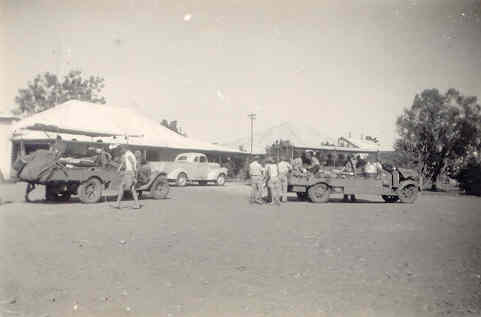
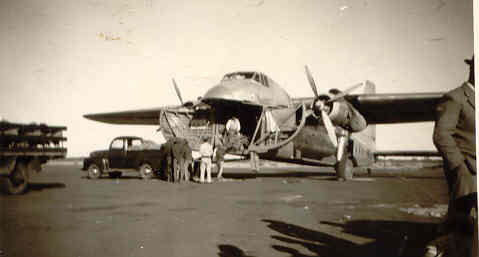
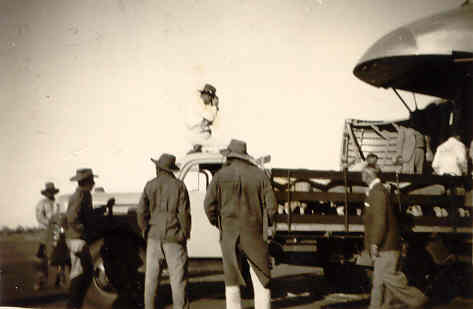
77 Airfare from Perth to Noonkanbah was £28 ($56). The DC3 landed right at Noonkanbah shed and dropped us off- the whole team. They had a beautiful airstrip there, left from the war, specially built for long-range bombers. Counted six big bays of earth Noonkanbah Airstrip. The ‘Synnot and Dunbar’ trucks used to transport the shearers from station to station.
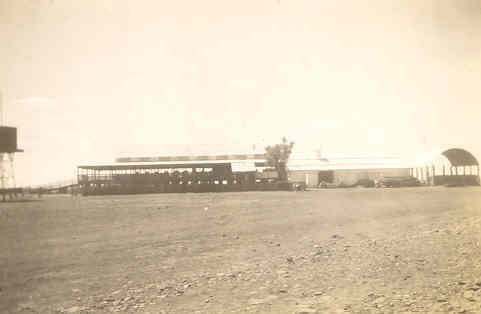
Noonkanbah AirstripNoonkanbah shearing shed 1951The ‘Synnot and Dunbar’ trucks used to transport the shearers from station to station.
Book page 299
bulldozed up to hide the planes. They used to throw camouflage nets over them and apparently the Japs never found them. When the plane came over the woolshed everybody would send up a cheer because it was mail day. There were 21 stands at Noonkanbah but only 16 were used, 8 each side. Two wool tables and the classers tables were at the back. Excerpt from Chris Fyfe’s Story P. 101 Prior to the War contractors, Synnot and Dunbar, sent their trucks to Derby by ship. They would travel with them and ferry the trucks and men out to the stations. During the War they drove the trucks the whole way. Shearers were manpowered during this period. In 1949 the State Government subsidised plane fares for North West workers. So began the chartering of DC3’s and the whole team (33) flew up. Excerpt from Tony Johnston’s Story P. 125 February 1952 off to Noonkanbah. Sixteen shearers, we were there six weeks.
I was a board boy. Noonkanbah had 60,000 sheep and pressed 100,000 bales that year. Considering it’s normally thirty bales to the 1000 there should have been twice as many but I think it was the biggest clip at the time. Excerpt from John Moore’s Story P. 205 The West Kimberley was all sheep then, not many cattle; now there are no sheep. Everyone made money in the years when wool was £1 ($2) per pound (500gm). Pages 208 and 209 Historical DOLA maps of Station areas. Noonkanbah is Section 129. Excerpt from Bruce Oldfield’s Story P. 225. Recounting experiences of the early 1960’s. Noonkanbah was an eye opener. There were about three hundred Aborigines living on the station the year I was there. Twenty or thirty women would come into the shed, laughing and jabbering among themselves, to sort the locks and dags. No doubt they enjoyed the change to normal station routine; they seemed very happy people.
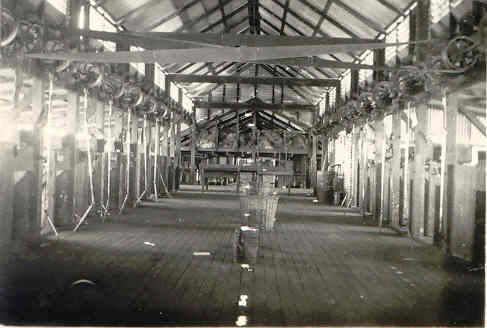
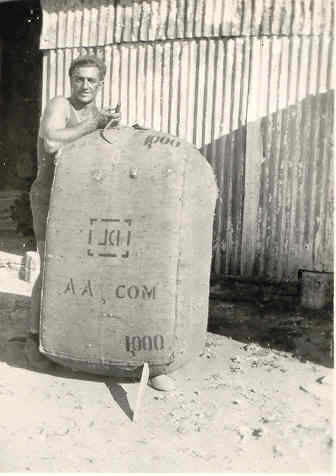
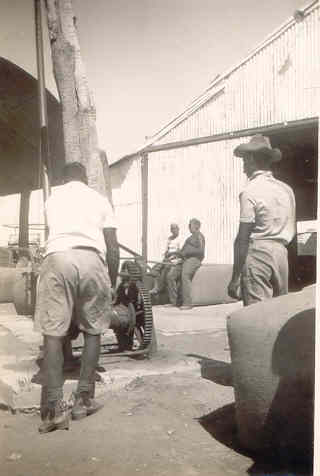
Noonkanbah was the only station I saw this happen. p.138 Noonkanbah reputed to be last working overhead belt driven driver double-board shed in Australia. The actual 1000th bale, 1951. Loading the truck. L to r:Peter Tuffin, ?, George Mawley and Hordacre.
Noonkanbah reputed to be last working overhead belt driven driver double-board shed in Australia.The actual 1000th bale, 1951
Book page 300
There is more information regarding George Mawley, Noonkanbah Station, the shearing sheds and the station in two other books : ‘The Shearer’ by Patsy Adam-Smith. Printed in 1982. ‘ Off Shears’ by June Lacy. Printed by Black Swan Press, 2002. Marcus Synnot said, “At Noonkanbah 101,000 sheep were shorn in five weeks in 1954; forty four men in the shed, twenty shearers on the board. They shore 20,000 one week, 1,000 per man per week. That was a world record. We shore over 4,400 one day ,” Arthur Dunbar a shearing contractor (in the partnership ‘Synnot and Dunbar’) in the North West and took a team to Noonkanbah Station for more than 40 consecutive years. His son, Reg, has a collection of his own and his father’s photographs. Several featuring Noonkanbah. Reg also has wonderful memories and an endless collection of tales about those shearing days. An bygone era but certainly not forgotten. Loading Cattle at Sandy Billabong.
Warrimbah, the outstation at Noonkanbah. 1950. Left :Loading stock for Glenroy Meat Works. Above: the Bristol Freighter they were loading.
Warrimbah, the outstation at Noonkanbah. 1950.: the Bristol Freighter they were loadingLoading stock for Glenroy Meat Works.
Book page 301
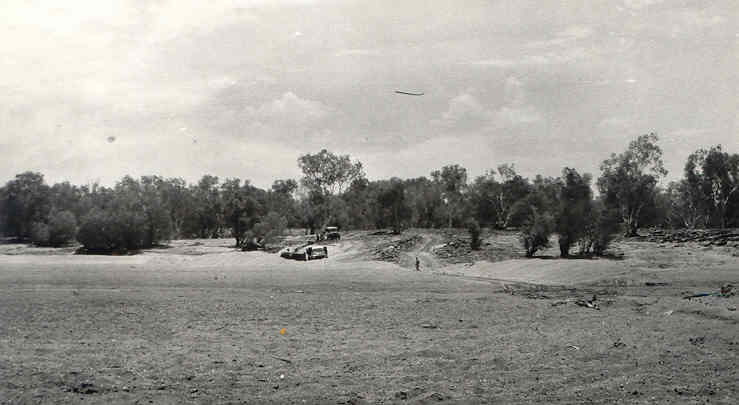
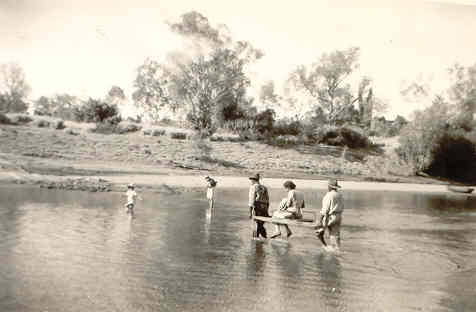
In the horseyards. The different faces of the Fitzroy River. Right: The Crossing in the dry bed. Below left: Betty Naylor being carried across , Liz and Mary walking in front. Below right: Rafting across the river Left : Working on machinery. Right : On the way to their cooking fire.
Working on machineryOn the way to their cooking fire.The different faces of the Fitzroy River. The Crossing in the dry bed.Betty Naylor being carried acrossRafting across the riverBattling a plague of grasshoppers on the front lawn.In the Horseyards
Book page 302
Ethel and Duncan.
Copy of undated newspaper article and photo published in – possibly The Sunday Times. Preserve Pea Hill -former manager by Genine Taylor A man who ran the Nookanbah station for 20 years said today that Pea Hill should be preserved as a sacred site. Mr Duncan Beaton who managed the station with his wife Ethel until 1969 said: “I know of four sacred sites on the station. Pea Hill is definitely one of them. The actual sites have to be preserved. There are graves thousands of years old. If they are desecrated it would be like going into Karrakatta and getting at Captain Stirling’s wife’s grave.” However, Mr Beaton said that definite sacred areas had to be worked out. He believed that “white stirrers” had confused the controversial Pea Hill issue by extending the area out from the hill. “As far as I know, the sacred areas did not extend very far out,”he said, “All this extra ground is just baloney.
I can vouch for four places. I know they’re true but there are some people who have got to the natives to spread the areas.” Mr Beaton said he did not think Amax Petroleum (Aust) Inc. would drill on the sacred sites. “Once the company knows of the sites it won’t want to go into them,”he said. “But the areas have to be designated. Then they could be fenced off so they would not be desecrated.” Mr Beaton said he thought that the aborigines had been stirred up by whites to get a victory over the government. “There has to be somebody who (undeciferable)………… government the proper sacred areas,” he said. “Like Sir Charles Court said, it would be better if the government could sit down and talk to the men who count.” However, there were many problems with sorting out the areas because most of the true tribal elders had died in recent years. Last year, the State government overrode the wishes of the WA Museum when it gave the go- ahead to Amax to drill on the Pea Hill site.
It was revealed then that the government had directed the museum trustees to consent to the drilling, though a museum survey found that the proposed area contained areas sacred to the Nookanbah Aborigines. Duncan’s love and respect for Ethel obvious to all. Ethel , Duncan and Andrew at Noonkanbah
Duncans love and respect for Ethel obvious to allEthel Duncan and Andrew NoonkanbahDuncan and Carolyn, 1977.Ethel Duncan in newspaper
Book page 303
Back Row: Anthony, Ethel, Angela, Mary Liz. Front Row : Carolyn, Aunt Tril, Heather Campbell, Katy, Jodi and Megan Cooper. Liz and Anthony Male Noonkanbah 1964. 1978 Standing L to R: Andrew, Elizabeth, Duncan, Ethel, Angela. Seated L to R: Mary, Jody, Carolyn.
Mary’s wedding at Noonkanbah under the bough shed.19591978 Standing L to R: Andrew, Elizabeth, Duncan, Ethel, Angela. Seated L to R: Mary, Jody, Carolyn.Back Row: Anthony, Ethel, Angela, Mary Liz. Front Row : Carolyn, Aunt Tril, Heather Campbell, Katy, Jodi and Megan Cooper.
Book page 304
Ethel passed away from cancer, at only 69 years of age on 12th December 1985. After some years as a resident in care at James Brown House in Osborne Park, Duncan passed away on 5th of December 1999. Duncan McIntosh Beaton Born on 26th January, 1913 at Thundelarra. Married: Ethel Mawley (born: 1916 ) on 1st March, 1938 at St. Mary’s South Perth Children: Angela McIntosh born 23rd May,1938 at Geraldton W.A. Mary McIntosh born 12th January, 1940. Died 22nd October, 1992 from cancer Elizabeth McIntosh born 2nd October, 1944 at Subiaco. Jocelyn McIntosh born 26th December, 1951at Subiaco. Carolyn McIntosh born 27th December, 1953 at Derby. Andrew McIntosh born 20th June, 1960 at Fremantle. Ethel died on 12th December, 1985 from cancer. Duncan died on the 5th December, 1999. Angela McIntosh Born on 23rd May, 1938 Married : John Errey ( born 23.11.1935) on 9th April,1960. Where : St John’s Church of England, Finch St, E Malvern, Vic.
Children: Howard John Born 31st August,1961 , Box Hill , Vic. Married : To Therese Gilfedder (b 6th July, 1958) on 9th January.1988. Children: Melanie Rose born 9th April, 1990, Hobart, Tasmania. Margaret Eleanor Rose born 11th April,1995, Melb,Victoria Duncan James born 22nd October,1962 , Box Hill, Vic. Married: Racquel Zonte,(b 29th October, 1970)31srDecember, 2001. Lachlan Hugh born 15.5.1967 ,Box Hill, Melbourne. Partner : Corrina Voutsinas (b 7th July, 1970) Children : Juniper born 27.2.1996 , Perth , West Aust. Sally Elizabeth Angela born 1.3.1970, Box Hill, Vic. Married : Adrian Junior Abdool (b 9th Jan, 1966) on 4th July, 1999 Vanc, Canada Mary McIntosh Born 12th January, 1940 Perth, W.A. Married: Robin Campbell on 10th March, 1959 Where : Nookanbah Station, West Kimberley W.A. Died : 17th October, 1992, Rylstone N.S.W. Children: Bruce born 12th June, 1960 Heather born 3rd January, 1962 Elizabeth McIntosh Born: 2.10.1944 , Perth W.A.
Married: Anthony Male on 20th June, 1964 Where : Nookanbah Station, West Kimberley, W.A. Children: Maryanne Born : 10th April, 1965 Died : 17th March, 1982 Alison Born : 9th March, 1967 Married : Justin Jerenic 3rd December, 1995. Children: Coe Born : 27th September, 1996 Noah Born :18th March, 1998 David Born 24th November,1972 Married : Veronica Large on 28th October, 2000. Jocelyn McIntosh Born : 26th December, 1951 , Perth, W.A Married: James Cooper on 22nd February, 1971 Where: St Mary’s C of E School Chapel ,West Perth, W.A. Children: Justin Born 26th July, 1972 Married: Rachel Gardner 18th November, 2001 Children: Bailey James Cooper born : 21st April, 1999. Jamin William Cooper born 5th March,2003 in Bathurst. Brad Born : 4th December, 1973 Katrina Born : 7th July, 1975 Megan Born : 21st September, 1983 Carolyn McIntosh Born : 27th December, 1953 Married : James Pollitt 24th November, 1977 Where : Aquinas College Chapel , Perth W.A.
Children : Christopher Born: 26th January, 1985 Jessica Born: 5th August, 1987 Andrew McIntosh Born : 20th June, 1960 , Perth, W.A. Married : Vera Wittington on January 1992. Where : Brookton, W.A. Children: Shaun Jones-Beaton Born:20th April, 1989 Kayne McIntosh Born : 21stOctober, 1992 October, 2000. Standing:Bruce Campbell, Justin Jerenic Seated:Elizabeth with Noah, David, Veronica, Anthony, Alison with Coe..
October, 2000. Standing:Bruce Campbell, Justin Jerenic Seated:Elizabeth with Noah, David, Veronica, Anthony, Alison with Coe..
Book page 305
Helen (Nell) Brain (nee Beaton)
Helen (Nell) Brain (nee Beaton)
The youngest of Sandy and Euphemia’s children was Helen ( or Nell as she was always known) was born in Adelaide S.A. on 21st November, 1883 her birth was registered at Parkside, District of Adelaide and her name is recorded at Ellen. Her birth is recorded in the family bible as Helen so I feel this is a mistake on the part of the recorders. Nell remained with her mother, sisters and brothers, Jim and Don until they left to join Sandy and the other boys at ‘Beatonsfield’ Yandanooka. They travelled on the S.S.Polynesian in November 1892 and then by coastal ship and road to Yandanooka. Nell was then nine years of age. The ‘Beatonsfield’ property was left to herself and Ann by their father on his death in 1909. Helen married Leonard Brain on 29.3.1919 they lost twin babies, who were stillborn, and thereafter remained childless. Len owned a large block of land at Yandanooka on the opposite side of the main road.
In that time this block was not regarded as good land and contained a section growing a poison plant which had to be fenced off from stock. In later years after the introduction of soil analysis and additives it is known as one of the best in the district. Len and Nell took a trip to England to see Len’s family during the late 20’s or early 30’s. Len owned a Bean Car which has been owned, restored and treasured by Mr A.Selley for a number of years. The car has had only three owners over the years. Len died suddenly on the 3rd of November 1948 and there was a community effort to get the crop off. It was shortly after that the land was resold under the soldier settlement scheme. Nell and Ann retired to Perth and lived together at 128 Mill Point Road, South Perth for many years, until Ann was admitted to hospital care. Nell remained alone at the house until she also became infirm. After Nell’s death (at 80 years of age) on the 19th of February 1964 at Parkside Hospital, she was interred with Len at the Mingenew Cemetery in Lot number E 1.
The youngest member of her family, with her death, there was the passing of an era. There are copies of Road Board receipts in the Mingenew Museum. ROAD BOARD Carriage cart and Licensing N 89 - 616 Sulky 20/- 6th February 1919 N 90 - 617 Waggonette 6th February 1919 Both made out to Misses A& H Beaton Wedding group at Ken and Gwen Sinclair’s wedding. L to r: Vaughn & Denise Butterley, Arlene Sinclair, Ann Beaton, ……….., (behind)Evelyn Sinclair, Nell Brain, Clarrie Sinclair, Rose Sinclair, Ken and his wife Gwen.
Wedding group at Ken and Gwen Sinclair’s wedding. L to r: Vaughn & Denise Butterley, Arlene Sinclair, Ann Beaton, ……….., (behind)Evelyn Sinclair, Nell Brain, Clarrie Sinclair, Rose Sinclair, Ken and his wife Gwen.
Book page 306
Soldier Settlement Blocks
Fourth from left : Len Brain 20th October 1921 Dalgety’s Cattle Sale Mingenew. Soldier Settlement Blocks Following the Second World War, the War Service Land Settlement Board obtained E.H.Lee Steere’s “Yanda,” E. Broad’s “Manarra,” Grant’s “Mt Scratch,” Beaton’s “Beatonsfield” and portion of Pearse’s “Yarragadee” for discharged servicemen. In the Mingenew Museum there is a large map of the area dated 1931. Yandanooka 21, 22 D.Beaton 1965 -33 24,25,77,78 A & H Beaton Paperwork obtained from DOLA possibly dated 1944 A.Beaton & H.Brain :- Area 215.2.18 Yandanooka Lot 25 Classification 123/80 E 1/2 Improvements $375.00 Correspondence No 704/19 Part fenced 320 $192 A.Beaton & H.Brain:- Area 83.0.8 Yandanooka Lot 78 Classification 123/80 E 1/2 Improvements Part cleared no value stated Correspondence No 704/19 Helen Beaton born on 21st November, 1883 at Parkside South Australia. Married: Leonard Brain On : 29th March, 1919 Len died on 3rd November, 1948 Nell died on the 19th February, 1964 and her ashes were interred with Len.
Len and Nell Brain’s grave at Mingenew.
Fourth from left : Len Brain 20th October 1921 Dalgety’s Cattle Sale Mingenew.Len and Nell Brains Grave Mingenew
Book page 307
The web version is arranged for screen reading and navigation. The printed page numbers refer to the original Land and Gold manuscript.