A Letter to Ken, 1907
Kenneth Beaton as told by his daughter, Joan Langdon.
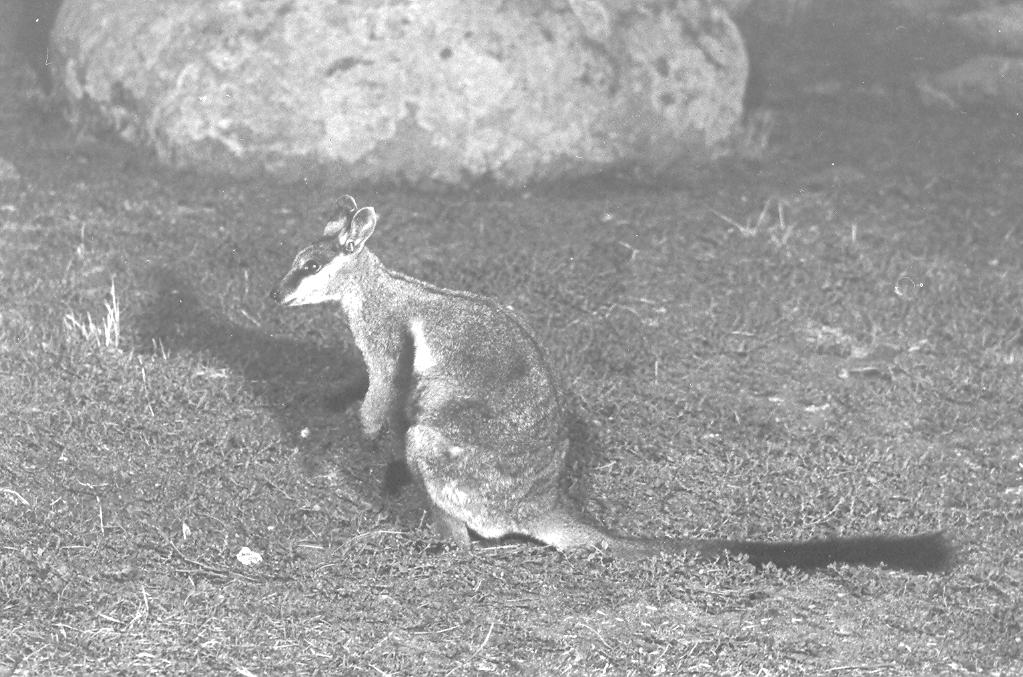
My father, Kenneth, was the seventh child and the fourth son of Alexander and Euphemia Beaton’s family of eleven children. He was born at Copmanhurst on the Clarence River outside Grafton in New South Wales on 12th of August 1875. The family moved to South Australia when Grandfather sold the property following the court case with James Ogilvie. The children attended Parkside School, a suburb of Adelaide. Also attending the same establishment were the family of John Thomas and Mary Emma Foale. The eldest daughter (Ethel) became my mother many years hence. The families became good friends and subsequently farmed next door in Western Australia. At the age of fourteen father , accompanied by his older brother Jack joined their father, Alexander and brothers Finlay and Charles at Nullagine in the far north west of the state of W.A. where the men had commenced mining for gold. The younger boys had travelled to the north in a banana boat and as boys would, they gorged themselves on bananas until they were ill, my father would never eat another banana for the rest of his life. Later the men moved south and grandfather purchased the property at Yandanooka and from there Father bought two thousand acres of good heavy land at Erikin in the Bruce Rock area, part of the central wheat belt. The farm he called ‘The Granites’, there being a thirty-five acre area of granite on the south east side.A colony of black-footed, black-tailed rock wallabies lived on the western side and became a focal point for visitors. The great stands of salmon gum and gimlet were gradually cleared by contractors over the ensuing twenty years. Two long strips of timber, two miles long and five chains wide, one servicing six paddocks, were left for future protection for the flocks of sheep which slowly grew in number over the years. In the meantime my mother had moved to Perth where one of her sisters was living. She worked on the Daily News as a stenographer, as did two of her sisters. Later she moved to Northam, working in the office of Messrs Mears and Mears, a well known firm of solicitors. Mother’s family were all very musical, the girls sang and played the piano and the brothers the tin whistle. Imagine thirteen of them around the piano.There was a musical society at Northam and through that Mother met and became good friends with John and Annie Sibbald, John was the Manager of the Northam Flour Mill. Annie was planning a trip to England and John asked Mother if she would accompany his wife. Naturally she was delighted and saved her money and they set out from Albany, having caught the train from Northam.(incidentally, driven by her brother, Howard) and joined the S.S.Persic, which took a month to reach England via The Cape, South Africa. It was to be two years before Mother returned to the west, during which time she travelled extensively covering the British Isles and the Continent. Ethel’s headquarters being with one of her father’s sisters, her aunt Annie. Her letters to her family and to Father were written in a letter book which I have in my possession and which makes fascinating reading.
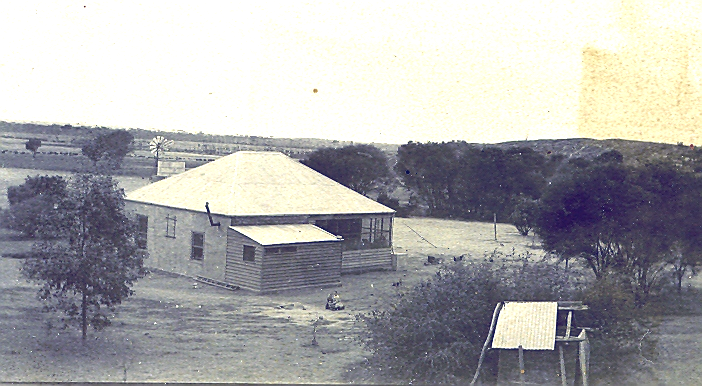
(The letters were written in triplica, one copy to father and one to the Foale family.) Arriving home once again at Albany she was met by father bearing a diamond and sapphire engagement ring. Mother continued on to Sydney then back to Adelaide and her family. She was joined by Father and they were married at the old home Summerlea in 1909. After a honeymoon at the Jenolan Caves in New South Wales they returned to ‘The Granites’ to set up home. It must have been a rude awakening for mother when she arrived at the farm. There was only a small area cleared and home was a tent and a bush shed. To obtain supplies father would take a wagon and horses to Kellerberrin, a trip of thirty-six miles. It was a three day journey, the first to Daadening Creek where there was water for the team, the second day to the township to load the three month supply of goods previously ordered from Perth, back to Daadening for the night and on the third day home to ‘The Granites’. Mother, during this time was alone on the farm, miles from anyone and with dingoes howling from the rocks during the long nights. Clearers were hired, they brought their own tents and camped on the job looking after themselves. Gradually the land was cleared, fenced and crops planted. A nucleus flock of sheep bought, Merino. It was very hard work and little reward, all proceeds going back to make more profit hopefully. I was born at Mt Kareenya Hospital in Perth on June 30th 1911. We stayed six weeks in Subiaco with one of mother’s friends before returning to Erikin. My father had made a cot for me from the running board of an old drill and I remember this as my brother used it when he was a baby. I graduated to a ‘bed’ when Nigel was born, it was fashioned from gimlet timber with sacking slung between the poles. There was always talk of a home being built and all spare time was taken up making mud batts with which construction finally began. Mother and I (at 18 months) planted an avenue of trees, me holding the string whilst the measurements between each tree were marked. There were lemon scented gums, red flowering gum, kurrajong , cape lilac and tagasaste. Many of these are now huge trees over eighty years old. When I was about three the new dwelling was livable. There were four good sized rooms,divided by a passage, a vestibule and verandahs on three sides. The wall facing north was blank except for a door in the middle, at the end of the passage. This was left so that future extensions could be added. Sadly for mother this never eventuated. My only brother Nigel was born in November 1915. He was not a robust baby and did not thrive till he was put onto broth and juices from the meat. Father named him Nigel, the Scot’s pronunciation with the hard ‘g’ not a soft one as in the English version. Mother had named me Joan. Whilst on her travels she had visited cemeteries where her forebears were buried and the names were all similar- John, Johan, Joanne,
Family and Farm Photographs
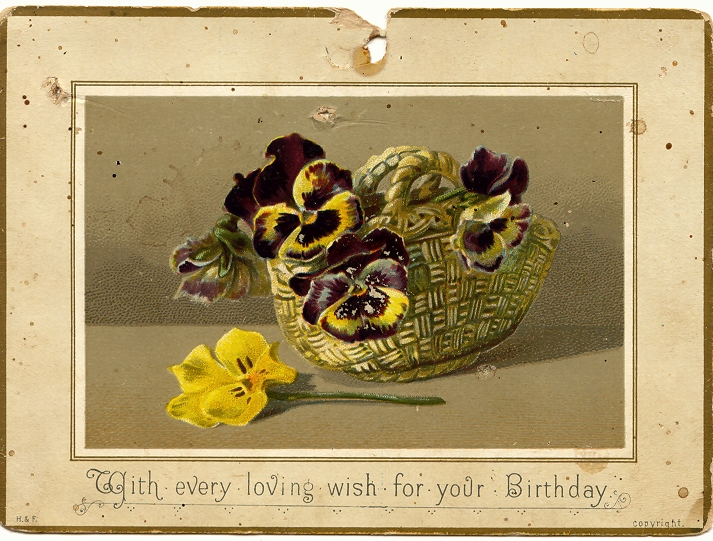
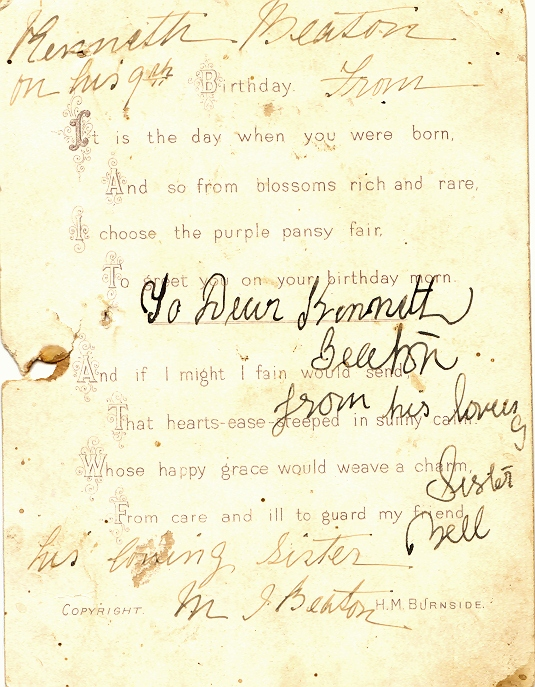
Ken’s 9th Birthday card from Nell.
1884.
Letter from ? to Ken 1907 Thundelarra 12th August 1907 Dear Ken, Your last to hand. You are evidently having your share of rain, we can’t complain here we are getting a nice drop we had 240 for July. It must be purely a coast rain or we would have had more considering the quantity you have had. It is rather funny when you think of it. The Foales all being up at the farm when we left Adelaide that is about the last thing that we would expect to happen. I am glad you had a whisky on hand that would keep the old boy going. I think Foale would know a bit about land, he knows how to make a good garden. He is evidently thinking about trying to get a start at it. I caught a dog since I wrote last or at least I don’t think I told you in my last. I caught him. They …….. keep back on there for a while now. He worked one paddock, turned out well. 93% or 1526 lambs out of 1639 ewes. We will be on the………..tomorrow. …… very close to …………. Time now and we are full of work. Then the half truck & cattle than yearlings will to … of them will be in a truck. We must get the bull now. You send them on to Yalgoo to arrive there on the 24th of this month that is a ………. It will meet our shearing goods. We will get Grant. To send ….. to ……. …… Those calves will be about …… …… …. ……. We could get for hire the harvester to take off the crop for grain we will have to get another machine. As we will want a lot of chaff up here what about cutting it all for hay and after we get our wool away and the wethers sold we will try and get an engine to drive that chaffcutter a 4 horse power motor would be simple to drive here and a fair quantity too. With a motor to drive her it would then pay to cut for the market as well .In any case we must have plenty of chaff for the station all the chaff that is used here and grown on the farm is money saved. You want to get all necessary parts for the binder if cutting for hay. You could tear the ……. off with the stripper could you. We could not lay any money out until after the New Year and if you go in for grain we will have to get that harvester on the nod. Either the £83.0.0.or the £96.0.0 class. The £86.0.0. perhaps for preference. But give the chaff idea a good go for we must have bales of chaff here we can run the place far better when the horses are fed it has cost us a good bit for chaff this season. One of us might be able to get down after the new year to help install a motor if we went in for one the only thing I see against chaff is the weather can it be thatched with chaff I think that is how most of them do it hay and binder twine with hooked sticks or wire would to thick and put plenty on it is not wasted if it keeps the rest O.K. and if done well would do that. The only thing that used to choke me off hay was the poor driving plant for the cutter. You would want to get a couple of hands to take it off for hay to stack and ……. it ……… get at the hay early so that it will be all near………. Was…………………………………………… incomplete
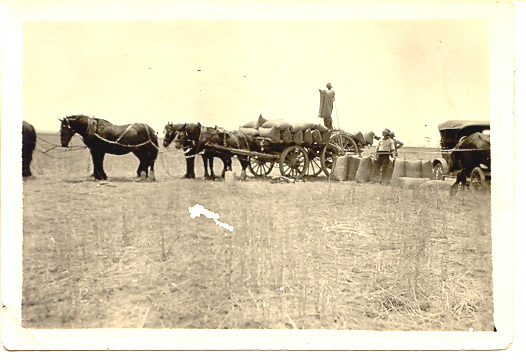
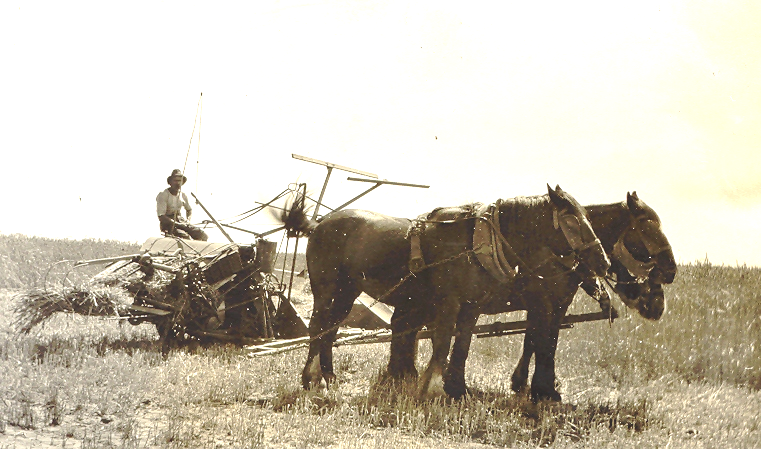
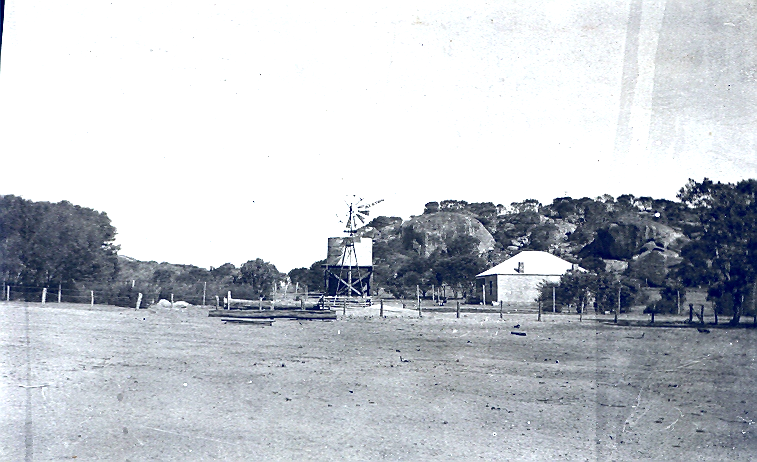
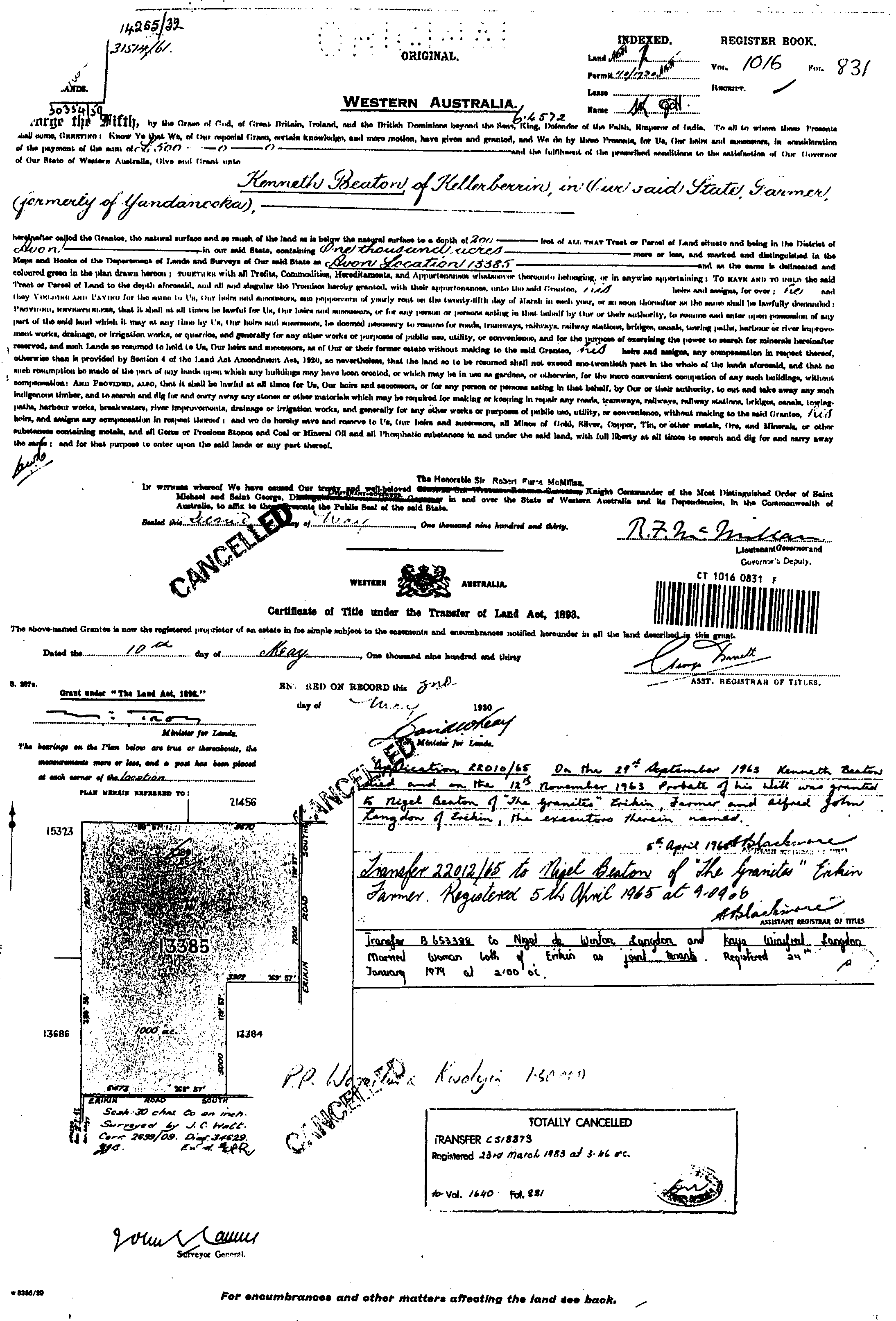
Land at Avon Location 13385
Growing Up at ‘The Granites’
Avon Location: 13385 for the price of £500. ($1000.00) and the fulfilment of prescribed conditions.
To Kenneth Beaton of Kellerberrin, farmer (formerly of Yandanooka) 1000 acres.
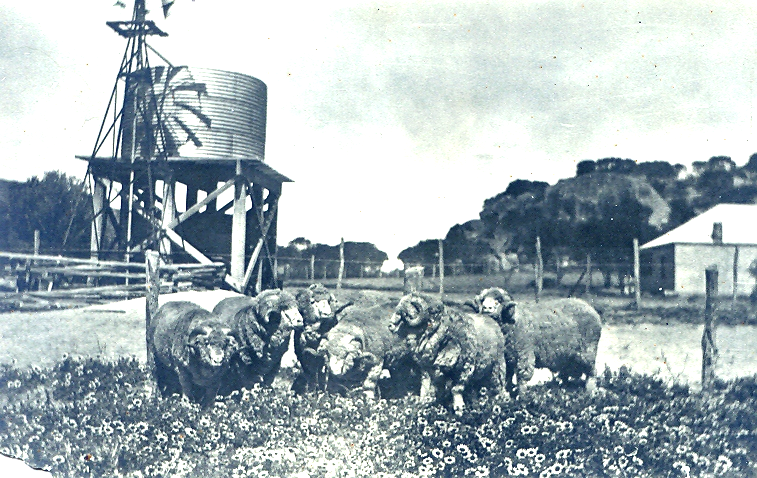
‘The Granites’
My cousins had correspondence lessons as there was no school within travelling distance. Shackleton School, run by the wife of a shop-keeper being the first teacher, ten miles away. My mother’s youngest sister, Marjory, was a school teacher and taught me to read and write, and the very year that I was to commence at P.L.C., the Yarding school opened and Nigel started there. However my mother was determined that I should go to college and in February 1920 I started my learning at Presbyterian Ladies College, known to the inmates as the ‘Place for the Lost Calves’ and indeed that is what I thought. I was tall for my age, had big feet (which I passed on to my grandchildren) and was put in the Kindergarten with the little girls and some little boys too. I gradually found my level, skipping one form, spending only one term in another, till I reached third form which was right for my age. I stayed at P.L.C. until I was seventeen, being allowed to leave mid-year because I was so miserable. Hoping that I would follow in her footsteps, mother obtained a job for me at Dalgety’s in Fremantle. I had been away from home so long that I refused to go.Mother must have been disappointed, no doubt thoughts of her travels were an influence, but it was not for me. At this stage Nigel was twelve and away at Northam High School having won an entrance examination. He studied there until he finished his education. One of mother’s brothers lived in Bunbury, and when times became tough during the depression, the second of his daughters came to live with us until things improved. During our late teens Gwen and I had a wonderful life. We were like sisters. There was a difference of only a few months in our ages and we were wonderful friends. We still are. We did all the household chores, alternating weekly, between the washing and the ironing and then housework. I was unhappy about the wages situation. Gwen was paid 25 shillings ($2.50) a week and I was not paid at all. However Mother always had a piece of material to make a new frock when I wanted one and I was given pocket money when we went out. We would be taken to the local dances almost every Saturday night by our parents and later by boy-friends. We played tennis on Saturdays, followed cricket on Sundays, and in winter followed the Shackleton Football Team. In the 1930’s a nine-hole golf course was laid down around the rocks and neighbours gathered there to play. This was the beginning of the Shackleton Golf Club that became so popular in later years. No one had much money but we made up for that with lots of fun and pleasure, singing around the piano on Sunday nights, tennis parties and matches with neighbouring clubs. We made most of our clothes and it was nothing to sit down on the lino covered floor with material surrounding us, cut out a frock, no pattern (we were both straight up and down anyway), sew it up on the old Singer Treadle and go out to the dance the same night wearing the new creation and feeling a million dollars. In 1929 Jack and I became engaged and Gwen had a boyfriend in Bunbury, whom she subsequently married. We spent hours on the rocks with a portable gramophone, a rug and our sewing.
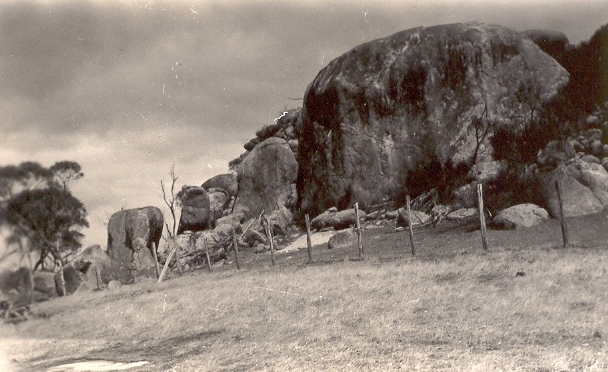
Joanna,Johannah, Joan, and Jon. I therefore had no way of escaping Joan. I have no recollection of who looked after me when Nigel was born. Mother was in Kellerberrin Hospital so I imagine it must have been one of her family, who by this time were farming on the adjoining farm to the west of ‘The Granites’. My first introduction to my new sibling was on a very wet day at Langdon’s farmhouse or should I say humpy. A hession -lined dwelling through the roof of which dripped the rain. Mrs Langdon held a big black umbrella over the new baby in his dress-basket as his proud parents came in from the sulky. Father had obviously collected mother and baby from Kellerberrin. A huge old pepper tree still stands where the old place was. By this time Jim Beaton, a younger brother , had taken up the adjoining land to the Granites. There were several children with whom we grew up.Marion was nearest to me in age and we were close mates. Nigel and Stuart were two of a kind, a pair of devils , up to all sorts of mischief. They slid down the rocks on pieces of tin wearing out the seats of their pants, usually home- made from the bottoms of the men’s cast off’s. They were also responsible for putting black caterpillars in a box of powder belonging to a girl who was one of mother’s friends.I don’t remember whether that finished the friendship or not. My cousins and I had wonderful times as we explored the rocky outcrops and found taddies and frogs, lizards and little orchids growing in ‘fairyland’, small patches of soil, moss and pools of water.It was a magical place for young folk. We used to lift up pieces of rock and bits of wood and Connie could always see the fairies there. Marion and I were not entirely convinced. In the background the granites where the black-tailed wallabies live. Now a protected area for these endangered animals. The railway from York to Merredin was opened in 1913 so it was easier to receive and despatch goods and a special treat was to go on the wagon to the siding at Erikin. We would sit on the bags of wheat singing at the top of our voices. Various parts of the road were always greeted with the same song. On Spiller’s Hill it was ‘There’s a long, long road a- winding’. Indeed it seemed long but in fact was a mere five miles from home. From that vantage point, in latter years , the first glimpse of the farm was seen and the chorus of ‘ I can see the Granites’ rang from the lips of the children. Originally , all that could be seen was the bush track ahead. To visit Aunt Winnie and Uncle Jim entailed a walk of half a mile around the ‘point of the rocks’, an out-crop that sloped gently to a point. To stay for a meal was fun but I was always scared of Aunt Winnie. We had to sit quietly at the table and behave ourselves, a hard job for a bunch of healthy youngsters. Auntie would admonish us - no doubt endeavouring to instil us with good manners saying ‘Don’t smack your lips girl’. We would always finish up singing hymns around the piano. I distinctly recall ‘Shall we gather at the river’ sung with great gusto.
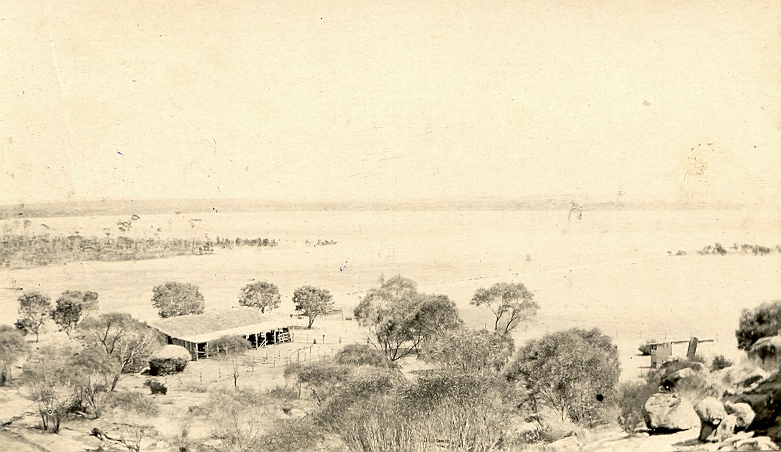
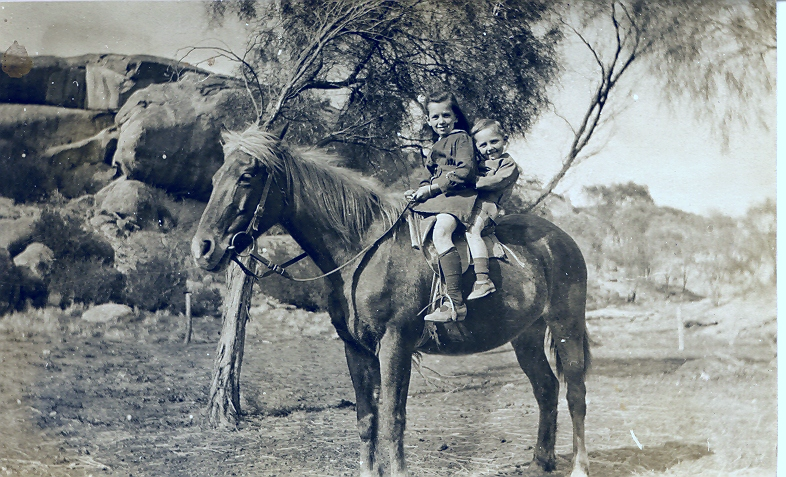
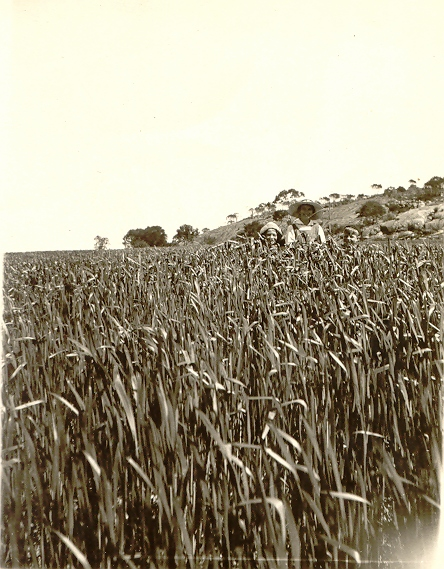
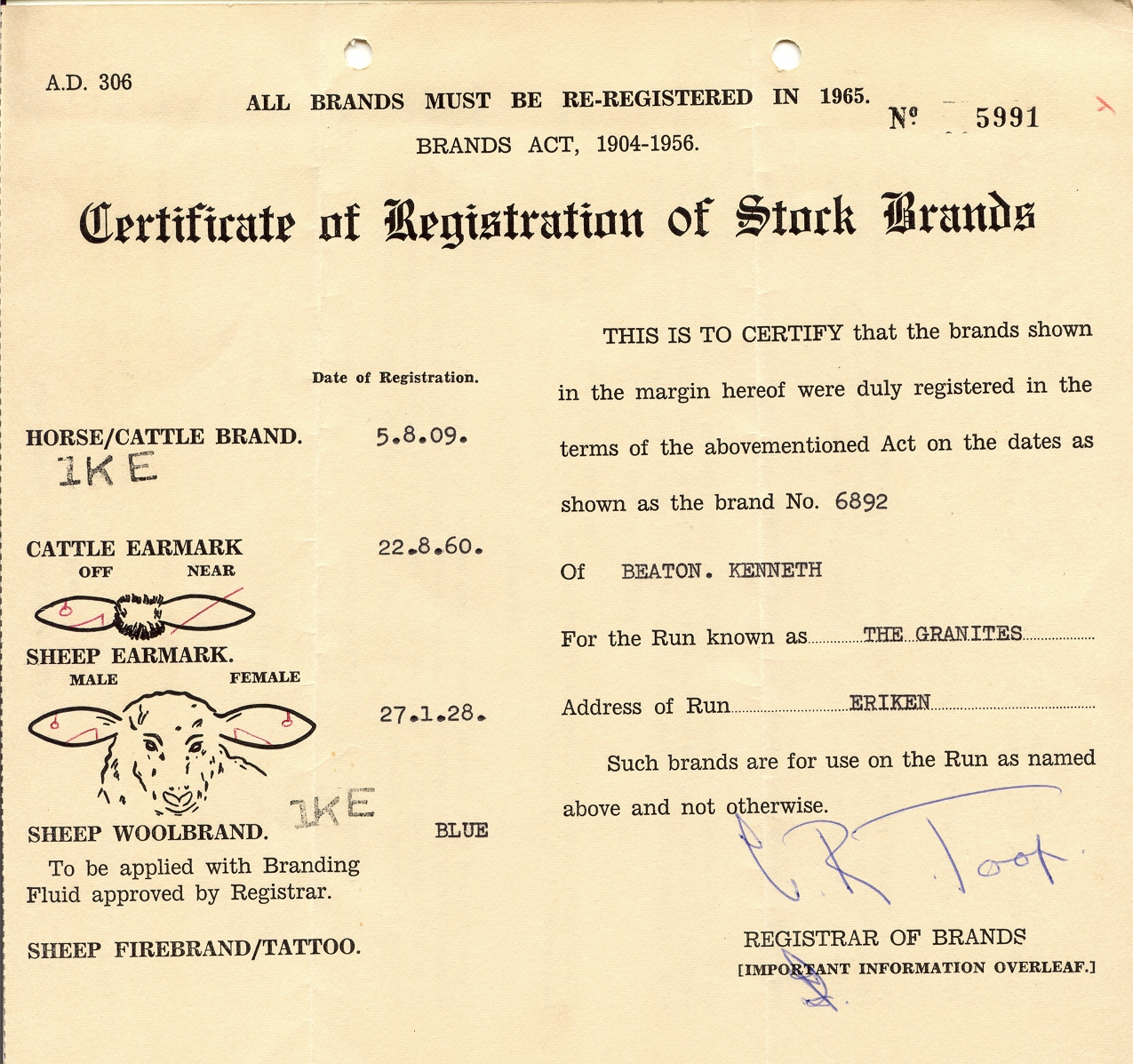
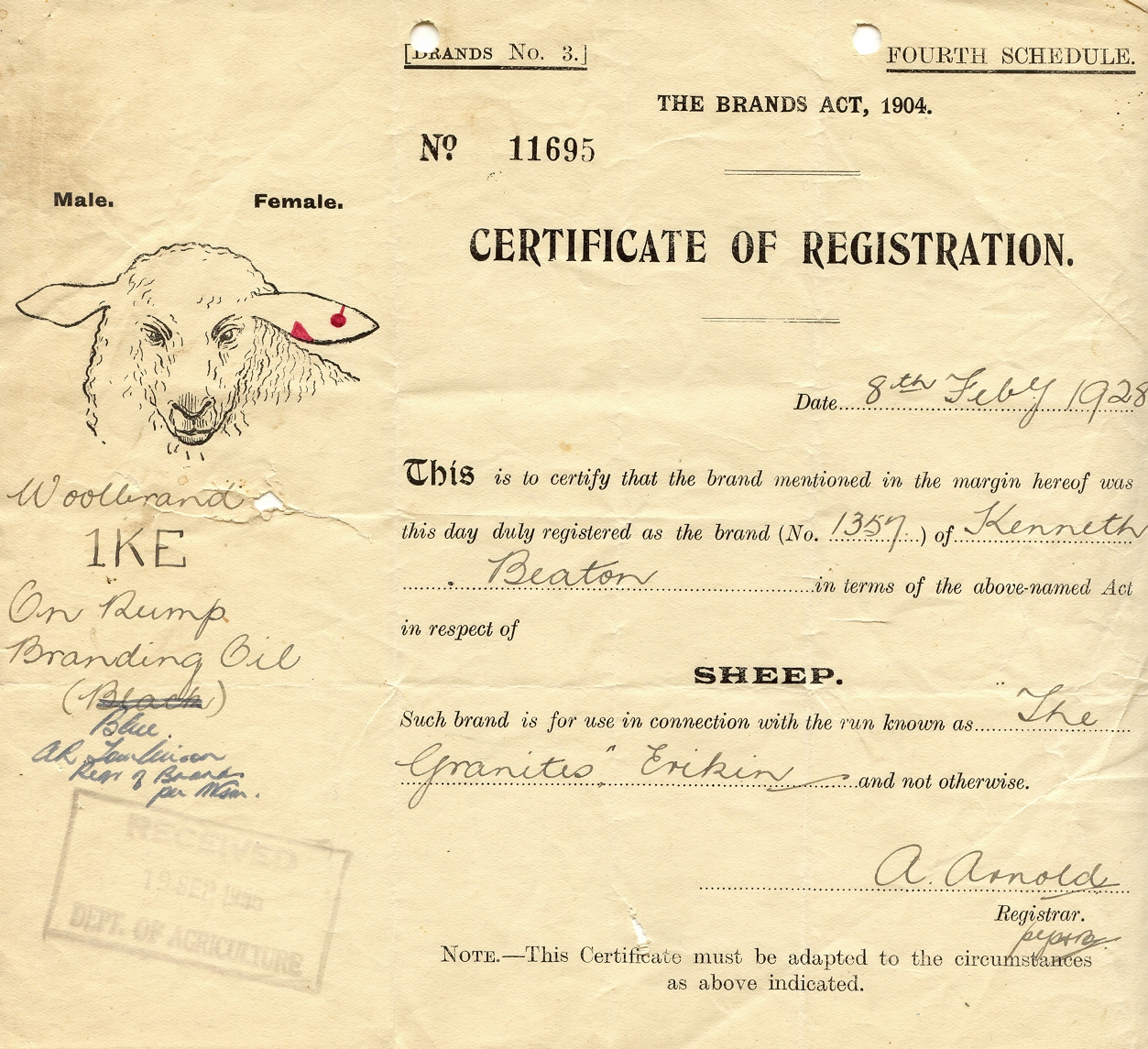
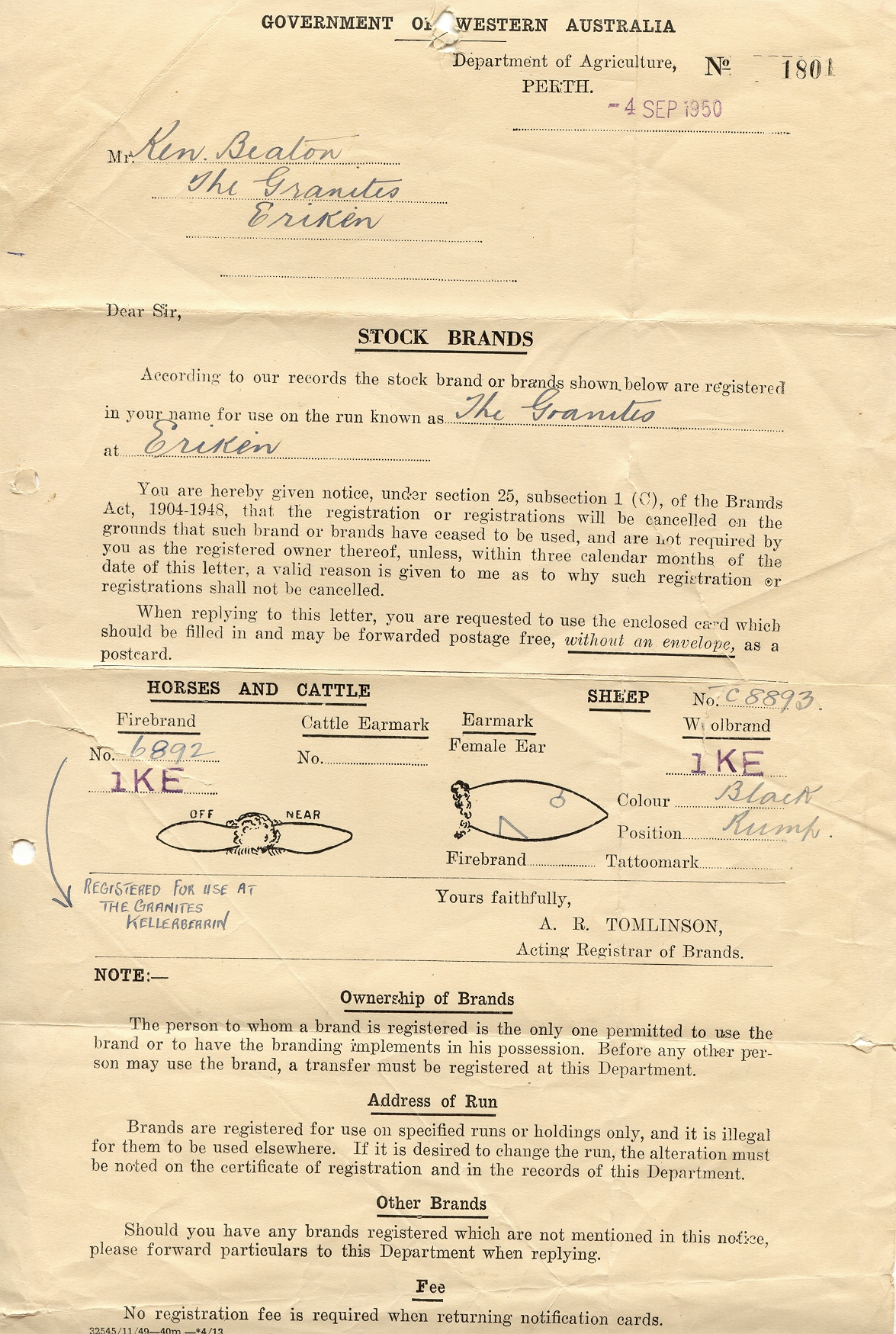
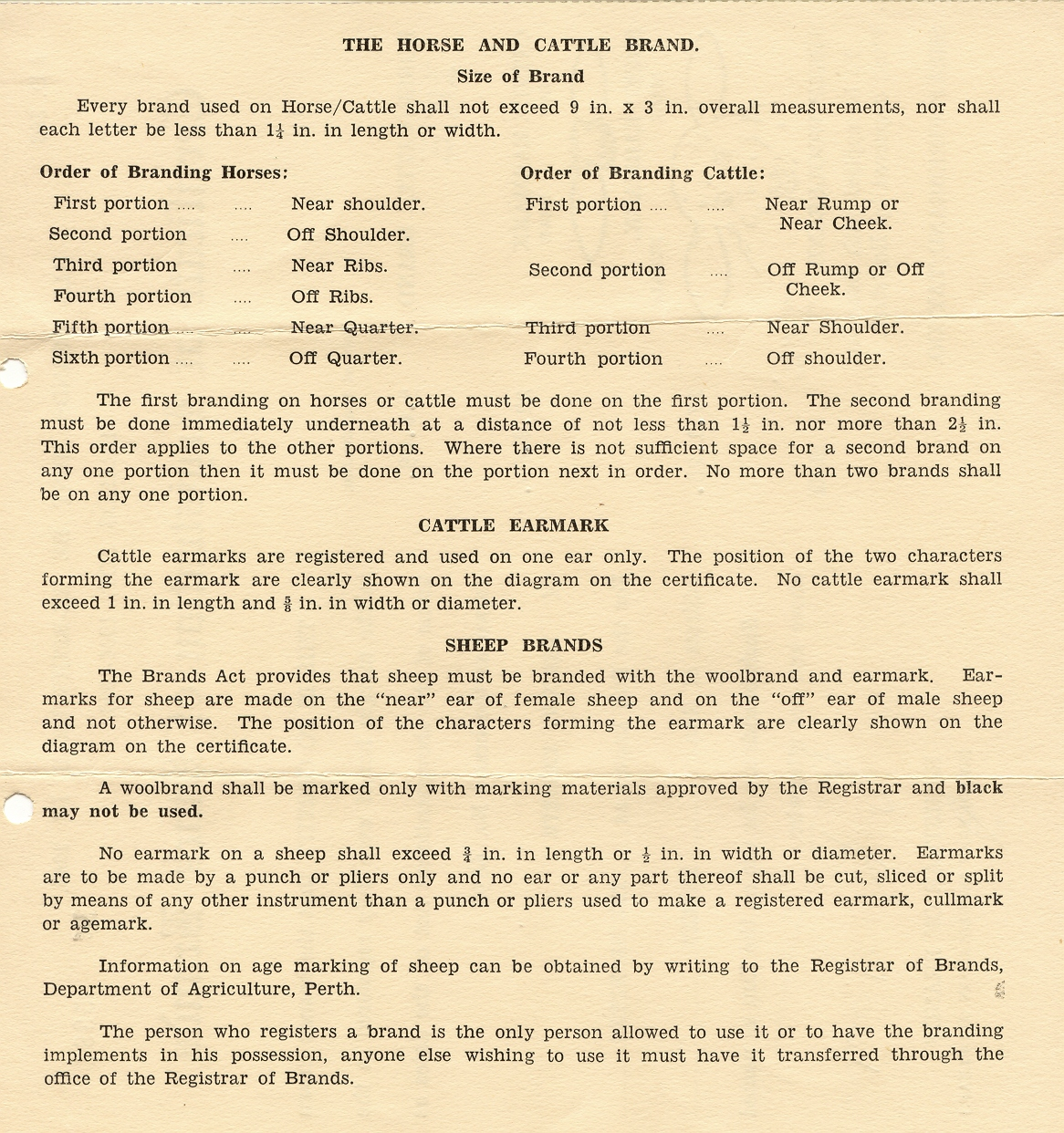
Ken’s Registration Papers
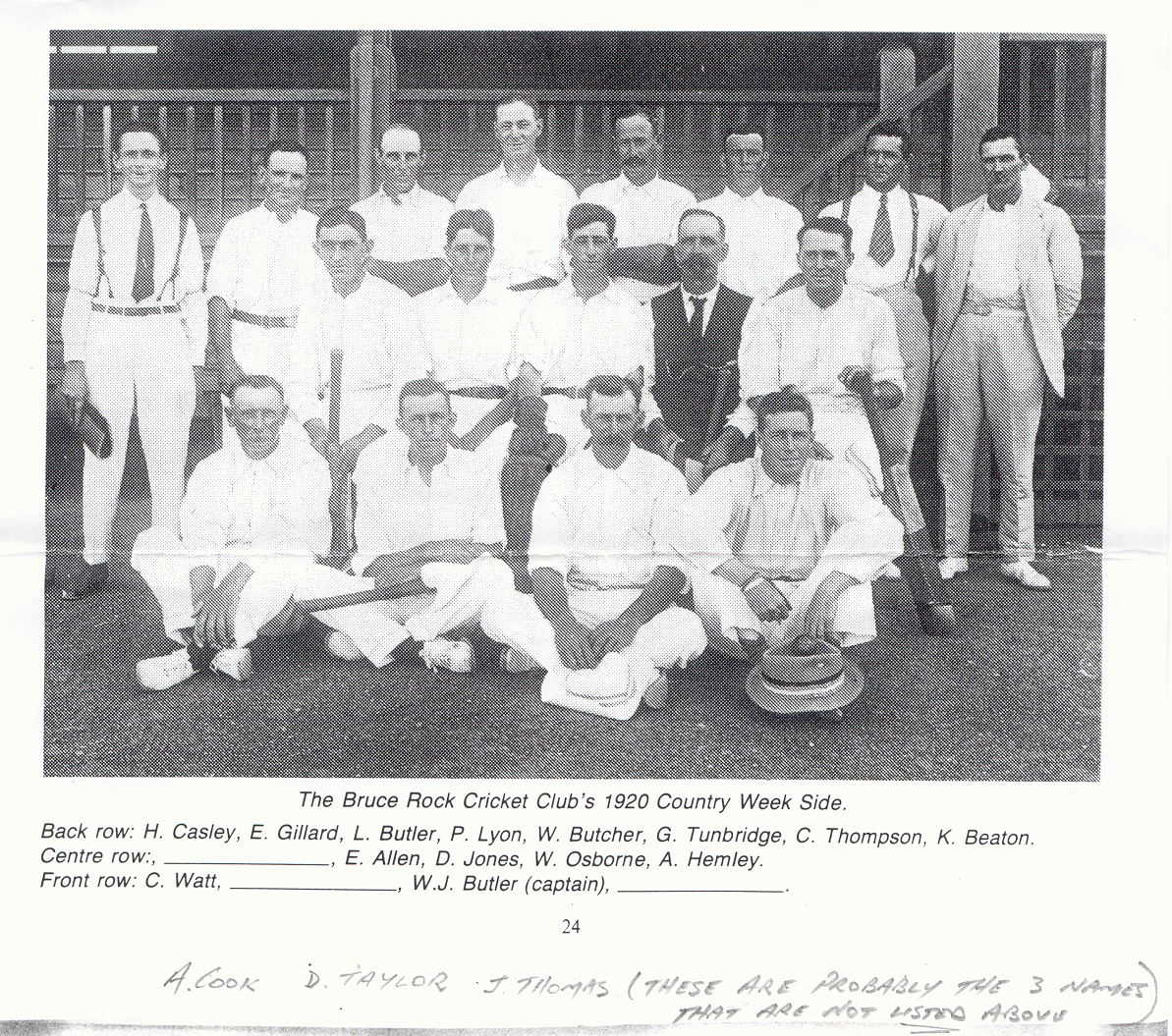
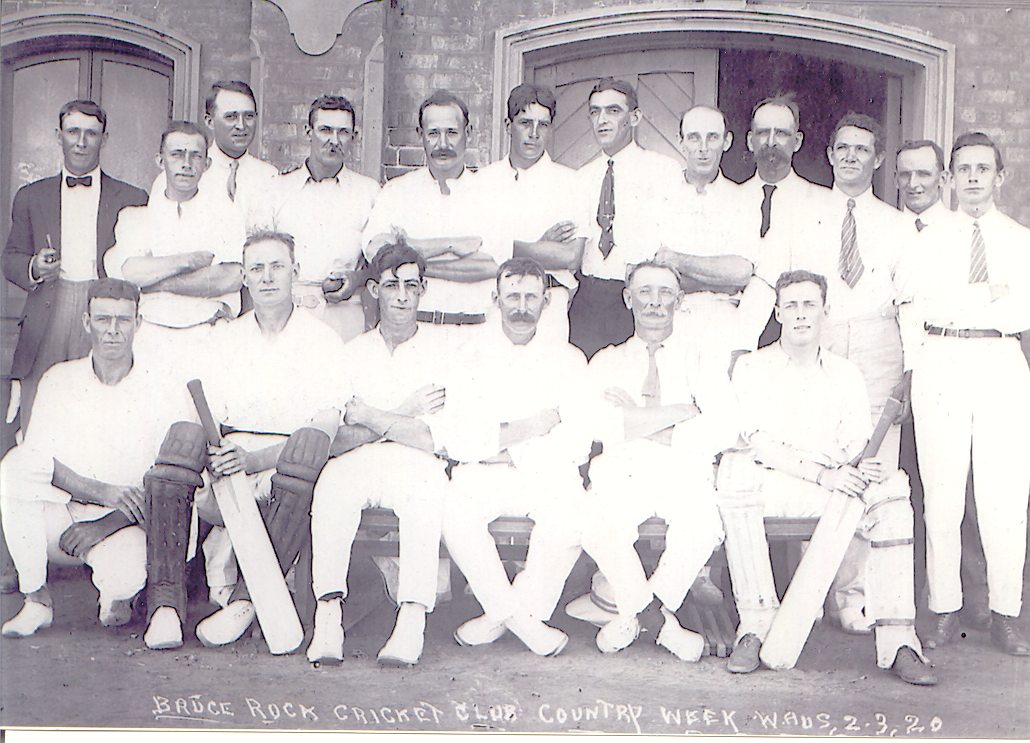
Bruce Rock Cricket Club
We both embroidered cloths, covers, dressing table sets and d’oileys for our respective Glory Boxes. Mother had given me her old cabin trunk in which I stored all my treasures.
Gwen was a very good cook, especially making sponge cakes. She used an old rotary egg-beater and whisked away with ease and the resultant cake was light, fluffy and inches high. When it was my week to cook I battled hard to get the same result to no avail. Mother would have been horrified to know just how many of my sponges would finish in the ’chook’ bucket, hammered even flatter by my fists than they were when they came out of the oven.
Although I was engaged when I was eighteen Father said that I could not marry until I was twenty-one. His decision was never questioned and after turning twenty-one in June, I was married the following November.
We were married in Bruce Rock by the Rev. Sam Slater, a very dear friend with whom we had spent many happy evenings singing around the piano.
The ceremony took place in the Methodist Church and the fact that Jack was Church of England and I was Presbyterian did not deter Sam. Many years later he was to marry Donal and Coral.
We set up home in a newly built wood and asbestos home on the top end of the farm.
We had been given $1000 to build and furnish the house. We managed and were quite comfortable and full of plans. Jack’s brother, Ron and his wife Lal had married and shared the old house with Alf Langdon, the boys’ father.
Jack had planted a small orchard and water reticulated down the hill to the house from a soak near where the boys used to camp when they were working that part of the farm. We had a beautiful vegetable garden and I grew huge carnations and stocks. The soil was admirably suited for a garden and we derived much satisfaction from our efforts. We were very happy together. For years we lived on $8.00 a week. We had our own vegetables, meat, eggs, milk, cream and butter from a cow that mother had given us for a wedding present. Wheat was taken to the mill at Kellerberrin and flour accepted in exchange. I made my own bread, jams, pickles and later we acquired a Fowler’s Bottling Outfit, bottled fruit, vegetables and if the fishermen were lucky, salmon from Albany.
Though we had little to spend we lived well.
We planned to have three years together before we had children but it was four before Kenneth John arrived. That year was a special year for us. We had a baby, we bought a wind light (The wind light had four blades on a long stand, it was connected to a bank of batteries. This kept us out of the dark when the wind blew but when it was still, out came the old kerosene lamps) and my Auntie Marj sold the farm at Bruce Rock and I was entrusted with her piano till they were settled again.
Two years later our second son arrived. He was a lovely chubby child who either had a huge grin or was howling because he fell and bumped his nose. He was particularly friendly and at tennis matches would, at lunchtimes, wander off and visit parties of players and score a sausage roll, sandwich or a cake. Everyone loved him.
Mother had a house at Middleton Beach, near Albany and we would all spend our summer holidays there. Both Ken and Donal were born there after harvest. Each time Jack had to return home before the babies arrived and my parents kept me company.
We spent 50 consecutive January holidays at Middleton Beach and we all loved the place. We went fishing, we swam and had picnics, played tennis and golf and I am sure tried all the fishing spots in the area. It was great fun.
In the evenings we would play cards and go to the pictures. Both Ken and Donal have holiday homes there and I still have the block though the old house that saw so many happy times is no longer there. Having the cool change half way through the year was good for us all and gave us new energy to see out the last of the summer.
In 1939 Ron enlisted and was drafted to the Second Fourth Machine Gunners and was sent to Malaysia. He died at Changi early in 1944.
Prior to him leaving W.A. he bought a house for Lal and their two boys, Colin Robert and Maurice Frank, so that should anything happen to him overseas, his family would be cared for.
The machinery sheds, workshop and motor vehicles were at the lower end of the farm and as Jack was expected to do the work, it meant he had to travel the two miles every day somehow, nowdays it would be simple but petrol was rationed then. Knowing that the family would not be returning to Erikin and Pops Langdon was on his own, after much deliberation (not enough I realise in hindsight) we moved to the old home.
All our dreams and plans for the future went out the window. What I went through for thirteen years trying to bring up our family was devastating and the interference shattering. They were the worst years of my life.
We had plans to have four children if we were lucky. It was six years after Donal’s birth before I became pregnant with our third son, Winton. We tried for twelve months without any luck, then I had appendicitis and finally in April 1944 we welcomed our baby. I was told that I should not have any more children so that was our family. We were very proud of all of them and loved them dearly.
Time went by and gradually after the war prices for wool rose and we were able to purchase our own vehicle and enjoy some good holidays in the Eastern States, taking the boys to see the Davis Cup in Adelaide.
When Mother died, Winton was about five, Jack and I took Father to New Zealand after his trying time in Albany for three years prior to mothers death. This was to be our only overseas trip as Jack was a very poor sailor and flatly refused to set foot in an aeroplane. However we had many happy holidays travelling by bus and train over almost every part of Australia. We were very fortunate there.
The three boys were educated at Shackleton State School and at Scotch College, a privilege that had been denied to Jack. Academically they were average students but all were above average sportsmen, much to the delight of their father. Jack was a very good participant in every sport that he followed, so the boys had to do well to come up to his expectations.
The Kellerberrin Bank Accounts
Account Number 2 at the Bank of New South Wales, Kellerberrin.
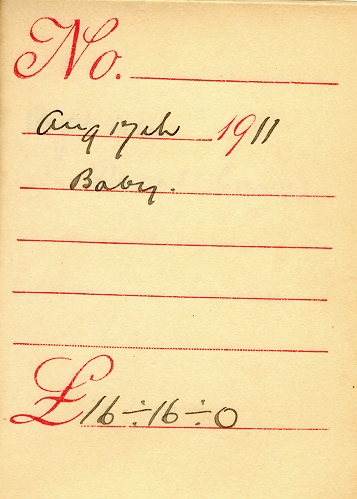
Entries in a 1911 cheque book showing amounts we can only dream of now.
Note: Account for BABY (Joan). There were no cheque numbers in 1911 and 1912.
Date
Payment to
For
Amount
Selected few cheque butts for 1924 and 1925 (numbered now).
Note: Expenses had risen over the intervening 13–14 years.
Date
Payment to / item
Amount
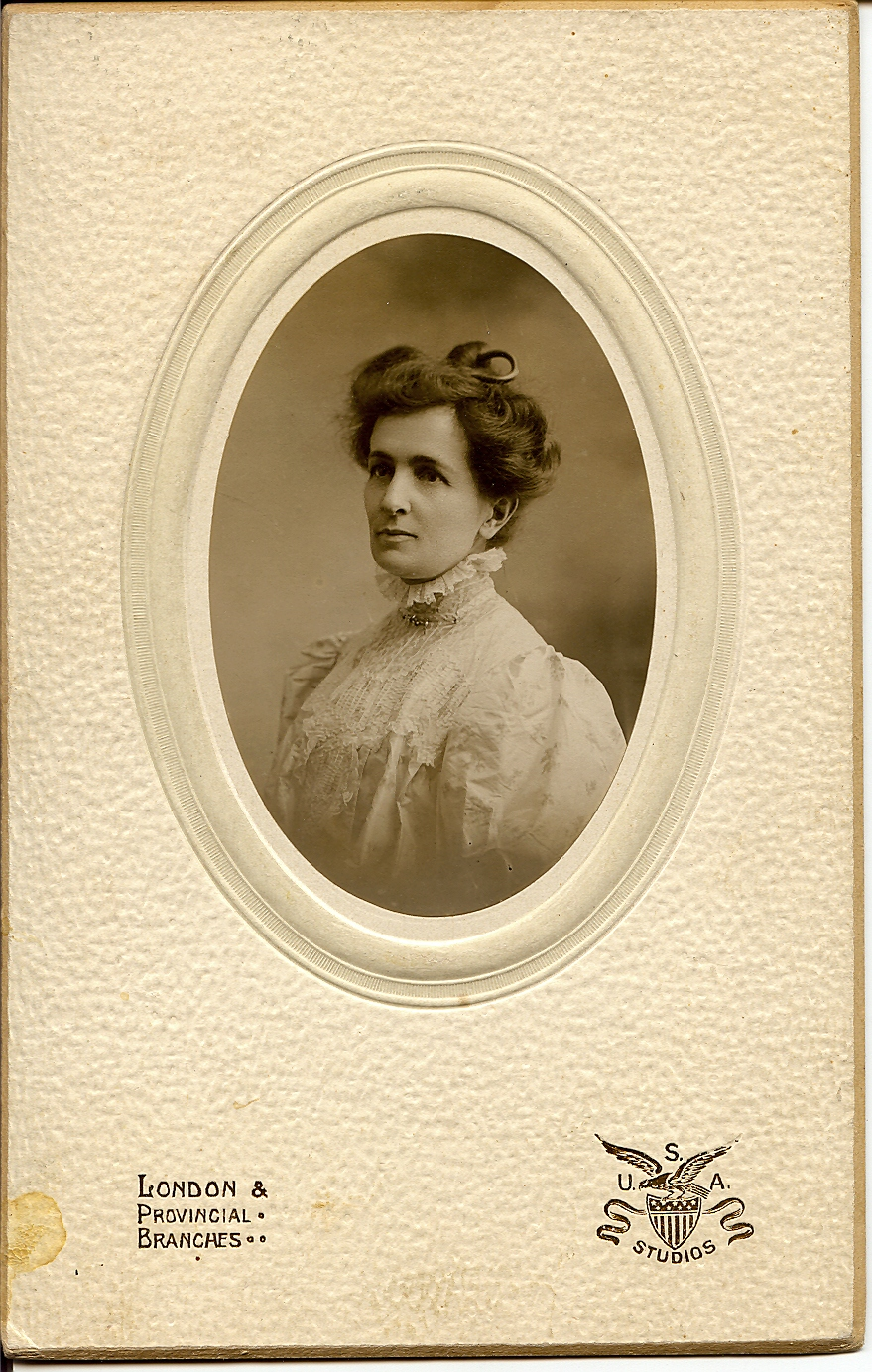
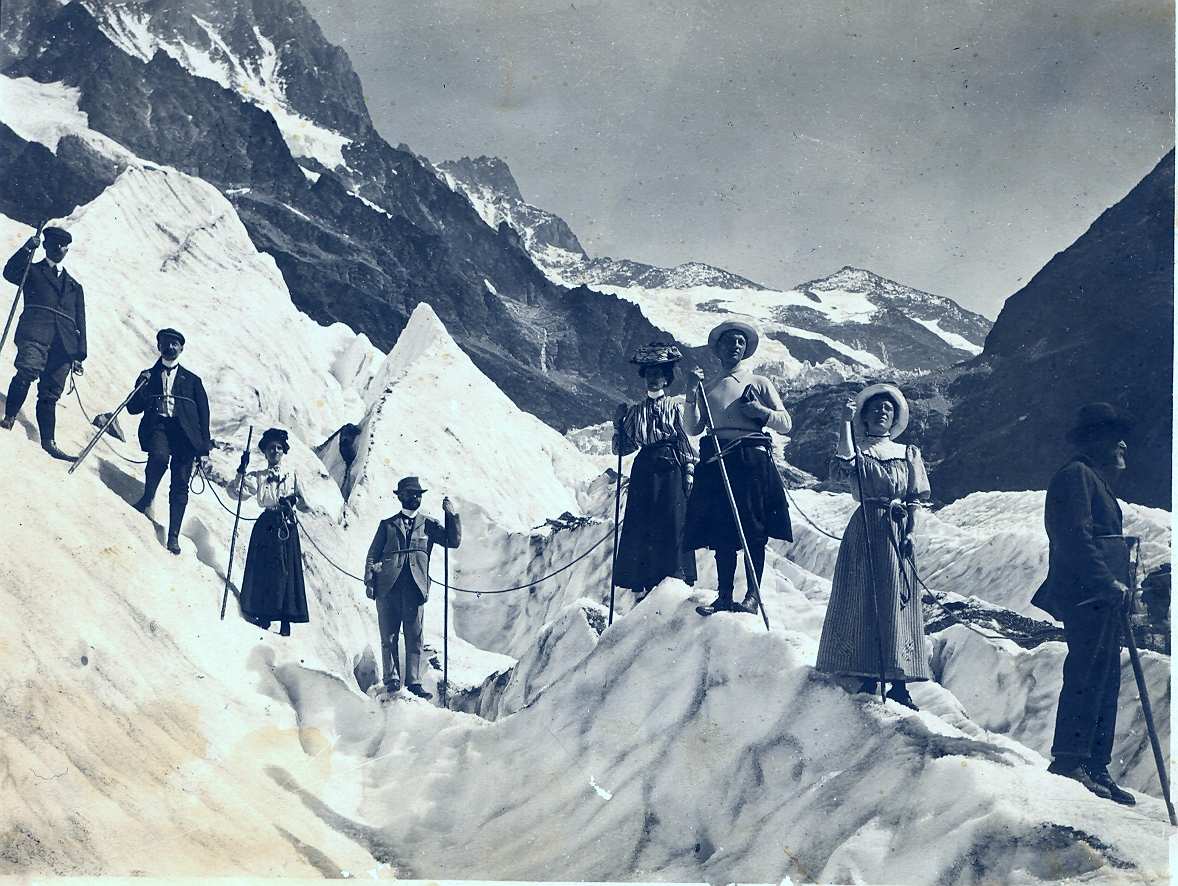
Family Photographs
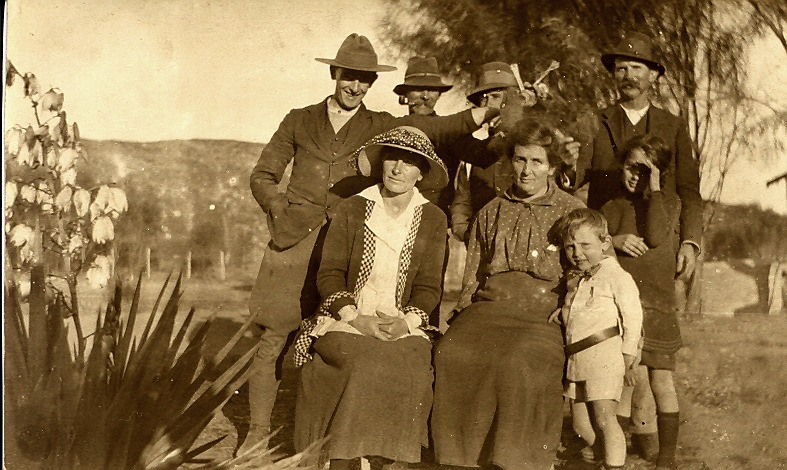
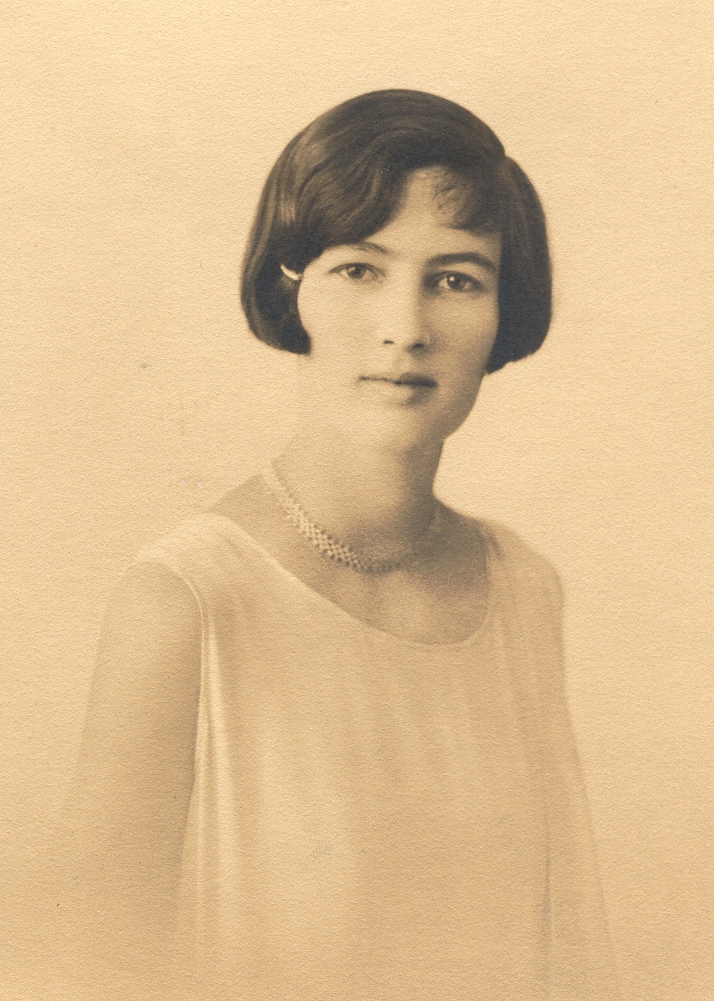
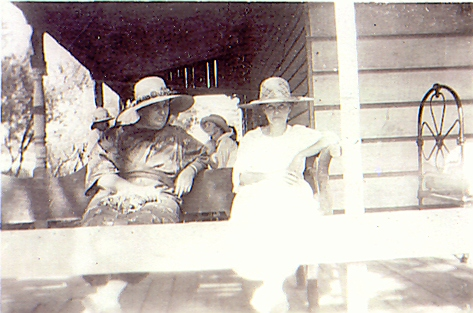
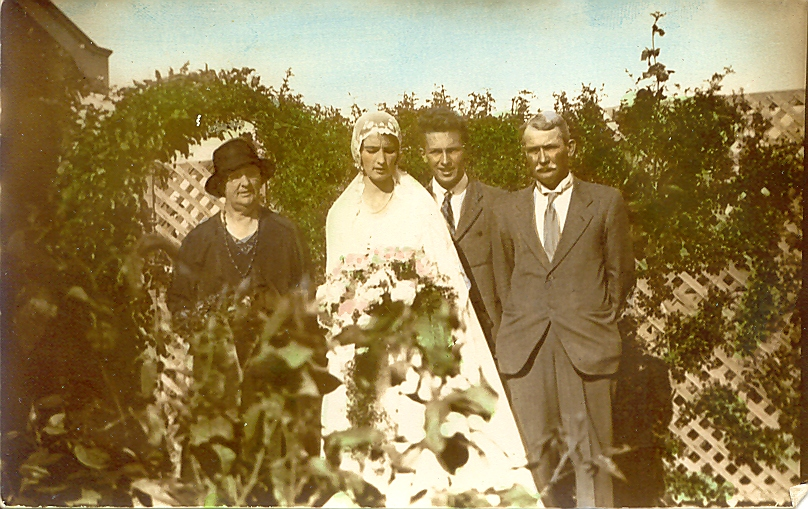
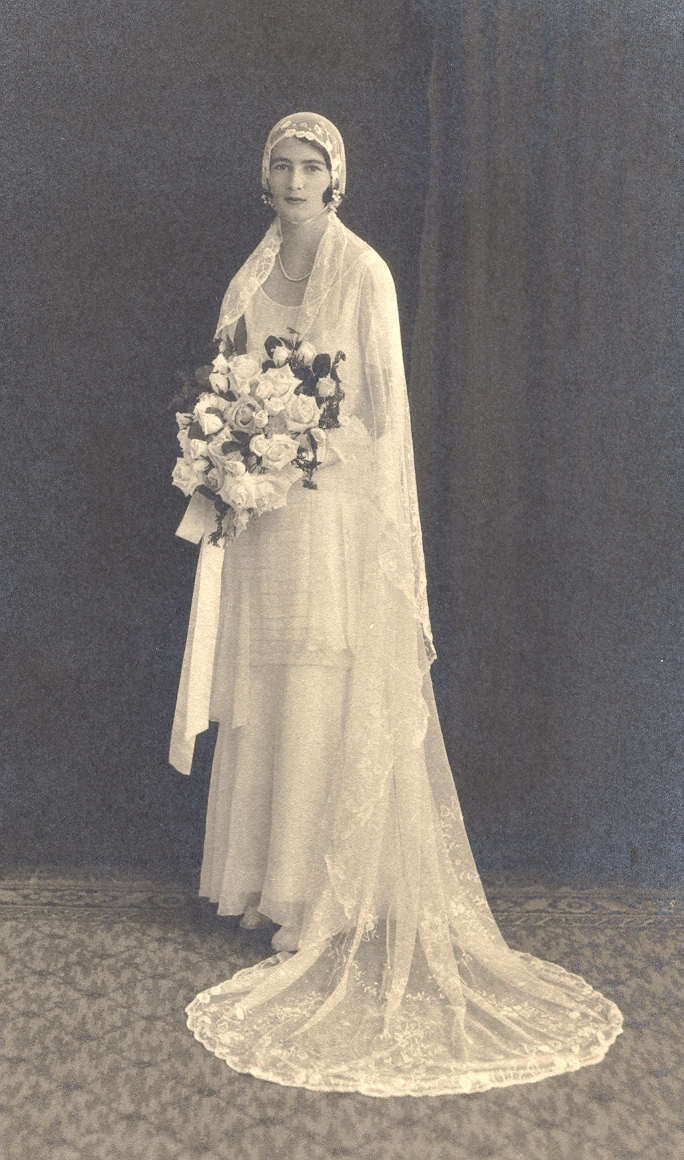
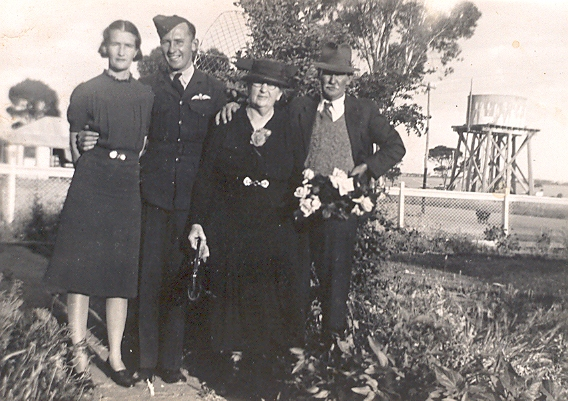
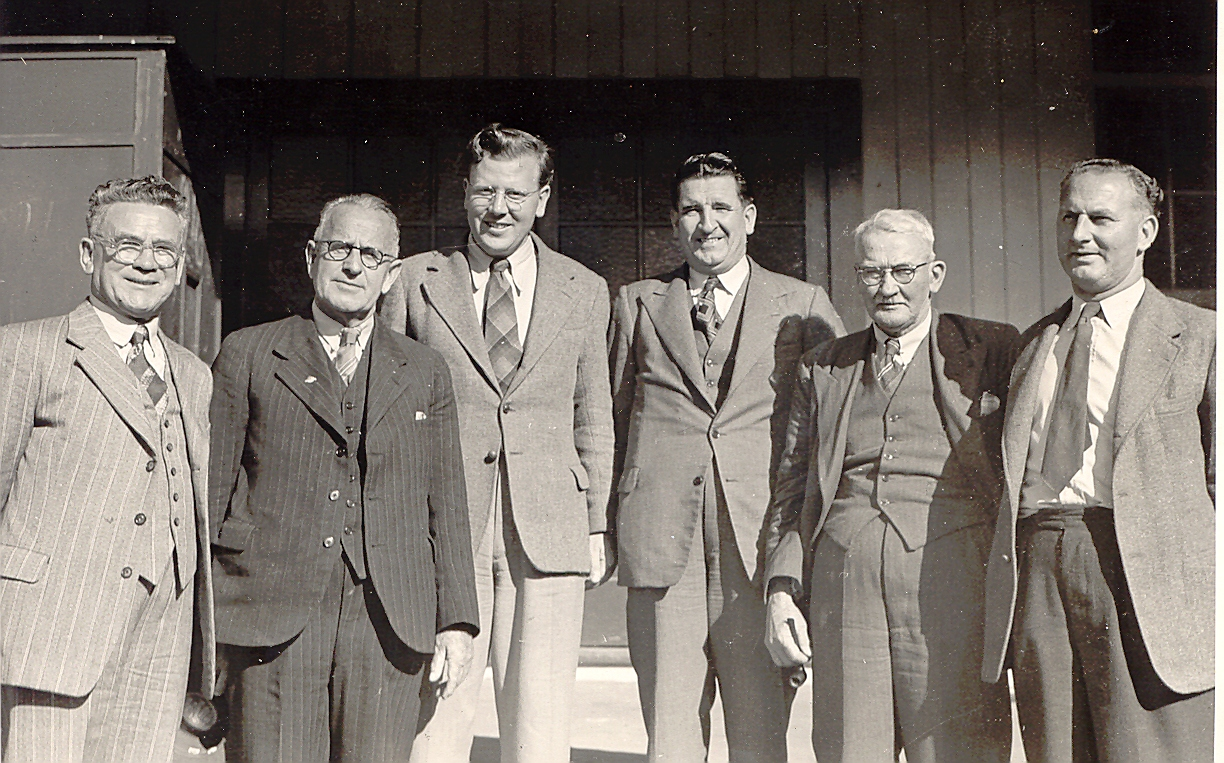
Ken Beaton’s record of service to his Community.
Member of the Irwin Road Board at Mingenew from 1904-1905 and again 1906-1909 Member of the Bruce Rock Road Board 1918 - 1924 . Member of the Masonic Lodge. Member of the Shackleton and Districts Club. Member of all the local sporting Clubs. Foundation Member of the Middleton Beach Bowling Club, Albany.
Later Years
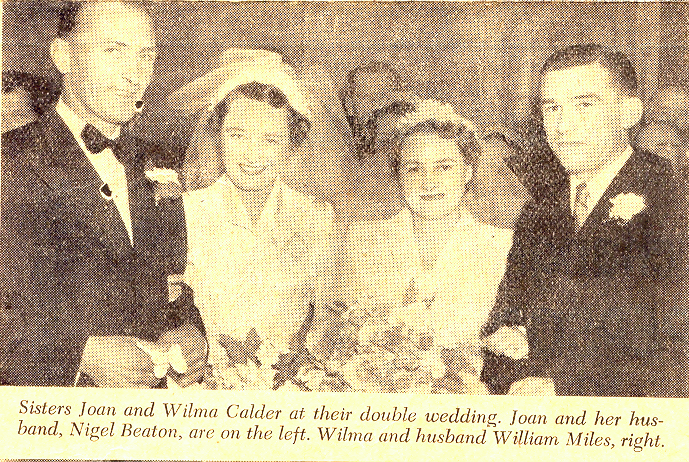
Jack had a heart problem and finally had to give the green keeping job away and with failing health he passed away at our home in November 1984, just four days before our fifty second anniversary. I have now been alone for nearly nine years. I am blessed with a group of very dear friends, a loving and caring family, three sons, three daughters-in-law and nine lovely grandchildren and I am proud of each and every one of them. At the outbreak of the Second World War Nigel enlisted in the Air Force, at this juncture I believe there were seven Beaton Brothers or cousins in the Air Force. Uncle Charles’ sons Ron and Peter, Uncle Jack’s Ian , Uncle Jim’s Stuart, Uncle Don’s Don and Duncan, and Nigel. Nigel became a flying instructor and served at Cunderdin, Geraldton and Batchelor. When mother had a stroke and was in hospital in Perth for eight months, Father was not able to cope with the farm as well, so Nigel was released on compassionate grounds to come back to the farm. My parents came back to ‘The Granites’ when mother was discharged from the hospital and when holidays came around she desperately wanted to go to Albany again. It was against our better judgement but she got her way and accompanied by a nurse we all set off. During these holidays our fears were realised and mother suffered a second severe stroke which left her unable to speak or move. It was a devastating blow, and we left her and Father there when we had to return to the farms. After mother died in Albany where she had spent three years in hospital, father returned to the farm. He had spent those years in Albany walking each day from the cottage in Middleton Beach to the Hospital, a distance of three miles, spending time with mother and then walking back to the empty house. Nigel was managing the farm and dealing with a series of married couples who were engaged to look after Nigel and Father. They came and went in quick succession, Father was not very co-operative. Nigel married Joan Calder, who was in the Army Signal Division and the daughter of Alec Calder who came out from England and actually worked for father in the early days. The situation with father became more than Joan could cope with and she went away to Melbourne where she stayed for several years. Nigel built a lovely new home on the farm and Joan came back and they took up residence. We had gone to Albany and Joan and Nigel had gone to Perth to buy things for the home and our old house was burned to the ground. It was a shocking thing to have to cope with and a traumatic time for all of us. We lost everything that we owned except the holiday things we had taken to Albany. A few years later when Winton and Kaye were married they started at the Granites, share-farming with Nigel. There were no children for Joan and Nigel, much to their sorrow, and they adored our three boys. They retired to Mandurah having sold the farm to Winton.
They gave us both, much joy and the satisfaction to realise that we had given them every chance and the rest was up to them. Not one has disappointed either of us. After completing their education all three came back to the farm, somehow it was the expected thing to do. We bought a second property at Babakin, about twenty miles south-east of Erikin. This we worked from home, and at busy times the boys would camp there. Ken was the first to marry , so it was automatic that he and Libby, the third daughter of my cousin Irene Hadley of Melbourne, were to live there. It was several years before Robert John was adopted and then in 1966 Susan Elizabeth arrived, Andrew Hadley in 1968 and finally Jennifer Kate in 1973. Robert has lived in Townsville for several years since he left Scotch College. Susan works in Perth. Andrew, after attending Scotch and the University of W.A. got a job with the Reserve Bank in Sydney and currently is enjoying a two year stint at the bank’s New York office and Kate is still at Uni, studying Physical Education. Winton was the next to marry and he and Kaye have a girl and a boy. Karl is a well known footballer with the Eagles and Kelsie works for a real estate agent in South Perth. Donal was with us the longest and he married Coral Godenzi from Kalgoorlie. Sam Slater performed the ceremony for them, as he had for Jack and I in 1932. Donal followed us in producing three lovely sons too, Donal Jnr, Anthony and Jay. Donal is an accountant in Perth and both Anthony and Jay are home on the farm. With Donal’s marriage impending Jack and I had much discussion about what we would do and where we would go. I wanted a home of my own, only having eight years in our first home, and Jack wanted to go somewhere where he could look after a bowling green and go fishing. He also wanted to be handy so that he could help out on the farms if needed at busy times. Winton and Kaye’s marriage broke up, ‘The Granites’ was sold and sadly passed out of the Beaton family. The original old house still stands and is over eighty years old. Father stayed in the old home when Nigel moved to the new building and one day he was in Shackleton at a busy bee for the Bowling Club . He was leaning on a garden seat and it was accidentally moved causing him to fall and break his hip. He was admitted to Bruce Rock Hospital where he passed away in September 1963 at the age of eighty eight. He was an avid reader who read without glasses and still loved his whisky. His tales of the north were legendary and although I must have heard them dozens of times I can not remember them. Father had a most retentive memory and could quote from any period of history. I have in my possession his collection of about two hundred books. Some of the books are quite valuable and many very old. We finally compromised and built a comfortable home in Shackleton. Jack would have lived in a tent but that was not for me. Jack was able to look after the local bowling green and I was happy with the house and garden and baby-sitting when the occasion arose.
Nigel had a job with the Country Party and travelled all over the state as a representative. He was instrumental in the formation of the Dudley Park Bowling Club and then the South Mandurah Bowling Club. They travelled extensively by caravan all over Australia and escaped the Mandurah winters by going north each year. When Alec Calder died Joan’s mother went to live with them in Florida, south of Mandurah, and they continued going to Broome, and then settling for Monkey Mia for several years. It was there that Nigel dropped dead whilst starting the boat to go fishing. He died in June So I lost my only brother and my husband within four months. Joan and her mother , with friends continued to visit Monkey Mia for several years before Rita Calder passed away.
Joan planned a trip to England, she had cousins in Jersey where her mother was born and before going , had a last minute trip to the doctor for a final check. He discovered cancer of the liver and said that he was not able to help her at all. She decided to go ahead with the trip but had to cut it short and returned home only to pass away two weeks later. Both Joan and Nigel were cremated at Fremantle Cemetery and their ashes are in a wall there. Father was a fluent speaker and was connected with the Masonic Lodge for many years. He served on the Bruce Rock Road Board from April 1918 to November 1924, was a member of all local sporting clubs, the Shackleton and Districts Club and was a foundation member of the Middleton Beach Bowling Club. The Beaton name has gone from this part of the family but the blood still runs in the veins of the Langdon brood.
Joan Langdon. Shackleton 1996
Yarding School
From ‘The West Australian’.
A couple of errors !
Location No. 22235 Opened 19th June 1922 Closed 4th June 1943.
(Children of Jim Beaton and Nigel Beaton, only son of Ken Beaton.
Written for “History of Schools in the Shire of Bruce Rock 1911-1988” a project of the Bruce Rock Tourist Committee. 1988.
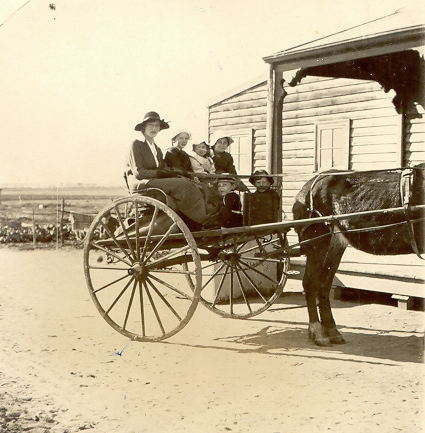
The school was located five miles south west of Yarding Siding. The first teacher was Hilda Hedges, who boarded with Jim Beaton’s family, and took Connie, Marion and Stuart and myself (cousin) to school in a horse-drawn sulky. I don’t know how long this arrangement continued, probably only for the first year. After that the teachers boarded with Frank Smith at the Greenville property. When Jim Beaton left the area , about 1925, I went with Eileen and Peggy Spiller, Dorothy, Sylvia and Charles (Boy) Smith in a sulky driven by Eileen Spiller. The school was the usual single room affair, with a bough shed in the back yard, and later three pepper trees out on the road verge, where there was also a bough stable for the horses. In the same book Margaret Smith adds to the story of the school. The school was a one-roomed wooden structure with a porch attached on the north side. It had a small fireplace at the west end which was needed and appreciated during the winter. Summer time we managed with a water bag ! There was a bough shed where we ate our lunch and playlunch. Two pan toilets at the end of the playground completed the school complex. Two boys were responsible for emptying the toilets - easier digging in the winter than the summer. A small tank caught the water off the school roof and provided our drinking and hand-washing water. In the 21 years that the school functioned there were eleven teachers, ten of them women.
From Chapter 16, Flora and Fauna, page 99 - Among the rarer marsupials is the black-flanked rock wallaby (Petrogale lateralis). It was formerly common at Kokerbin and Coarin. Today it is found in more remote parts of the wheatbelt, in the north-west and Kimberleys. It still exists at the Quurekin Rocks alongside the homestead of Mr K.Beaton. From 1909, when he first selected on this property, Mr Beaton has acted as protector of these animals, threatening to shoot anyone who shot them. He recalls seeing as many as forty or fifty of them at one time in the early days, but in spite of his provision of food and water for them and his dire threats against those whose trigger-finger itched to shoot them, they are diminishing in numbers. In the summer of 1955-56 he found twelve dead bodies around the rocks. They were unmarked and he had no idea what caused them to die. In September, 1956, he doubted if there were more than six left. Naturalists came from time to time to study and photograph these attractive little animals which began to emerge from the rocks at sundown and continue feeding during the night. Recently two men came from an eastern states museum and set up a flash camera and a small calibre rifle on a tripod. Seeing this , Mr Beaton went inside and returned with his .303. “Don’t use that on them,” cried one of the naturalists. “You’ll spoil the pelt.” “This isn’t for the wallabies,” said Beaton, “ It’s for you if you shoot one.” The naturalist sighed, removed his rifle and tripod, and had to remain content with what his naked eye and the camera recorded.
Extracts of interest from “BRUCE ROCK -THE STORY OF A DISTRICT” by John K.Ewers. Written for the Bruce Rock Road Board in 1959.
Nigel’s War Service Records
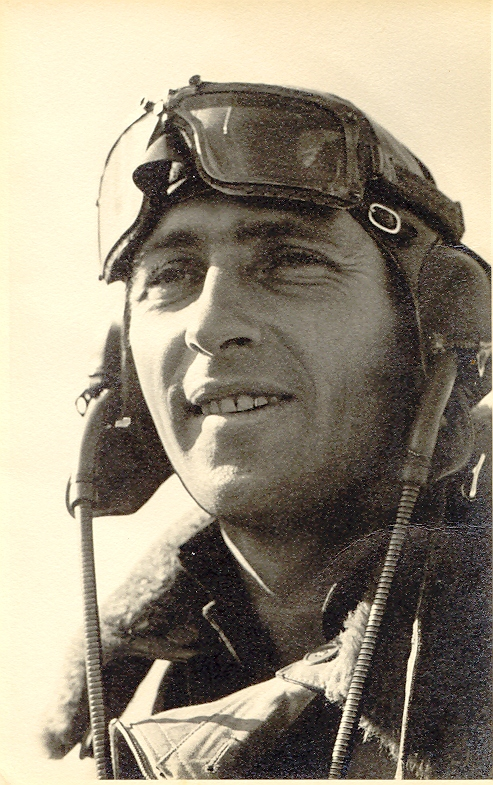
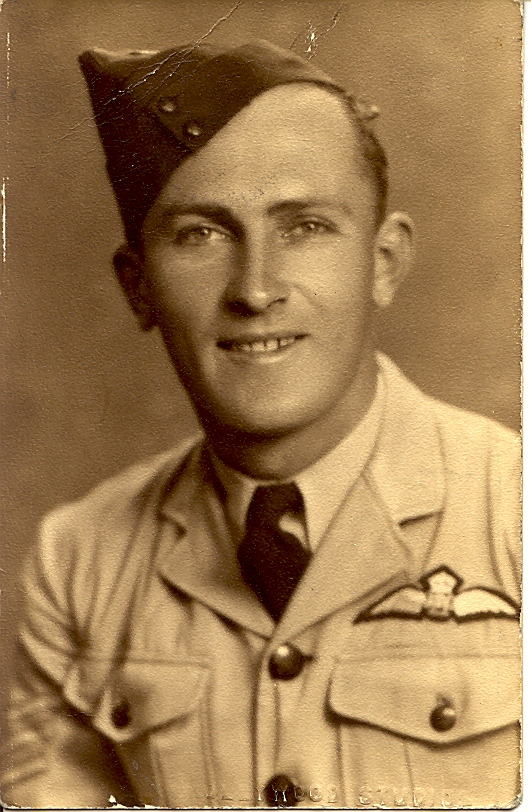
Royal Australian Air Force Attestation of No 406686 BEATON Nigel No 4 R.A.A.F. Recruiting Centre, Perth, W.A. Trade : Farming and Grazing Age : 25 years 3 months Height:5 feet, 10 inches. Weight: 138 lbs Hair: Dark brown. Eyes Grey. Appointed to No 5 Initial Training School, Pearce. 3rd March, 1941. Awarded Flying Badge 26.8.41 4S.F.T.S. DH82A Dual 28 hours 05 minutes Solo 25 15 Anson Dual 30 00 Solo 73 15 14/6/45 Assessment Certified that this officer was employed on full flying duties. A good type of officer, keen and conscientious and with a pleasant personality. Extracts from Flying Log Book Flying Officer N.BEATON (406686) 7 Comm Unit Pearce First Flight 26.2.44 Ansons Last Flight 5.7.44 All flights carried out on Mainland 6 Comm Unit BATCHELOR First Flight 15.8.44 D.H. 82S Last Flight 30.5.45 Units 5 I.T.S 3.3.41 - 24.4.41 9 E.F.T.S. 25.4.41 - 26.6.41 4 S.F.T.S. 27.6.41 - 17.10.41 C.F.S Camden 18.10.41- 19.1.42 4 S.F.T.S.Geraldton 20.1.42 - 14.2.44 7 Comm Unit 14.2.44 - 10.7.44 5 P.D. 11.7.44 - 9.8.44 6 Comm Unit 9.8.44 7 days Commpassionate Leave 26.1.45 - 1.2.45 6.C.U. 4/45 Discharged 13.8.45 5 P.D.P.O.R. 578/45 Movements To Derby 2/4/44 Returned 15/4/44 Tour Unit 15/44 Proc. on T. Duty to Batchelor on 10/5/44 Returned 25/5/44 7 Comm Unit 15/44 Proc. on T. Duty to Kalgoorlie on 1/6/44 Returned 2/6/44 7 Comm Unit 15/44 Discharged from the R.A.A.F. ON 31.5.44 under A.F.R. 115. “On being granted a Commission” 6 Comm U. 14/44. Awarded: Returned from Active Service Badge, 1939-45 Star
Obituary of the late Mr Nigel Beaton
The sudden passing of Nigel Beaton on June 14th was a tremendous shock to his family and friends, even though he had not enjoyed good health for some time. Nigel with his wife Joan and Joan’s mother, Mrs Calder, had gone to Monkey Mia in Shark Bay from Florida on a fishing holiday expecting to stay five months and thus escape the wet and wintry weather of the south of the State. They had only had two weeks in the sun when Nigel collapsed and died instantly. Nigel was born in Kellerberrin on November 17th 1915, the only son of the late E.M. and Ken Beaton of “The Granites” Erikin. He was one of the first pupils in the newly opened Yarding school and later won an entrance to Northam High School where he completed his education and passed his Leaving examination with good marks in nine subjects. After leaving school it was back to the farm where he worked with his father until the outbreak of World War 11. He enlisted in the R.A.A.F. and served with them till his release towards the end of the war, when his father was no longer able to manage on his own. Nigel became a flying instructor and was stationed at Batchelor in the Northern Territory, Geraldton and Cunderdin.He also piloted the Flying Dr Plane for Dr Fenton. He was elected a member of the Bruce Rock Road Board in 1950 and served on the board until 1954. Later in 1969 he was elected for a second term of office and became President of the Shire in 1969, which position he held for several years. He resigned in 1973, having sold his farm to retire to Mandurah. He was instrumental in the formation of the Shackleton Golf Club, which had its’ beginnings at “The Granites” and was later to move to its present site. Nigel played cricket for Yarding and Shackleton, football and tennis for Shackleton and was one of the original members of the Bowling Club, helping in laying down the green and making much of the early equipment used in the maintenance of the green. He was also a foundation member of the Middleton Beach Bowling Club. Nigel belonged to almost all of Shackleton’s organisations, R.S.L. Community Service Assoc. and Shackleton and Districts Club. Nigel joined the Bruce Rock Lodge No. 104 W.A.C. on March 12th 1954. He held various offices and was made Worshipful Master of the Lodge in 1963. He joined Kellerberrin Chapter on June 8th 1959. He was Foundation Steward of Bruce Rock Chapter No 63, on May 28th 1960. He held various offices and was made 1st Principal on July 24th 1965. Grand Chapter Honours. Past 3rd Grand Sojourner was conferred on him on Oct 30th 1971 He resigned from Bruce Rock Lodge and the Chapter on December 8th 1981. After retiring from the farm he became involved in the political arena but his only venture was as Field Officer for the Country Party of W.A. which position took him to many areas of the State with which he was previously unfamiliar. Still interested in bowls, he was one of the many retired folk who instigated the formation of the Dudley Park Bowling Club, of which he was President for some time, and which Club now boasts a beautiful clubhouse and four greens. Because of the growth of the area and the popularity of the game, a third Mandurah Club was founded, the South Mandurah Bowling Club and Nigel was very much involved with that at the time of his death. As a mark of respect, the flags of all three Mandurah clubs were flown at half-mast the week of his passing. Nigel gave of his knowledge willingly and was a fluent speaker. He will be sadly missed by his family and his many friends throughout the state.
Kenneth Beaton born 12th August, 1875 in Copmanhurst
Married: Ethel Mary Foale Born 20th March, 1876
Father: John Thomas Foale.
Mother : Mary Emma Cobbledick
On 18th August, 1909 at Summerlea, Adelaide S.A.
Children: Joan born 30th June, 1911 at Mt Kareenya Hospital, Perth.
Nigel born 17th November, 1915 at Kellerberrin.
Died: Ethel , 1st March, 1949 at Albany and is buried in Albany.
Ken , 29th September, 1964 is buried at Bruce Rock.
Joan married 9th November 1932, Methodist Church, Bruce Rock
To: Alfred John (Jack) Langdon
Born 2/9/1908 Died 5th November 1984.
Children: Kenneth John 10th February,1936, Kareenya Hosp. Albany.
Donal 7th February, 1938, Kareenya Hosp. Albany.
Nigel deWinton 24Th April, 1944 , Parkside Hospital, Perth.
Died : On 5th June, 2002 at Glengarry Hospital, Duncraig.
Kenneth John Married: 5/2/1960 at St John’s Church, Toorak, Melb.
To : Edith Elizabeth (Libby) Hadley born 9th July, 1937 Melb, Vic.
Children: Robert John born 23rd July, 1963 (Adopted)
Susan Elizabeth born 6th May, 1966, Perth
Andrew Hadley born 24th May, 1968, Perth
Jennifer Kate born 9th August, 1973, Perth
Susan Elizabeth and her spouse David Howat
Children: Matthew James 29th November, 1994, Fremantle.
Christopher John 6th December, 1997
Joshua David 31st May, 2002.
Donal Married: 14th February, 1970 at Perth.
To : Coral Anne Godenzi born 4th September, 1941, Kalgoorlie
Children: Donal Joseph born 10th November, 1970.
Anthony John born 26th April, 1972.
Bradley Jay born 18th November, 1976.
Nigel deWinton Married
To : Kaye Winifred Shenton born 24th May, 1945 at Quairading
Grt-grandaughter of George Shenton who ran ‘The Old Mill’ Sth Pth.
Children: Karl John born 28th March, 1968.
Kelsie Lee born 6th May,1970.
Nigel married November, 1950 at St Georges Cathedral , Perth.
To : Joan BeauchampCalder
Nigel died 14th June, 1984.
Joan died on 11th October, 1992
196