
FINDING PURPOSE.
After completing the three month live in rehabilitation program at Moonya, I graduated.
Walking out of rehab was something I had worked incredibly hard for, but graduation did not mean I was fixed. If anything, it meant the real work was about to begin. For three months I had lived inside an environment designed around recovery. There were routines, boundaries, counselling, support and people around me who understood addiction. Now it was time to take everything I had learned and put it into practice in the real world.
I had to learn how to live without constantly self medicating.
For me, that meant making some difficult decisions. I could no longer associate with many of the only friends I had. I needed to stay away from people, places and situations that could trigger me. I had to recognise the warning signs in myself and learn how to deal with emotions instead of trying to escape from them.
Most importantly, I needed purpose.
Before going into rehab, I had bought an empty old truck. That truck still sits on my lawn today.
I bought it because I genuinely did not know where I was going to live once rehab was finished. My future was uncertain. I had no rental history, no employment and no regular income. The operations on my wrists had taken away my ability to return to much of the physical work I had done throughout my life. I had a trade background and plenty of practical skills, but suddenly there were restrictions around what my body would allow me to do.
The truck was not some exciting project or dream of travelling around Australia. It was insurance against homelessness.
If everything else failed, I could turn it into somewhere to live.
I had around $20,000 in savings, but I knew I needed to protect that money. I could not just burn through it trying to survive. My goal was eventually to have my son returned to my care, and if that happened, I needed to be able to support both of us.
A halfway house or shared accommodation was not really suitable either. Perhaps it could have worked temporarily for me alone, but I was trying to build towards something bigger than that. I wanted to be a father to my boy again. Even the truck, while potentially enough for me, was never going to be a proper long term home for a child.
Once again, housing stood between where I was and where I desperately wanted to be.
Throughout my time at Moonya, Jenny had kept her distance. We had very little direct contact, and any contact with my son was organised through my sister, who he was living with at the time.
Child Safety was involved, as you would expect given everything that had happened. There were requirements I had to meet before visits with my son, including mandatory urine testing. I was completely happy to do it. I understood why those safeguards existed, and I knew that nobody owed me their trust just because I said I had changed.
My sobriety had to be demonstrated through my actions.
Getting my boy back was one of my biggest long term goals.
I want to make something very clear here. I had never been a bad father to my children. I loved my kids deeply. I had always been affectionate, loving, kind and fun with them. My children knew that I loved them.
But loving your children does not automatically mean you are in a position to safely care for them.
My substance abuse had become severe. It had contributed to psychosis, self harm and a complete collapse of my life. There is a difference between being a bad person and being a person who is no longer capable of providing the stability a child deserves. As painful as that was for me to accept, at that point in my life I had become the latter.
Love was not enough.
I had to prove that I could provide stability as well.
While I was doing that, Jenny had been watching my progress from a distance. She was communicating with my family and could see the changes I was trying to make. She also understood something that I was becoming increasingly worried about. Without somewhere stable to live, there was virtually no chance of my son being returned to my care.
Despite everything I had put her through, Jenny made an extraordinary decision.
She put our differences aside and allowed me to stay in her home.
That did not magically repair our relationship. It did not erase what had happened, and it certainly did not mean everything was forgiven. Trust does not return because somebody completes rehab. When you spend years damaging trust, you cannot expect another person to hand it straight back.
But she gave me an opportunity.
For the next four months, I continued doing what was required of me. There were processes to follow, boxes to tick and hoops to jump through. I kept working on myself, stayed sober and did everything I could to demonstrate that I could once again provide a safe and stable environment for my boy.
Then, eventually, the day came.
I got my son back.
It is difficult to explain what that meant to me.
Only months earlier, I had been at the lowest point of my life. I had lost my home, my stability, my sense of direction and, for a period, the ability to have my child living with me. Now I was sober, rebuilding my life and holding my boy knowing that I had earned back the right and responsibility of being his full time dad.
I was incredibly grateful.
There was still plenty of work ahead.
My relationship with Jenny was badly damaged, and rebuilding trust would take much longer than rebuilding a routine. We attended couples counselling during those early stages and started trying to work through some of what had happened.
I also continued with aftercare through Lives Lived Well, an organisation that provides alcohol and other drug counselling and recovery support. Rehab had given me tools, but recovery did not finish the day I graduated. After twenty five years of addiction, I knew three months in a program was not going to undo everything overnight.
There was another part of my recovery that I was still searching for.
Purpose.
I desperately needed something positive to do with my life.
One of the strangest things I discovered during recovery was something I can only describe as finding my soul.
Addiction had taken so much from me over twenty five years that I had become numb to a lot of things. People would talk about everyone having a soul, and I genuinely used to wonder what that meant. Sometimes I wondered whether I even had one.
For years, most of my energy had been directed towards survival, addiction, getting through the day and trying to silence whatever was happening inside my own head. There was not much room left for anything else.
After Moonya, something began changing.
I started feeling things differently.
Empathy was one of them.
It was not that I had never cared about anyone before. Of course I had. I loved my children and the people close to me. But this was different. I started looking beyond myself. I began thinking about what my family had experienced because of my addiction. I started recognising the pain I had caused. I developed compassion for myself too, which was something I had never really understood.
And slowly, I started noticing other people.
A couple of months after leaving rehab, Jenny and I went for a scenic drive along the Redcliffe waterfront.
It should have been an ordinary drive.
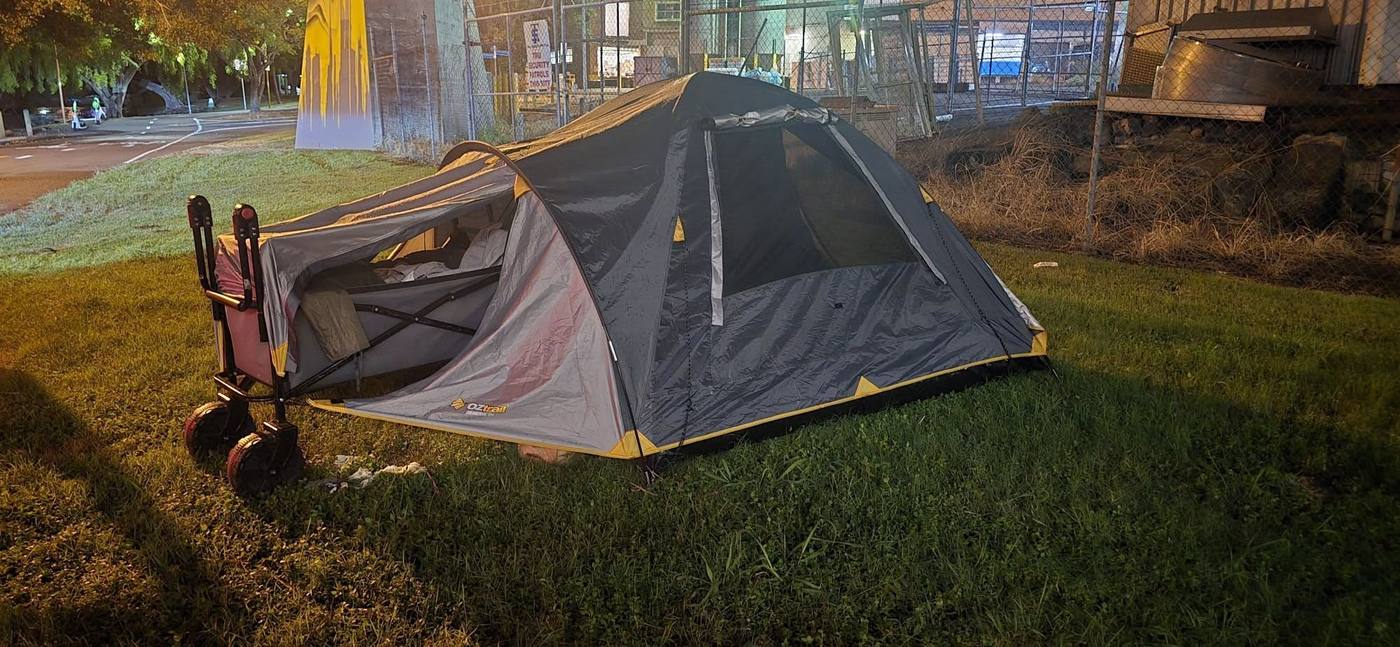
Instead, I noticed tents.
One after another.
I started counting them.
There were 49.
Some had one person living inside. Others had couples. Some had families.
I could not stop looking at them.
Only six months earlier, I had been living in circumstances not that different from the people I was now looking at. I knew what it was like to have nowhere secure to call home. I knew the embarrassment. I knew the uncertainty of wondering where you would sleep and what tomorrow would bring.
More than anything, I remembered what it felt like to think nobody cared.
This time, instead of driving past and forgetting about it, something inside me told me I needed to do something.
I did not have an organisation. I did not have funding. I did not have a warehouse, volunteers, sponsors or some grand plan.
I certainly did not think I was starting anything.
I just wanted to help a few people.
So I went onto social media and asked whether anyone could donate non perishable groceries so I could put together some food hampers.
Predictably, not everybody thought it was a good idea.
The snarky comments started appearing. Some people believed those living in tents were undeserving of help. Others questioned their circumstances without knowing anything about them. There were even people who suggested I might be collecting the groceries to stock up my own cupboards.
I had only recently rebuilt my own life, and here were complete strangers deciding what kind of person I was and what kind of people those living in tents must be.
But amongst the negativity, something much more important happened.
People helped.
Groceries started coming in.
A few bags became more bags. People contacted me offering tins, pasta, cereal and other food. I spent my days driving around in my ute collecting donations from people who believed that helping somebody did not require knowing their entire life story first.
Before long, my house began filling with groceries.
I sorted everything and made up hampers.
Eventually, I had fifty of them.
Then I went back out and delivered them.
I still remember the response.
The gratitude was overwhelming. To me, it was just a box or bag of groceries. To the people receiving them, it meant something much bigger. Somebody had noticed them. Somebody had stopped. Somebody had bothered to ask how they were going.
And something happened to me at the same time.
For the first time in a very long time, I felt useful.
Not because I was earning money. Not because I had a job title or a trade. Not because somebody was telling me I had done well in recovery.
I felt useful because I had helped another human being.
Six months earlier, I had been the person who needed help.
Now I was standing on the other side of the conversation.
I understood their embarrassment because I had felt it. I understood the uncertainty because I had lived it. I knew how easily a human being could disappear from ordinary life and become somebody that others drove past, judged or pretended not to see.
I had gone looking for purpose because I thought I needed something to fill my days.
Instead, I found people.
I did not know it at the time, but those fifty hampers were going to change the direction of my life.
For now, though, there was no Nourish Street.
There was just me, an old ute, fifty food hampers and a group of people living in tents along the Redcliffe waterfront.
And for the first time in years, I knew exactly what I wanted to do the next day.
Help again.